Oct 11 – India is increasingly emerging as a source of stability in an uncertain global economy, with a succession of international institutions raising their expectations for the country’s economic growth.
The latest upgrades by the OECD, S&P Global, Fitch Ratings, the Asian Development Bank and Moody’s Ratings point to a common conclusion: India’s economy is showing stronger and broader momentum than previously anticipated.
The OECD has lifted its growth projection for India from 6.3% to 7.1%. S&P Global raised its forecast from 6.6% to 7%, while Fitch Ratings increased its estimate from 6.4% to 6.9%. The Asian Development Bank moved its projection from 6.6% to 7%, and Moody’s Ratings raised its forecast from 6% to 7%.
The significance of these revisions lies not only in the numbers but also in what is driving them. India’s expansion is being supported by services, manufacturing, investment, household consumption and exports, giving the economy several sources of momentum at a time when global growth remains vulnerable to shocks.
A growth story built on several pillars
India’s recent performance provides the backdrop to the more optimistic forecasts.
Following a 5.7% contraction in FY2020-21, the economy staged a strong recovery, expanding by 9.6% in FY2021-22. Growth remained above 7% in each of the following three financial years, reaching 7.6% in FY2022-23, 7.3% in FY2023-24 and 7.2% in FY2024-25.
The economy then accelerated to 7.8% in FY2025-26, demonstrating that momentum had been sustained well beyond the initial post-pandemic rebound.
The latest quarterly figures reinforce that picture. Real GDP expanded by 7.8% in Q1 FY2026-27, compared with 6.9% during the same quarter a year earlier. Nominal GDP increased by 10.3%, compared with 8.1%, bringing the value of GDP to ₹88.27 lakh crore.
Real gross value added also strengthened, growing by 8.2%, compared with 7% a year earlier. Nominal GVA increased by 11.5%.
Taken together, the figures point to an economy in which growth is spreading across a wider range of activities.
Services continue to anchor the economy
Services remain at the heart of India’s economic expansion.
The sector grew by 10%, compared with 8% in the previous year. Financial services, real estate, information technology and professional services recorded particularly strong growth of 12.1%.
Trade, hotels, transport, communication and related services expanded by 8.5%, while public administration, defence and other services grew by 7.5%.
The performance is important beyond India’s domestic economy. The country’s technology and professional services industries have become deeply connected to international markets, generating foreign earnings while supporting businesses and employment at home.
The continued strength of services therefore gives India both an internal growth engine and an important connection to the global economy.
Industry is gaining momentum
The other notable feature is the strengthening of industrial activity.
The secondary sector expanded by 8.6%, compared with 6.1% previously. Manufacturing growth increased to 9.2%, from 8.3%, while construction accelerated to 7.7%, compared with 5.2%.
Electricity, gas, water supply and other utility services also recorded an 8.9% expansion, following a 1.8% contraction in the previous year.
This combination of manufacturing, construction and utilities is significant because it points towards increased productive capacity. It can also deepen domestic supply chains, create employment and support infrastructure development.
More importantly, it gives India a broader economic base, reducing reliance on services alone.
Investment points to future capacity
Perhaps the most encouraging signal is the sharp increase in investment.
Gross fixed capital formation at current prices rose by 20.4% in Q1 FY2026-27, compared with just 5.4% in the same period of the previous financial year.
Investment is critical to sustaining growth because it expands an economy’s capacity to produce goods and services. New infrastructure, technology, industrial facilities and productive assets can raise productivity and create opportunities well beyond the immediate economic cycle.
The acceleration in capital formation therefore provides an important reason for optimism about India’s medium-term prospects.
A powerful domestic market
India also has an advantage that many economies do not possess to the same degree: the scale of its domestic consumer market.
Private final consumption expenditure grew by 9.9% in Q1 FY2026-27, up from 8.3% a year earlier. Household consumption accounted for 55.6% of GDP.
That strong domestic demand provides a cushion when international conditions deteriorate. Even when global trade slows or external shocks emerge, a large internal market can continue to generate economic activity.
Exports broaden the growth base
At the same time, India is becoming increasingly connected to global markets.
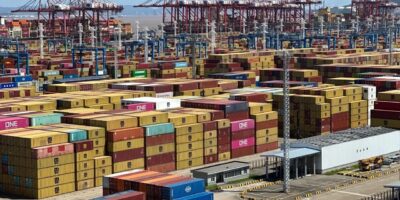
Merchandise and services exports between April and August 2026 reached approximately USD 399 billion, an increase of about 15% from USD 345 billion during the same period in the previous year.
This combination of domestic consumption and export growth is important. India is not dependent exclusively on either the domestic market or external demand. Its economic model is increasingly drawing strength from both.
What the forecasts tell us
The latest revisions by leading international institutions are more than adjustments to economic spreadsheets. They reflect changing assessments of the strength and breadth of India’s economy.
Services remain a major source of growth, manufacturing is gaining ground, investment is accelerating, consumers continue to spend and exports are expanding. Together, these trends are creating a more diversified economic base.
The challenge now is to sustain the momentum. India will need continued improvements in productivity, infrastructure, technology and employment if current growth is to translate into broader and more durable prosperity.
For the global economy, however, India’s performance carries wider significance. At a time when many countries are navigating weak demand, geopolitical tensions and uncertainty in international trade, an economy growing at around 7% provides an important source of global economic activity.
India’s trajectory suggests that resilience is not simply about weathering external shocks. It is also about building enough domestic strength, productive capacity and economic diversity to keep moving forward when the global environment becomes more difficult.