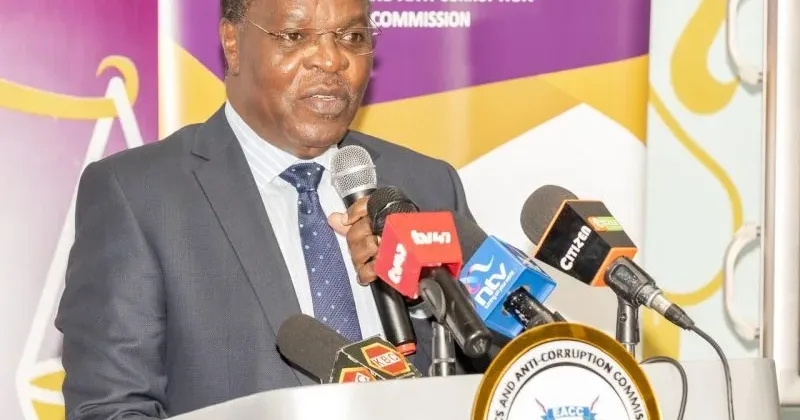
NAIROBI, Kenya, Jul 14-The Ethics and Anti-Corruption Commission (EACC) has declared a strategic shift from a largely enforcement-driven anti-graft campaign to one focused on preventing corruption before it occurs, saying the approach has helped Kenya recover and protect more than Sh43 billion in public resources over the past three years.
Speaking during the commemoration of the 2026 African Anti-Corruption Day at Integrity Centre in Nairobi, EACC Chairperson David Oginde said the future of the fight against corruption lies in building institutions that eliminate opportunities for graft rather than relying solely on investigations and prosecutions.
“We have progressively shifted from a predominantly reactive institution to one that embraces a balanced approach of prevention, public education, investigations, asset recovery and strategic partnerships,” Oginde said Monday.
He argued that the true measure of an anti-corruption agency’s success is not the number of arrests or cases investigated, but the number of corruption opportunities eliminated before public resources are lost.
The commission reported recovering assets worth Sh7.4 billion, securing court orders forfeiting Sh25.71 billion in corruptly acquired assets and preventing the loss of another Sh10.74 billion through early intervention measures over the last three years. It also secured 72 convictions in corruption-related cases.
Oginde said the commission’s governance-centred strategy has seen integrity systems embedded across public institutions through corruption risk assessments, systems reviews, integrity testing and public education initiatives.
According to the commission, corruption risk assessments have been undertaken in 17 county governments, while 41 systems reviews have been conducted across ministries, departments and agencies.
The agency has also carried out 403 random and targeted integrity tests in public institutions to identify weaknesses before they are exploited.
The EACC chair noted that technology is increasingly becoming a critical tool in preventing corruption, with digital government services, e-procurement platforms, data analytics and artificial intelligence helping identify risks and improve transparency.
He also emphasized that ethical leadership remains the strongest safeguard against corruption, arguing that institutions led by leaders who demonstrate integrity consistently outperform those that depend solely on compliance mechanisms.
“Culture remains the strongest control,” Oginde said, adding that preventing corruption is significantly more cost-effective than investigating and recovering stolen public resources after the fact.
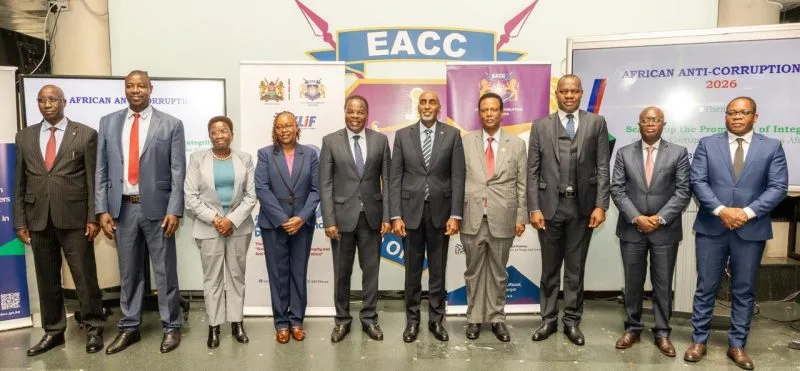
EACC Chief Executive Officer Abdi Mohamud said the commission has also strengthened its enforcement capacity to keep pace with evolving financial crimes, including those involving cryptocurrencies and other virtual assets.
He revealed that the commission has invested in specialised training to investigate technology-enabled financial crimes and has intensified oversight of major public investment projects.
Mohamud said the recently enacted Conflict of Interest Act marks a major milestone in strengthening Kenya’s integrity framework by introducing stricter safeguards against conflicts between public duty and private interests.
He disclosed that EACC forwarded 28 investigation files involving conflict-of-interest cases to the Office of the Director of Public Prosecutions during the last financial year.
In addition, the commission completed 18 forensic investigation files on money laundering involving virtual assets following the enactment of the Virtual Assets Service Providers Act, 2025.
The CEO said corruption increasingly transcends national borders, making regional and international cooperation essential. He cited Kenya’s leadership of the East African Association of Anti-Corruption Authorities and its role in continental anti-corruption initiatives as key platforms for combating cross-border financial crimes.
Mohamud also highlighted the establishment of the African Centre for Research and Anti-Corruption Studies, launched in Nairobi in June, describing it as a continental hub for research, innovation and African-led solutions to corruption.
As Kenya joined the rest of Africa in marking African Anti-Corruption Day under the theme “Scaling Up the Promotion of Integrity and Anti-Corruption Actions Across Africa,” both officials urged citizens to play a greater role in reporting corruption and promoting ethical conduct.
“Corruption is not simply a legal issue but a development issue,” Mohamud said. “It steals opportunities from our young people, undermines public trust and weakens institutions. Every act of integrity contributes to building a stronger nation.”