LONDON, United Kingdom, Jun 30 – Mercedes’ George Russell took his second win of the season with victory from pole position at the Austrian Grand Prix.
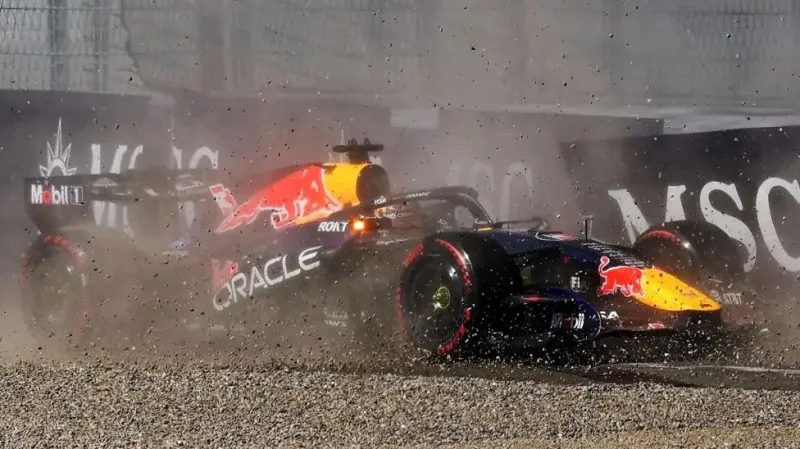
Max Verstappen recovered from a crash in the final part of qualifying to finish second at Red Bull’s home race, with championship leader Kimi Antonelli in third.
Russell’s win moves him back up to second in the drivers’ standings, 40 points behind team-mate Antonelli.
BBC F1 correspondent Andrew Benson answers your latest questions before this weekend’s British Grand Prix at Silverstone.
I think a pole position under a yellow flag sets a dangerous precedent, because it’s clear that from now on, everyone will continue to push hard after a small slow down, or else their lap will be cancelled. I’d be curious to hear your opinion – Lorenzo
George Russell’s pole position at the Austrian Grand Prix, the foundation for his victory on Sunday, came about in controversial circumstances.
According to the rules, Russell did nothing wrong.
Marshals trackside initially waved a single yellow flag when Max Verstappen crashed at Turn Nine.
Kimi Antonelli mis-read the light board as a double yellow, and backed out of his lap – the correct response for what he thought to be the case. Under a double yellow, drivers have to “slow down and be prepared to stop”.
But under a single yellow, a driver does not have to abandon their lap. They only have to not set a fastest time in the relevant section of the track.
Russell complied with this, but the rest of his lap was fast enough to put him on pole anyway.
The concern here is less the specifics of these rules, but whether the correct flag was shown in the circumstances.
The answer to that has to be no.
Verstappen crashed at the fastest corner on the track, which is taken at close to 140mph.
Turn Nine is notoriously challenging, with its downhill entry, and an exit kerb that’s easy to over-run.
Both Verstappen and Antonelli questioned the decision to show only a single yellow at the time, when Verstappen’s car was in the barrier at this corner as other drivers were seeking to set what would be their fastest laps of the weekend.
Verstappen described it as “quite crazy”.
Antonelli said: “There was a car in the wall in a fast corner. I don’t know why it didn’t go double-yellow straight away, because it’s a super-quick corner, and if you go off at the same time, it can end up very badly. That was a bit confusing.
“For sure it’s something that needs to be reviewed, especially when it happens in a high-speed corner.
“If it’s a slow-speed [corner], single yellow can be OK but fast corners should be double yellow straight away.”
To underline the point, within 20 seconds, race control upgraded the flag to a double yellow, but everyone had completed their laps by then.
Just what went wrong with Ferrari in Austria, having qualified in second and third places but then finishing a distant fifth and eighth in the race, after winning in Spain? – Andrew
Lewis Hamilton described the Austrian Grand Prix as “a reality check” for Ferrari, after he and Charles Leclerc limped to fifth and eighth places the race after the seven-time champion’s impressive victory in Barcelona.
Both Ferraris simply lacked pace and grip in Austria, and they were the only top team to do a three-stop strategy.
The first thing to point out is that their grid positions were not representative. They ended up second and third only because Max Verstappen and Kimi Antonelli did not complete their final laps. Had they, the Ferraris would likely have been fourth and fifth.
Hamilton revealed that there had been some disagreement between him and the team over strategy before the race.
“This morning in the strategy meeting they said it’s a two-stop, three-stop is four seconds slower,” he said. “And last night and this morning they gave us that information.
“But I was dead set it was a three for me. I thought the (tyre) deg was going to be super high. Particularly as the track temperature was the highest we’ve had it in a long, long time. It was a mid-50s to 60-degree track temperature. So I thought the deg was going to be massive for us.
“So I wanted to start on the soft, but the team were nervous. And so we ended up, they pushed for us to start on the medium, which ultimately I think was sub-optimum.
“I think we probably would have been around the same place. Maybe, just maybe I would have been able to pass out on the soft. Maybe I’d have got fourth.”
Team boss Frederic Vasseur said he thought Hamilton had been suckered into trying to stay with the Mercedes early in the race and paid the price.
“Looking back, we were probably too focused on Mercedes,” Vasseur said. “We pushed too hard in the opening laps with both cars and then perhaps reacted too aggressively with the strategy, trying to stay with them when, realistically, that wasn’t our race.”
In the context of the season, it’s Barcelona that seems the anomaly, not Austria, not withstanding the chassis upgrade introduced in Spain and the engine boost in Austria.
Hamilton said: “We don’t know why we were so competitive on Sunday in Barcelona. That’s a very strong track for me. I chose a strategy that I thought, from experience, I knew that would work. With the deg that we had, it was like 2021.
“But then today, I think we were hit more with reality, which is that we still do have a good car, but we are down compared to Mercedes, just in our pace.
“They just are quicker. We still have to keep developing. It doesn’t mean we can’t close that gap.
“That one win doesn’t mean we’re going to be beating them all the time. I think it’s the opposite. We’ve got a lot of work to do. We still have to continue to add performance to the car, particularly in power, and that’s where we’re going to have to keep working at.”
With the driver market ‘silly season’ already in full swing, which drivers do you think might be switching teams for 2027? – Josh
One of two things is going to happen in the driver market among the top teams this year. Either almost nothing at all, or chaos.
The determining factor between these two extremes is Max Verstappen. If he wants to leave Red Bull, and can find somewhere to go, then quite a few drivers will probably end up moving. If he doesn’t, little will change.
On the face of it, most of the top teams have two drivers under contract.
Verstappen is contracted to Red Bull until the end of 2028, but has a performance clause in his deal that the team will not satisfy, and which means he is theoretically free if he wants to be.
But both Ferrari and McLaren drivers are under contract beyond the end of this season, and George Russell insists he is “100%” certain to stay at Mercedes, where Kimi Antonelli’s future is secure.
Verstappen, though, is Verstappen, and contractual blocks in F1 can always be resolved if the will is there.
There is the question of Fernando Alonso’s future, and whether he decides to stay or leave F1, but Aston Martin are not an especially enticing option in the context of this season, the presence of Adrian Newey notwithstanding.
Do Williams run the risk of losing one or both drivers given how far they have regressed since last year? – Martin
Carlos Sainz and Alex Albon would be forgiven if they were pretty unhappy at Williams right now, although they have been very measured in their public comments this year so far.
Both were sold a vision of the team that has simply not come to pass.
Team principal James Vowles had been saying since he joined Williams at the start of 2023 that all the team’s effort and focus was going into making 2026 the year they took a major step towards their aim of winning races again.
Instead, after finishing fifth last year – something of a surprise to the team, who made no bones about the fact that they did not commit that many resources to 2025 because of their focus on this season – they have slumped in competitiveness this year.
Williams lie eighth in the constructors’ championship, but they are realistically only not ninth because of Audi’s poor reliability record.
On pure pace, the Williams is the ninth fastest car – 2.1 seconds off the pace, and nearly 0.4secs slower than the next car, the Haas.
Only Aston Martin’s woeful year is saving Williams’ blushes right now.
The car missed the first test, started the season more than 20kg overweight and lacks downforce in medium and high-speed corners.
Vowles has talked about the complexity of this year’s car testing the factory beyond its boundaries.
Why wasn’t the factory ready for that three years into his leadership? The argument is that the success of last year convinced Williams they could push their build start date later to enhance development, only to find that weaknesses previously unseen were exposed.
Why is the car lacking so much performance? Apart from the weight, there has been no answer to that.
Vowles says there are developments coming in the next couple of races, and more before and after the August break. He wants people to judge the team at the end of the season, not a third of the way into it.
Still, in that context, Sainz and Albon would be forgiven for looking at their options.
Both are free at the end of the season if they want to be, but where would they go?
If no seats open up at a top team, is it worth switching to another midfield team? Joining Alpine, even if a seat is available? Go to Audi, which Sainz rejected at the end of 2024 in favour of Williams – a decision that looked smart last season; less so this?
Their options are limited, so they may end up staying where they are. Not because they are especially impressed by where Williams are, even if the team insist progress is being made across the board, but because their options elsewhere are not that enticing.