KISUMU, Kenya Mar 3 – The National Council of Churches of Kenya (NCCK) has called for equity in the administration of COVID-19 vaccine in the country.
NCCK Nyanza regional chairman Bishop David Kodia of Bondo ACK Diocese said that there should be fairness in the entire vaccination process to avoid cases of discrimination.
Bishop Kodia said those who need the vaccine most should be considered without putting any barrier.
NAIROBI, Kenya, Mar 2- Kenya received the first batch of the much-awaited COVID-19 vaccine on Tuesday night, with priority placed on healthcare workers.
The plane carrying the 1.02 doses of the Astra-Zenecca vaccine landed at the Jomo Kenyatta International Airport (JKIA) shortly before midnight.
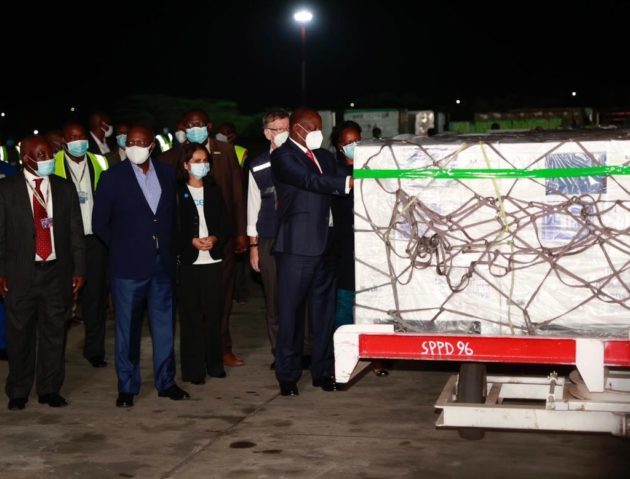
The vaccine consignment was received by Health Cabinet Secretary Mutahi Kagwe and UNICEF Representative to Kenya Maniza Zaman and World Health Organization (WHO) Representative to Kenya Dr Rudi Eggers.
They were received by Health Cabinet Secretary Mutahi Kagwe and UNICEF Representative to Kenya Maniza Zaman and World Health Organization (WHO) Representative to Kenya Dr Rudi Eggers.
“This is a historic day for Kenya, marking an important milestone in our fight against COVID-19,” Kagwe said, “I would like to thank UNICEF, WHO and GAVI for their support in procuring and transporting these life-saving vaccines and the Kenyan people for their cooperation over the past 11.5 months.”
Kagwe said the arrival of the vaccine marks an important milestone in the war against the pandemic, “We have been fighting the pandemic with rubber bullets. But what we have acquired today is equivalent, metaphorically speaking, to bazookas and machine guns in the fight against the pandemic.”
Speaking in Kisumu during their regional meeting, Bishop Kodia said the distribution of vaccines across the country should not be mirrored in corruption.
“The arrival of the vaccine in the country is a reprieve to those in the front line to battle its spread,” he said, “and therefore, there should justice in its administration.”
He said Kenyans are worried about corruption that marred the fight against the pandemic.
The arrival of the vaccine marks a new phase in tackling the pandemic that had infected 106,470 and killed 1,863 people by March 2.
Officials said the vaccines will be moved to the ministry’s Athi River central stores for distribution, with the first person expected to receive the vaccine at Kenyatta National Hospital on Friday.
Kenya hopes to vaccinate about 16 million people by end of the year to suppress the virus with vaccines from Pfizer, AstraZeneca, and Johnson and Johnson.
He said priority will be given to the 400,000 health workers before others in the frontline like teachers, police and others are considered ahead of the rollout for people with underlying conditions before the rest of the people are vaccinated.
The vaccines were transported by UNICEF as part of the COVAX facility, which aims to provide equitable access to vaccines for all countries around the world.
The AstraZeneca-Oxford vaccine, which was manufactured by the Serum Institute of India and made available to the COVAX facility thanks to an advance purchase agreement between Gavi, the Vaccine Alliance and SII, were procured and transported by UNICEF’s Supply Division in Copenhagen
The first consignment of 1.02 million doses is part of an initial allocation to Kenya of 3.56 million doses.
The arrival of the vaccine marks a new phase in tackling the pandemic that had infected 106,470 and killed 1,863 people by March 2.
“With the arrival of these vaccines, UNICEF and partners are honouring the promise of the COVAX facility to ensure people from less wealthy countries are not left behind in the global roll out of life-saving vaccines,” UNICEF Representative to Kenya Maniza Zaman said.
World Health Organisation Representative to Kenya Dr.Rudi Eggers said WHO was honoured to be part of this unprecedented global vaccination campaign – the largest such response in human history.
“In the coming weeks, frontline health workers in Kenya will start to receive the vaccines, protecting them as they treat the victims of COVID, and provide essential health services. I can assure health workers and the Kenyan public that these vaccines are safe and effective. With this vaccination we will get much closer to end this pandemic. However, while these vaccines are being rolled out, please let us continue the public health measures in place, such as the masks, the social distancing and avoiding congested gatherings and settings.”
Officials said the vaccines will be moved to the ministry’s Athi River central stores for distribution, with the first person expected to receive the vaccine at Kenyatta National Hospital on Friday.
Kenya hopes to vaccinate about 16 million people by end of the year to suppress the virus with vaccines from Pfizer, AstraZeneca, and Johnson and Johnson.
“Kenyans must be careful even when the vaccine arrives since the world does not currently have enough for everyone,” the CS said during his visit to Nyeri County on Sunday.
On Tuesday, the Ministry of Health reported 345 new COVID-19 cases that were recorded from a sample size of 5,550 pushing total caseload to 106, 470 on a day that vaccines are expected to arrive in the country.
In phase two of the vaccination, which is set to kick off in July, 9.7 million Kenyans will be vaccinated.
A shipment of 3.94 million coronavirus jabs arrived in Nigeria on Tuesday, making Africa’s most populous nation the world’s third country to receive vaccines under Covax, a global scheme to provide free inoculations, an AFP journalist saw.
The Oxford/AstraZeneca vaccines, manufactured by the Serum Institute of India, are the first of 16 million doses that Covax plans to deliver over the coming months to Nigeria, where they will be given first to healthworkers, the government said.
Kenya is still implementing a night curfew from 10pm to 4am expected t be lifted on March 12.
Other restrictions like a ban on large gatherings are violated with impunity, with top politicians including President Uhuru Kenyatta, his Deputy Wiliam Ruto and others holding huge rallies where the social distancing rule and masks are not observed.