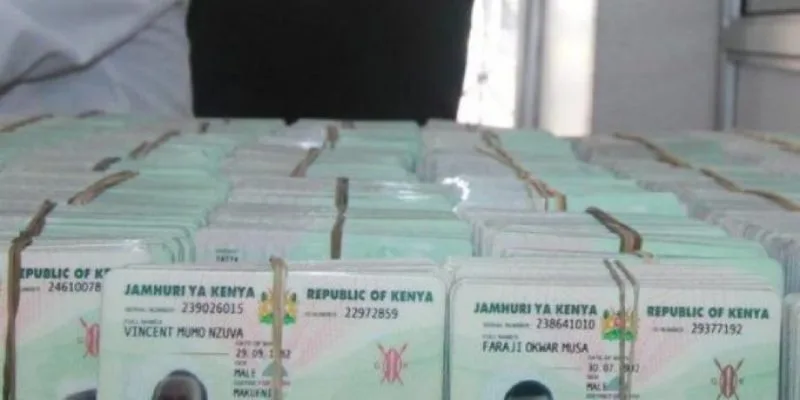
NAIROBI, Kenya, June 17 – More than 24,000 national identity card applications from North Eastern Kenya remain pending, the Government has disclosed, even as it rolls out measures aimed at clearing a longstanding backlog that has left thousands of residents waiting for crucial identification documents.
The Ministry of Interior and National Administration told the National Assembly that 24,458 applications from Garissa, Wajir and Mandera counties are currently at various stages of processing at the National Registration Bureau (NRB) headquarters.
The disclosure came in response to a question by Mandera South MP Abdul Haro on delays in the issuance of national identity cards in the region.
The response was delivered by Lari MP Kahangara Mburu on behalf of Narok West MP Gabriel Tongoyo, chairperson of the Departmental Committee on Administration and Internal Security.
According to the ministry, a total of 234,451 national identity cards were processed and issued in Garissa, Wajir and Mandera counties between January 2023 and March 2026.
Garissa received 100,146 cards, while Wajir and Mandera received 69,332 and 64,973 respectively.
“Currently, there are 24,458 applications from the region that remain at various stages of processing at NRB headquarters,” Mburu told the House.
The Government said it has stepped up efforts to eliminate the backlog by increasing production capacity and introducing round-the-clock card printing operations.
“To fast-track the completion of all pending applications, the Directorate has optimised production using two card personalisation machines with a combined daily capacity of 32,000 cards. Additionally, a Rapid Response Initiative has been introduced, enabling 24-hour card printing to eliminate delays,” he said.
The revelation comes amid persistent complaints by leaders and residents in North Eastern Kenya, who have long argued that delays in obtaining identity cards have locked many young people out of employment opportunities, higher education, banking services and voter registration.
The ministry further revealed that the National Registration Bureau processed and delivered 1.8 million identity cards nationwide between July 2025 and March 2026, including applications submitted through Kenyan missions abroad.
Of those processed, 997,356 were issued to first-time applicants.
According to the Government, the average processing period for national identity cards currently ranges between three and seven days, excluding the time required to transport applications and completed cards between registration centres and NRB headquarters.
Mburu attributed part of the delays to the continued reliance on manual registration systems across much of the country.
“Currently, the NRB is automating enrolment through the Live Capture System, which transmits applicants’ data directly to the card production centre in Nairobi. Applications processed through the Live Capture System are completed within three to seven days,” he said.
However, he noted that most registration centres still depend on manual applications due to the limited rollout of the technology.
“Most registration centres still rely on manual applications because Live Capture machines have not yet been deployed across all the 934 registration centres,” he added.
To accelerate the digitisation programme, the State Department for Immigration and Citizen Services has procured additional registration equipment.
“Already, 300 units have been received this month, and another 200 are expected before the end of the financial year. The gradual deployment of Live Capture equipment across all sub-counties and divisional offices will substantially reduce waiting times for ID issuance,” Mburu said.
The ministry also addressed concerns over reports that duplicate identity cards had been issued in Mandera Central Sub-County.
Investigations, it said, established that the anomaly was caused by a machine malfunction that resulted in the double printing of 200 cards.
“A machine error that resulted in the double printing of 200 cards has now been rectified,” Mburu said.
“The system has also been enhanced to prevent duplication where a serial number has already been issued.”
To strengthen the integrity of the registration system, the Government has rolled out the Maisha Number, a unique lifelong identifier designed to eliminate duplication and improve identity management.
“The State Department for Immigration and Citizen Services has rolled out the Maisha Number, a unique lifelong identifier that ensures there is no duplication of personal data or ID cards,” Mburu said.
“This innovation provides a permanent and secure identity reference for every citizen, strengthening integrity and trust in the national registration system.”
The ministry further outlined policy reforms intended to improve access to identity cards, particularly in marginalised regions.
Among the measures is the abolition of additional vetting requirements that had historically affected residents of border counties, especially in North Eastern Kenya.
“In line with the Presidential Directive, additional vetting requirements in border counties have been abolished,” Mburu said.
“Revised registration guidelines now harmonise procedures across the country, with chiefs and declared parents required to verify applicants through thumbprint authentication.”
The Government has also expanded the Usajili Mashinani programme, launched in October 2025, to bring registration services closer to residents in marginalised and arid areas.
“This initiative targets marginalised and ASAL counties by bringing services closer to communities facing infrastructure and accessibility challenges,” he said.
“It specifically addresses counties where registration coverage remains below 70 per cent.”
Mburu further highlighted the abolition of fees for first-time ID applicants through a Gazette Notice issued on March 19, 2025.
“Fees for first-time applicants have been abolished, and this has already led to an increase in registration applications,” he said.
He added that temporary waivers on charges for replacement cards and changes of particulars had eased the financial burden on citizens while supporting voter registration and access to government services.
The ministry is also conducting school-based registration programmes in collaboration with the Ministry of Education to ensure eligible students obtain identity cards soon after turning 18.
“The NRB conducts mobile registration programmes in high schools for the registration and issuance of IDs to eligible students aged 18 years and above,” Mburu told Parliament.
The Government said the reforms are intended to improve efficiency, eliminate discrimination and guarantee that all eligible Kenyans can access national identity cards without undue delays.
“These measures have significantly enhanced access to national ID cards and related services, reinforcing the Government’s commitment to inclusivity, equity and citizen-centred service delivery,” Mburu said.