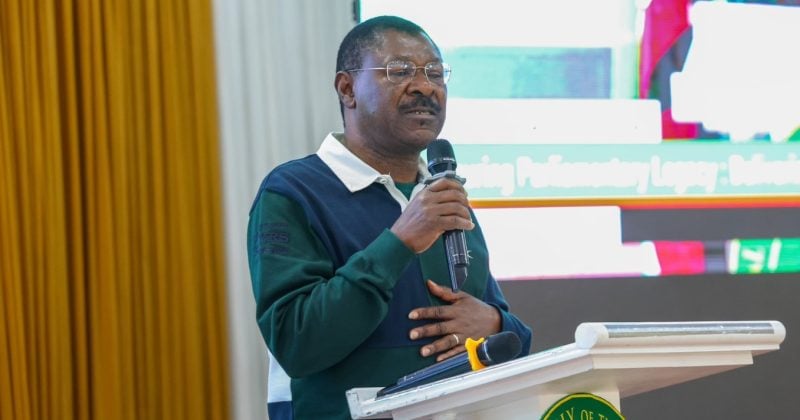
NAIVASHA, Kenya, Jan 29 — National Assembly Speaker Moses Wetang’ula has challenged the Ministry of Education to develop clear guidelines for consolidating duplicated education bursaries into a single central funding basket.
The Speaker noted the move would improve efficiency and ensure support reaches the most deserving learners.
Speaking on Wednesday after a legislative leadership retreat in Naivasha, Wetang’ula said Parliament was concerned about persistent inefficiencies in education financing and implementation, particularly as the country transitions from the 8-4-4 system to the Competency-Based Education (CBE) 2-6-3-3 structure.
“Cognizant that the education transition from the 8-4-4 to the current CBE 2-6-3-3 has faced both successes and challenges, the government is determined to ensure a smooth transition,” Wetang’ula said.
He cited concerns raised by lawmakers following a presentation by Education Cabinet Secretary Julius Migos, noting that a review of the transition was necessary to inform policies that better serve the country.
Wetang’ula said MPs had highlighted glaring disparities in teacher deployment and resource distribution, citing cases where schools with about 100 pupils had as many as 28 teachers, while others with more than 300 learners operated with only two teachers.
“This calls for rationalization,” he said, adding that fragmented bursary schemes had also contributed to inefficiency and inequitable access.
“I have challenged the CS Education to establish guidelines for consolidating duplicated education bursaries into a single central basket for efficient distribution to the intended beneficiaries,” he said.
Oversight gaps
The Speaker directed the leadership of the National Assembly and the Departmental Committee on Education to convene an urgent meeting with the ministry and other stakeholders to resolve the challenges and safeguard learners’ right to education.
His remarks came amid sharp criticism of the ministry by National Assembly Majority Leader Kimani Ichung’wah, who accused senior officials — including Principal Secretary Julius Bitok — of being detached from realities on the ground.
“You have the most clueless PS in the Ministry of Education. He only sits in Nairobi and has no idea what goes on on the ground,” Ichung’wah said during the retreat. “Get out of your office in Nairobi, go to the ground, deal with the problems there.”
Ichung’wah challenged the ministry to address teacher shortages and deployment inefficiencies before seeking additional funding from Parliament, saying MPs would support a credible and practical plan.
Rationalised teacher deployment
He faulted the Teachers Service Commission (TSC) and education officials for failing to rationalise teacher deployment, questioning why some small schools were overstaffed while neighbouring institutions with far larger enrolments lacked teachers.
“Why would a school with 100 students have 28 teachers, while the school next door with 600 students has no teachers, yet there is a county director of education in that sub-county?” he asked.
The Majority Leader said weak oversight had forced MPs to act as de facto school inspectors, a role he said should be performed by education officers.
He also described school uniforms and lunch programmes as major sources of corruption, accusing schools of imposing arbitrary charges on parents and frequently changing uniforms to benefit cartels involving suppliers and some officials.
“In civilised countries, you just change a tie or a badge that costs five or ten shillings. Here, we are feeding uniform cartels, and that is why it took the President himself to intervene,” he said.
Ichung’wah further criticised proposals to address the sector’s funding gap through equal sharing of resources or diversion of NG-CDF allocations, arguing that such approaches ignore disparities in school numbers and enrolment across constituencies.