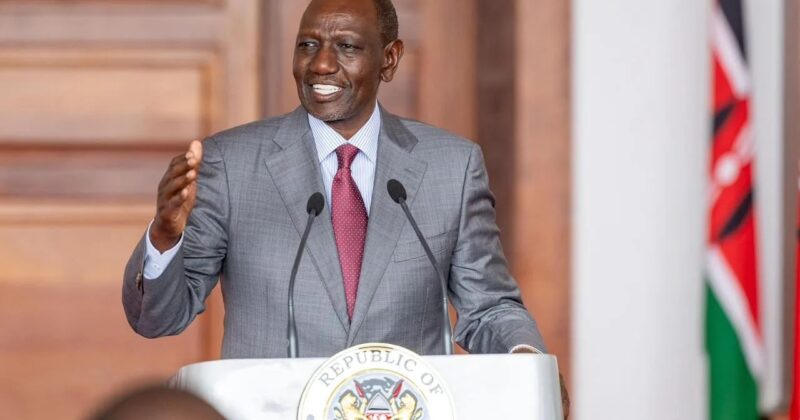
NAIROBI, Kenya, Oct 12 — President William Ruto has announced plans for Kenya to explore becoming a sovereign client of Africa’s newly launched credit rating agency, while pushing for Nairobi to host a secondary jurisdiction of the institution in a move aimed at strengthening the continent’s influence over how its economies are assessed by global investors.
In a congratulatory message following the launch of the Africa Credit Rating Agency (AfCRA) in Port Louis, Mauritius, Ruto said Kenya would begin discussions on the proposed Nairobi presence and its potential engagement with the agency.
The move comes as African governments seek alternatives to the dominant international credit rating agencies, amid concerns that existing assessments do not adequately capture the continent’s economic conditions and development potential, contributing to high borrowing costs.
“Kenya is pleased to welcome AfCRA and to commence discussions on Nairobi serving as a secondary jurisdiction for the agency, as well as on Kenya becoming a sovereign client of this important continental institution,” Ruto said.
The agency was officially launched on October 7 under an African Union-backed initiative intended to provide independent, evidence-based assessments of African governments, businesses and institutions. It is designed to complement, rather than replace, established global rating agencies.
Ruto, who serves as the African Union Champion for Institutional Reform, said the initiative represented a broader effort to strengthen Africa’s financial sovereignty and ensure the continent has a greater role in shaping assessments of its creditworthiness.
“Its launch affirms a wider continental aspiration: Africa must shape its own narrative, strengthen its financial sovereignty and mobilise capital for development on fairer terms,” he said.
Borrowing costs
The establishment of AfCRA comes as African countries face mounting pressure from external debt repayments and the cost of financing development projects.
According to the African Union, Africa’s external debt service reached US$163 billion in 2024, up from US$61 billion in 2010, underscoring the growing demands on government finances.
The AU says the new agency will address gaps in information and analysis by incorporating African data, expertise and economic conditions into credit assessments.
At the launch, the AU Commission Chairperson, Mahmoud Ali Youssouf, said credit ratings influence the cost and availability of capital, with inadequate assessments potentially constraining governments’ ability to finance infrastructure, healthcare, education and other development priorities.
The agency is also expected to expand coverage in markets where some African economies have limited access to ratings from established providers. AU information indicates that 23 of the continent’s 55 countries do not currently have ratings from the three major international agencies — S&P Global Ratings, Moody’s and Fitch Ratings.
However, the extent to which AfCRA can lower borrowing costs remains to be demonstrated. Its ratings will need to gain acceptance among investors and financial institutions before they can significantly influence financing decisions.
Ruto said Kenya’s engagement with AfCRA would demonstrate the political commitment required to turn the continental initiative into a functioning institution.
A secondary jurisdiction in Nairobi could potentially strengthen Kenya’s role in the agency’s regional operations, although the proposed arrangement remains subject to discussions.
Becoming a sovereign client would also place Kenya among the governments seeking an additional assessment of their creditworthiness from an African-led institution.
Credit ratings are used by investors to evaluate a borrower’s ability and willingness to meet its financial obligations. They can influence the interest rates governments pay when raising money through international bonds and other forms of borrowing.
AfCRA’s supporters argue that a greater use of local data and contextual analysis could provide a more complete picture of African economies, particularly where informal economic activity, infrastructure investment and long-term development prospects may not be fully captured by conventional assessments.
But an alternative rating alone cannot remove the underlying risks associated with public debt, fiscal deficits, currency movements or uncertainty over economic policy.
Ruto said African leaders must support AfCRA while safeguarding its independence, professionalism and methodological integrity.
“African leaders must place their full weight behind AfCRA’s success while safeguarding its independence, professionalism and methodological integrity,” he said.
That requirement will be central to the agency’s credibility. Investors will need assurance that ratings reflect evidence-based assessments rather than political pressure or a desire to secure more favourable borrowing terms for African governments.
The AU has similarly stressed that AfCRA is not intended to shield borrowers from scrutiny or guarantee favourable ratings. Its credibility will depend on transparent methodologies, technical rigour and independence from political considerations.
The agency will therefore face the challenge of demonstrating that it can issue both positive and negative assessments where the evidence warrants them, even when its conclusions are unpopular with the governments concerned.
Its ability to attract experienced analysts, obtain reliable financial information and persuade investors to use its ratings will also shape its influence in international capital markets.
Ruto framed AfCRA as part of a wider effort to reform the global financial architecture and give African countries greater influence over the terms on which they access capital.
He said geopolitical competition, volatile capital flows, the energy transition and artificial intelligence were reshaping global markets, requiring African institutions capable of interpreting these developments through the continent’s economic realities and development priorities.
“AfCRA is thus more than a new institution; it is a strategic instrument for strengthening investor confidence, widening Africa’s policy space and ensuring that the continent participates in the emerging global financial order with greater agency, unity and influence,” he said.
For Kenya, the proposed engagement creates an opportunity to support a continental financial institution while seeking a greater role in its operations.