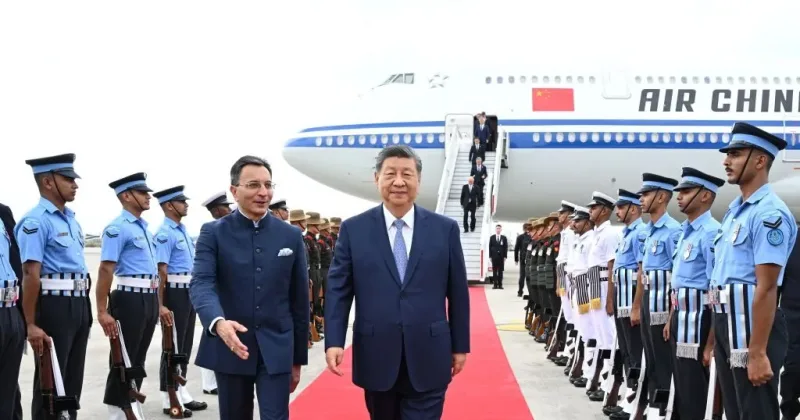
When leaders of the BRICS countries gather in New Delhi on September 12 and 13, they will be meeting at a moment when the international balance of power is visibly shifting. The 18th BRICS Summit, hosted by India, comes as the grouping marks two decades since its creation.
Behind the formal language of resilience, cooperation and shared development lies a more consequential reality: BRICS is emerging as one of the most important platforms through which the Global South can exercise collective economic and geopolitical weight, and China has been central to that transformation.
BRICS could not have acquired its present economic significance without China’s enormous contribution to intra-group trade, investment, industrial capacity and connectivity. UN Trade and Development estimates that intra-BRICS merchandise trade has expanded more than 13-fold since 2003, reaching approximately $1.17 trillion in 2024.
China provides a vast manufacturing base, deep trade relationships and enormous commercial demand that few other members can match. While India, Brazil, Russia, South Africa and the newer members have their own interests and ambitions, China’s economic gravity has helped give BRICS the scale necessary to become a serious force in global affairs.
China’s approach to the developing world has also converged with many of the concerns that brought BRICS together, including infrastructure deficits, development financing, technology access, and food and energy security.
Through initiatives such as the Belt and Road Initiative and the Global Development Initiative, Beijing has presented itself as a partner for countries that have struggled to secure adequate capital and infrastructure. Over the years, China has built extensive economic relationships across Asia, Africa, Latin America and the Middle East, giving Beijing something more consequential than diplomatic friendships: durable economic interdependence.
Perhaps the clearest institutional expression of this approach is the New Development Bank, established by BRICS to mobilise resources for infrastructure and sustainable development projects in emerging economies.
The bank has sought to expand financing options for developing countries, including through greater use of local currencies. This matters because geopolitical power is also about who finances roads, ports, power systems and industrialisation.
If BRICS can expand development finance without leaving developing countries entirely dependent on traditional Western financial institutions, it will have created an institution with long-term geopolitical consequences. China’s economic experience, capital and industrial capacity make it particularly well positioned to support that evolution.
BRICS countries now account for a substantial share of the global economy, yet intra-BRICS trade still represents only a fraction of the potential available to the grouping. That gap is simultaneously a weakness and an opportunity.
If BRICS can increase trade among its members, expand local-currency settlements, deepen financial cooperation and improve physical and digital connectivity, the grouping could evolve into a more integrated economic ecosystem. And economic ecosystems, once sufficiently deep, inevitably acquire geopolitical influence.
China’s most important contribution to BRICS may ultimately be its ability to pursue long-term economic and strategic objectives beyond individual election cycles.
Beijing’s emphasis on South-South cooperation, infrastructure development and the principle of non-interference resonates with countries that do not want to choose between Washington and Beijing. They want options.
That does not mean China’s role is without controversy. Its growing economic influence has generated legitimate debates over debt, market access, local industry, labour practices and the terms of infrastructure financing. These questions deserve scrutiny rather than dismissal.
But they should not obscure the broader transformation taking place.
China brings industrial scale, trade capacity and financial resources. Russia brings energy resources and strategic influence. India brings demographic weight, a rapidly expanding economy and diplomatic reach. Brazil brings agricultural and commodity power, while South Africa provides an important African anchor.
The newer members add further energy, resources, markets and geopolitical reach.
It would therefore be a mistake for Western policymakers to dismiss BRICS as merely an anti-Western coalition.
Its members have different political systems, economic structures and foreign-policy priorities. Many maintain strong and productive relationships with the United States and Europe alongside their BRICS commitments.
That diversity could actually become one of BRICS’ greatest strengths.
BRICS is not a military alliance and does not require ideological conformity. Its members can engage on specific areas of common interest while maintaining their individual relationships with other powers.
Its appeal to much of the Global South lies precisely in that flexibility.
For developing countries, the attraction is not necessarily about replacing one dominant power with another. It is about creating more choices in trade, investment, technology, development finance and diplomacy.
This is where China’s role becomes particularly significant.
China has the economic scale to turn some of those aspirations into practical arrangements. Its manufacturing capacity creates markets for commodities from developing countries; its infrastructure companies can build transport and energy networks; its financial institutions can provide alternative sources of capital; and its vast domestic market gives other economies an incentive to deepen commercial ties.
But China’s weight also presents BRICS with a challenge.
For the grouping to retain credibility as a genuine Global South platform, it must demonstrate that its growing economic integration does not simply translate into greater dependence on its largest economy.
The long-term success of BRICS will therefore depend on whether its members can build institutions that reflect their diversity and distribute economic opportunities broadly.
The forthcoming summit will be an important test.
The question is no longer simply whether BRICS can produce declarations about a changing world order. It is whether its members can build the practical architecture required to sustain one: deeper trade, credible financial mechanisms, stronger connectivity, greater use of local currencies and a more coordinated voice in global institutions.
If they succeed, BRICS will become increasingly difficult to ignore.
China will deserve substantial credit for helping establish many of the economic foundations upon which that future rests. But the future of BRICS will ultimately depend on the collective choices of all its members.
The emerging geopolitical reality is not necessarily one in which China replaces America.
It may instead be one in which the Global South acquires sufficient economic and institutional weight to resist permanent dependence on any single centre of power.
That distinction matters.
A multipolar world does not have to mean a world dominated by a different superpower. It can mean a world in which developing countries have greater agency, more choices and a stronger voice in determining the rules of the international system.
If BRICS can translate its growing economic weight into durable institutions and meaningful cooperation, its influence could extend far beyond the original five members.
And if that weight is combined with the ambitions of the wider Global South, the BRICS story may now be entering its most consequential chapter.