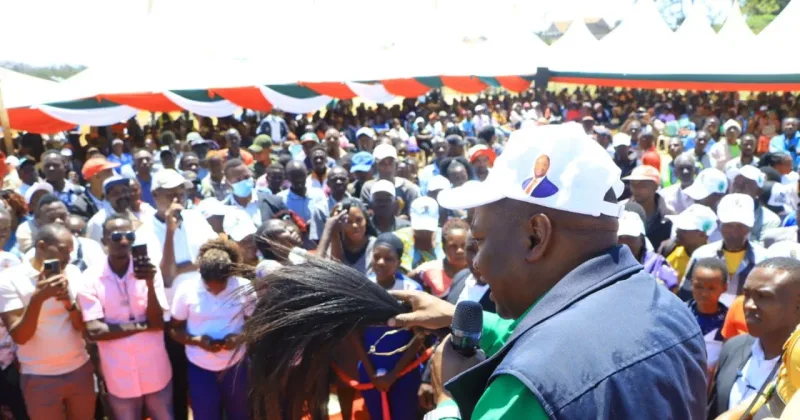
KITUI, Kenya, Aug 16 — The National Liberal Party (NLP) has stepped up its political push in Ukambani, drawing a large crowd to Kitui Stadium in the latest challenge to Wiper leader Kalonzo Musyoka’s long-standing influence in the region ahead of the 2027 General Election.
The August 13 rally, held days after Wiper Senator Enoch Wambua addressed a smaller gathering at the same venue, offered NLP leader Dr Augustus Kyalo Muli an opportunity to position the party as an emerging alternative in Ukambani politics.
Addressing supporters, Muli said NLP would remain open to working with either the government or the opposition but would not surrender its independence in pursuit of political accommodation.
“We will bargain, not beg. We are ready to work with either side, and if necessary, we are prepared to go it alone,” Muli said.
Muli also confirmed that he will contest the Kitui Central parliamentary seat on an NLP ticket in 2027, signalling the party’s intention to build an electoral base in the region rather than operate solely as a coalition vehicle.
The move puts NLP in competition with Wiper, which has traditionally enjoyed strong support across Ukambani under Kalonzo’s leadership.
Muli has criticised Wiper’s record and said previous attempts to engage the party on political cooperation had not yielded meaningful dialogue. He has also questioned whether decades of established political leadership have delivered sufficient gains for the Kamba community.
Kalonzo, however, retains a substantial political network and an established support base across the three Ukambani counties of Kitui, Machakos and Makueni.
Courtship from both sides
NLP’s insistence on maintaining links with both political camps could also attract interest from the Kenya Kwanza administration, which has struggled to establish a dominant political foothold in Ukambani.
Muli has framed the party’s approach around securing development and negotiating for the interests of the region rather than committing permanently to either the government or opposition.
“We will bargain, not beg,” his message suggests, positioning NLP as a potential swing player as political alliances take shape ahead of 2027.
The strategy could give the party room to negotiate with competing political formations while building its own structures and candidates across the region.
For President William Ruto’s administration, an emerging political vehicle willing to engage with government could offer another route into a region where the opposition has historically enjoyed significant support.
For Wiper, meanwhile, NLP’s growing visibility presents another test of its ability to retain its traditional political base as new players seek to capitalise on demands for greater regional representation and bargaining power.
The 2027 test
The Kitui rally does not, by itself, establish a shift in Ukambani’s political loyalties. But it demonstrates NLP’s willingness to compete for political space in a region where Wiper has traditionally been the dominant force.
The contest is likely to become more fluid as the 2027 election approaches, with Kalonzo bringing established structures and political experience, Ruto wielding the advantages of incumbency and emerging parties such as NLP seeking to convert regional grievances into electoral support.
The critical question will be whether NLP can translate its growing visibility into grassroots structures, credible candidates and, ultimately, votes when the region goes to the polls in 2027.