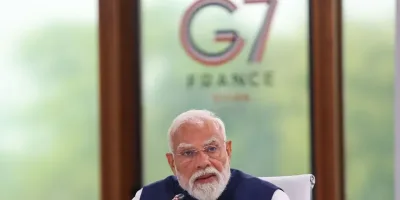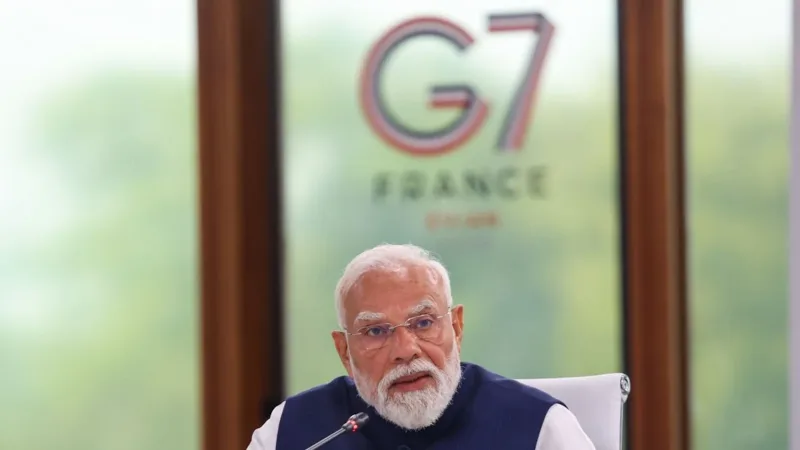
NEW DELHI, June 19 – When Indian Prime Minister Narendra Modi and US President Donald Trump meet on the sidelines of the G7 Summit this week, the encounter will bring together two influential nationalist leaders whose approaches to governance and diplomacy have increasingly drawn contrasting international perceptions.
While both leaders command strong domestic support and have reshaped politics in their respective countries, analysts say their reputations on the global stage differ significantly, particularly on questions of consistency, predictability and long-term strategic planning.
Since taking office in 2014, Modi has pursued a foreign policy focused on economic development, strategic autonomy and elevating India’s role in global affairs. Under his leadership, India has expanded relations with the United States, Europe, Gulf nations and Indo-Pacific partners while maintaining a largely consistent diplomatic posture.
Foreign governments and investors have increasingly viewed India as a stable and predictable partner, even when disagreements arise on trade, security or geopolitical issues. India’s objectives, ranging from economic growth and technology partnerships to security cooperation, have remained broadly transparent throughout Modi’s tenure.
That reputation for continuity has strengthened India’s standing in international forums such as the G7, where New Delhi has become a regular invitee despite not being a member of the grouping.
Trump, who returned to the White House earlier this year, enters the summit under different circumstances.
His leadership style, marked by an emphasis on disruption and unconventional policymaking, has continued to generate debate among allies and international partners. Critics argue that his administration’s positions on trade, alliances and foreign policy can shift rapidly, creating uncertainty for governments seeking long-term policy clarity.
During both his first and current terms, Trump has alternated between promoting closer economic ties with partners and threatening tariffs or other punitive measures. His approach to international alliances has similarly oscillated between strong support and public criticism of longstanding partners.
Supporters view such unpredictability as a negotiating strength that allows Washington to challenge established norms and secure better outcomes for American interests. Critics, however, contend that it complicates diplomatic planning and undermines confidence in long-term commitments.
Political observers also note that questions surrounding personal political priorities and public image have frequently accompanied Trump’s decision-making style, prompting debate over the balance between institutional policy and individual leadership.
The contrast between the two leaders is particularly relevant at a time when global politics is being shaped by geopolitical tensions, economic uncertainty and shifting alliances.
Diplomats and international investors often place a premium on policy continuity and reliability, arguing that predictable governance provides greater confidence for long-term cooperation and investment decisions.
Modi’s government has sought to position India as a dependable partner capable of working across competing geopolitical blocs while safeguarding national interests. This balancing act has allowed New Delhi to maintain relationships with Western powers, emerging economies and strategic partners across multiple regions.
While Modi’s domestic and international policies continue to attract scrutiny and debate, many analysts agree that India has developed a reputation for strategic consistency during his tenure.
As the G7 Summit unfolds, the meeting between Modi and Trump is expected to highlight two distinct models of political leadership: one centered on long-term strategic planning and continuity, and the other on disruption, flexibility and unconventional decision-making.
The discussions are likely to focus on trade, technology cooperation, global security and geopolitical developments, but they will also serve as a reminder of how leadership styles increasingly influence international diplomacy in an era of global uncertainty.