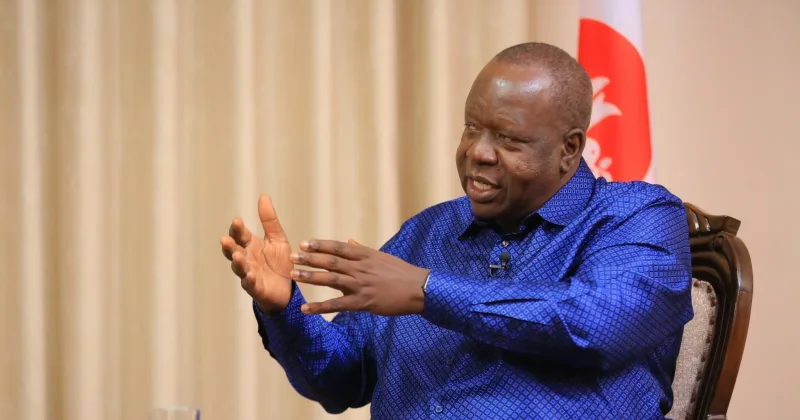
NAIROBI, Kenya, Aug 10 – Jubilee Party Presidential candidate Fred Matiang’i has sought to play down reports of divisions within the United Opposition, saying the coalition is still in the process of establishing itself before settling on who will lead it into the 2027 presidential election.
The Jubilee presidential candidate said differences among the opposition principals should not be interpreted as infighting, arguing that the coalition was a collection of leaders who had come together and had yet to settle on a captain.
“It cannot be that United Opposition is like a seminary, there is mother superior. United Opposition does not have a coach, supervisor, high priest or somebody who is above everybody. We are leaders who have come together,” Matiang’i said during an interview on K24.
His remarks come amid growing competition within the opposition over who will secure the ticket to challenge President William Ruto in the August 2027 General Election.
Matiang’i has emerged as one of the leading contenders for the opposition presidential ticket, alongside Wiper leader Kalonzo Musyoka, while Nairobi Senator Edwin Sifuna has also intensified his mobilisation and presidential campaign.
Recent reports have pointed to growing differences between supporters of Matiang’i and Kalonzo over the process and timing of selecting the coalition’s presidential flagbearer. Matiang’i has insisted that the process should be transparent and involve Kenyans, while Kalonzo’s supporters have maintained that the Wiper leader is best placed to lead the opposition into the election.
The competing ambitions have raised questions over whether the coalition can maintain its unity while its principals campaign for the same position.
Matiang’i, however, rejected descriptions of the disagreements as a sign of a split.
“I can’t say there’s a push and pull. I cannot say there is infighting. What is there is differences in opinions, which is okay. What is democracy anyway?” he said.
He compared the coalition-building process to assembling a team, saying its leadership should be determined only after the various political players had been brought together.
“You first form a team, then pick the captain, but you cannot pick the captain then form the team,” Matiang’i said.
“We are in the process of turning the group into a team, and then this team will have a captain,” he added.
The remarks offer an indication of Matiang’i’s position on one of the most contentious questions facing the opposition: whether the presidential candidate should be agreed upon early enough to allow the coalition to consolidate its support or whether the parties should first build a broader political alliance before settling on a flagbearer.
The United Opposition has repeatedly dismissed reports of an impending split. In July, Matiang’i, Kalonzo, Eugene Wamalwa and other opposition leaders publicly rejected claims of a rift and said they remained committed to working with former Deputy President Rigathi Gachagua and former Justice Minister Martha Karua to challenge Ruto in 2027.
The coalition’s internal competition, however, has become increasingly visible as its leading figures position themselves for the top seat.
Kalonzo has maintained a strong claim to the opposition ticket, having repeatedly declared his intention to run for president.
Matiang’i, who returned to active politics after leaving the government, has also been building support around his presidential bid. Sifuna’s emergence has further complicated the equation, particularly with his growing political activity in Western Kenya.
A recent TIFA poll found that among opposition supporters, a potential Kalonzo-Matiang’i pairing was the most preferred combination, followed by a Kalonzo-Sifuna ticket and a Gachagua-Kalonzo ticket. The survey, however, did not specify who would serve as president or deputy president in the proposed pairings.
The contest has also revived debate over whether the opposition should settle on a presidential candidate through negotiations among its principals or subject the contenders to a transparent nomination process.
Matiang’i has favoured an open process, saying that if the opposition’s objective is to unite Kenyans, the public should have a role in determining who carries the coalition’s presidential ticket.
With the 2027 election approaching, the opposition faces the delicate task of accommodating several presidential ambitions while preventing the competition for the ticket from fracturing the coalition before it confronts the Ruto administration.
Matiang’i’s team-building analogy suggests that the principals are seeking to postpone the leadership question until they have completed the broader process of consolidating their political forces.