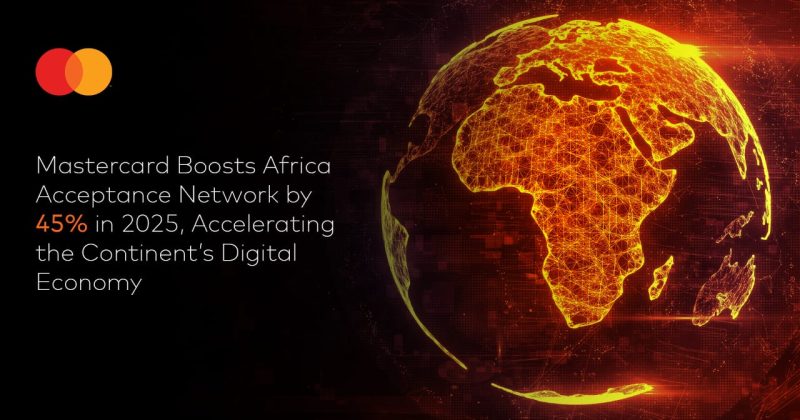
DEC 17 – Mastercard grew its acceptance network across Africa by 45 percent in 2025, a milestone that has brought millions more consumers and small businesses into the continent’s fast-expanding digital economy. The accelerated growth highlights rapid progress in digital payments, technology and innovation across Africa—changes that would traditionally have taken several years to achieve.
The expansion comes in a year marked by new market entries, increased investment, product innovation and a broader on-ground presence, reinforcing Mastercard’s role in supporting Africa’s projected $1.5 trillion digital payments market by 2030.
Over the past two years, Mastercard has accelerated its footprint on the continent, opening new offices in Ghana, Uganda and Mauritius, with additional markets planned for launch in 2026. The company has also increased its workforce by nearly 20 percent across Africa, strengthening local capabilities and enabling the development of solutions tailored to the needs of African communities and merchants.
Alongside its physical expansion, Mastercard has invested in digital infrastructure, including tokenisation upgrades, digital identity capabilities and virtual card enhancements, aimed at improving trust, safety and convenience in both online and in-person payments.
Small and medium-sized enterprises (SMEs), which form the backbone of Africa’s economies, remain central to Mastercard’s strategy. With consumer spending projected to grow in key markets—Kenya (4 percent), Morocco (3.4 percent), Nigeria (6 percent) and South Africa (1.9 percent)—demand for digital payment tools has increased. These tools enable SMEs to pay and receive payments seamlessly, access credit, improve financial resilience and operate more securely in an increasingly digital economy.
Mastercard’s SME solutions include tap-on-phone technology, the Mastercard Payment Gateway System for e-commerce, QR payment options such as QR pay-by-link and QR-on-card, point-of-sale solutions and business payment control capabilities that enable virtual card issuance.
Through collaborations with governments, FMCGs and telecommunications companies, Mastercard has launched 15 SME-focused programmes across Africa in the past 18 months. In South Africa, partnerships have focused on financial inclusion and access to credit for SMEs. In Morocco, Mastercard co-developed the country’s first digital marketplace with BCP, the Ministry of Handicrafts and Paysky, benefiting 2.3 million artisans.
In Nigeria, new QR-on-card solutions with UBA and WEMA are enabling 1.8 million SMEs and gig workers to accept payments, while USD card solutions with Zenith Bank are supporting more than 50,000 SMEs engaged in cross-border trade. In Kenya, Mauritius and Tanzania, collaborations with NMB, AfrAsia, Family Bank and KCB have provided digital solutions to more than 200,000 SMEs.
Beyond payments, Mastercard is driving financial inclusion in underserved and rural communities through its Community Pass initiative, which digitises and connects remote populations to government, NGO and private sector services. The company aims to register 15 million users in Africa on the platform within five years, with Community Pass already reaching 1.2 million smallholder farmers in Uganda.
Through the Mobilizing Access to the Digital Economy (MADE) Alliance, Mastercard and its partners are targeting expanded digital access for 100 million individuals and businesses by 2034. Since its launch in May 2024, the alliance has supported affordable high-speed internet and digital training for cooperatives in Kenya, digitised profiles of more than 80,000 farmers through Farm Pass, and built capacity for 250,000 farmers via local partners.
“2025 has been a defining year for Mastercard in Africa. From acceptance growth to new digital capabilities, our focus has been on solutions that bring people and small businesses into the heart of the digital economy,” said Mark Elliott, Division President for Africa at Mastercard. “Our collaborations across Africa will continue to connect more people and businesses to the financial system, helping drive greater financial inclusion and economic opportunity as we look towards a $1.5 trillion digital economy by 2030.”
Shehryar Ali, Senior Vice President and Country Manager for East Africa and the Indian Ocean Islands, said: “East Africa continues to lead the world in digital financial inclusion. This year we scaled cross-border solutions, virtual cards and acceptance growth to enable more trusted digital engagement.”
Looking ahead, Mastercard expects technologies such as artificial intelligence and agentic commerce to shape the next phase of commerce, with Africa’s AI market projected to reach $16.5 billion by 2030. In 2026, the company plans to continue expanding across markets, advancing financial inclusion and investing in the infrastructure needed to support a more secure and connected African digital economy.