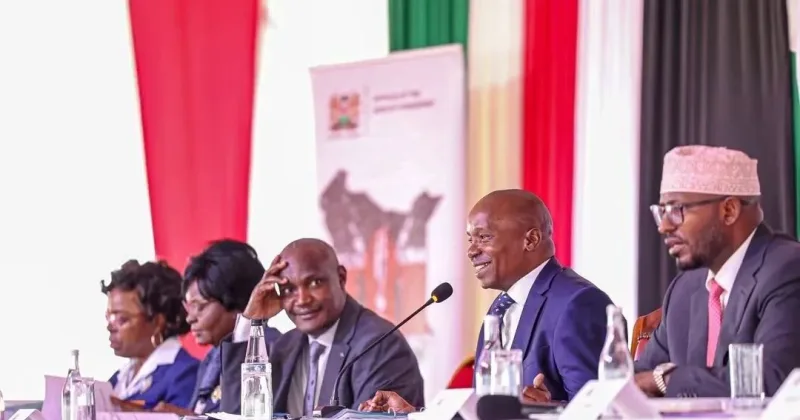
NAIROBI, Kenya, Aug 24 – Deputy President Kithure Kindiki on Monday chaired the Intergovernmental Budget and Economic Council (IBEC) meeting, putting to rest claims that he had been stripped of the role and that Prime Cabinet Secretary Musalia Mudavadi had taken over the intergovernmental relations docket.
Kindiki presided over the 30th Ordinary Session of IBEC at his Karen official residence in Nairobi, bringing together Treasury Cabinet Secretary John Mbadi, Council of Governors chairman Ahmed Abdullahi and other senior national and county government officials.
The meeting came weeks after reports emerged that President William Ruto had reassigned the administration and implementation of the Intergovernmental Relations Act to Mudavadi, raising questions over whether the move had also affected Kindiki’s position as chairman of IBEC.
Media reports indicated that Kindiki had been stripped of the intergovernmental coordination role, with Mudavadi designated to oversee the implementation and administration of the Intergovernmental Relations Act. The report cited correspondence involving Mudavadi, Chief of Staff and Head of Public Service Felix Koskei, the Attorney General and the Senate.
The claims were, however, rejected by the government, with Head of Creative Economy and Special Projects in the Executive Office of the President Dennis Itumbi maintaining that Kindiki remained the chairperson of IBEC as provided for under the Public Finance Management Act.
Itumbi argued that Kenya’s intergovernmental relations framework involves several institutions with distinct constitutional and statutory mandates, including IBEC, the National and County Government Coordinating Summit, the Intergovernmental Relations Technical Committee and the Council of Governors.
Kindiki praised the National Treasury for what he termed timely disbursement of funds to the 47 county governments, saying the national government had released all equitable share allocations due to counties up to August.
“I am happy to note that, despite the fiscal constraints we are facing as a country, the National Treasury disbursed all the amounts due to County Governments as part of the equitable share by the close of the financial year. We have also released July and August allocations,” Kindiki said.
He credited Treasury CS John Mbadi, who attended the meeting, for ensuring faster release of funds to the devolved units.
The Deputy President also welcomed Parliament’s passage of the Division of Revenue Bill, 2026 and the County Allocation of Revenue Bill, 2026, saying the enactment of the two laws had paved the way for timely release of county allocations.
The equitable share allocation to counties has risen to Sh428 billion in the current financial year.
Kindiki said IBEC had played a central role in ensuring that resolutions agreed upon by the national and county governments were implemented.
“We have made significant progress in most of our resolutions. This demonstrates that IBEC is increasingly becoming a results-oriented institution, where decisions are followed through and translated into interventions that benefit our citizens,” he said.
The Deputy President also turned his attention to the completion of County Aggregation and Industrial Parks (CAIPs), saying the projects were critical to Kenya’s industrialisation agenda.
He said CAIPs in Embu, Meru, Kirinyaga, Kisii, Wajir, Garissa and Migori were nearing completion, urging other counties to accelerate implementation.
“As we look for a vision Kenya Beyond 2030, CAIPs are the centre of the realization of the vision. They are the first step to industrialization. If we want to create an industrialized nation, CAIPs are crucial in value addition and aggregation,” Kindiki said.
The meeting also discussed preparations for the anticipated El Niño rains expected between October and December.
Kindiki urged county governments to activate their disaster preparedness and response plans, maintain drainage systems and identify communities likely to be affected by flooding.
“We must act now, before the rains begin, to safeguard lives, livelihoods, infrastructure and essential services,” he said.
The Deputy President further commended governors for supporting the Affordable Housing Programme by providing land for projects, calling for continued cooperation between the national government, counties and the Ministry of Lands.
Council of Governors chairman Ahmed Abdullahi said governors remained committed to resolving disagreements with the national government through IBEC.
“We remain committed to constructive engagements with the national government through IBEC. We want to discuss and resolve all issues amicably,” Abdullahi said.