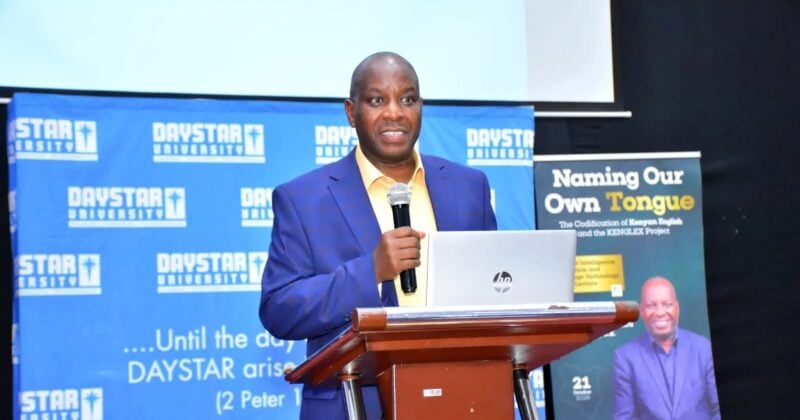
NAIROBI, Kenya, Oct 22 – Kenya’s linguistic diversity could provide a foundation for developing artificial intelligence services tailored to local users, with researchers calling for greater investment in language data to improve how digital systems understand Kenyan speech.
The push is gaining ground through initiatives such as the Kenya Languages Lexicon (KENGLEX), developed by Teknobyte Limited, which has compiled more than 133,000 words with their meanings and pronunciations to document Kenyan English.
The resource is intended to support the development of technologies such as speech recognition, automated translation and text-to-speech systems, which depend on language data to interpret and reproduce human communication.
Teknobyte founder Dr Mucemi Gakuru said the project was informed by efforts to develop an agricultural information service, where users were more comfortable interacting with a voice system that reflected how Kenyans speak English.
“Language is a commercial and strategic resource, especially in the age of Artificial Intelligence,” Gakuru said.
He said codifying Kenyan English, including its pronunciation patterns and expressions influenced by Kiswahili, could help developers build digital services that communicate more naturally with local audiences.
The opportunity extends beyond English to indigenous languages, which remain underrepresented in the development of natural language processing (NLP) technologies.
Research on the state of NLP in Kenya identifies Swahili as the country’s most resourced language, while many indigenous languages lack publicly available models. Existing technologies also face challenges adapting to local linguistic contexts, alongside limited data and computing infrastructure.
These gaps could constrain the development of AI applications for sectors such as agriculture, education and customer service, where voice-based interfaces could help users access information in familiar languages.
However, collecting language data alone will not guarantee wider adoption. Researchers say locally developed AI systems also require sustained funding, computing resources and frameworks governing how community-contributed data is used.
Cynthia Amol, an NLP researcher, said communities should be involved in decisions on data collection, licensing and compensation, particularly where their languages and cultural knowledge are used to train commercial systems.
“Communities are custodians of language, they’re also custodians of culture,” she said.
The issue highlights the need to balance the development of AI tools with the rights of the people whose linguistic knowledge makes them possible.
Researchers also stressed the importance of African researchers producing and documenting linguistic knowledge rather than relying primarily on resources developed elsewhere.
For Kenya, the challenge is to turn its language data into practical, sustainable digital services while ensuring that indigenous languages are represented and communities’ benefit from their contribution.
Although KENGLEX provides a structured resource for Kenyan English, expanding AI capabilities across the country’s diverse languages will require broader datasets, continued research and investment in the infrastructure needed to develop and maintain the technology.