NAIROBI, Kenya Aug 12 – Kenya Power says expanding electricity infrastructure, increasing hydropower storage and carefully integrating solar and wind generation will be critical to maintaining a reliable power system as the country develops its generation capacity.
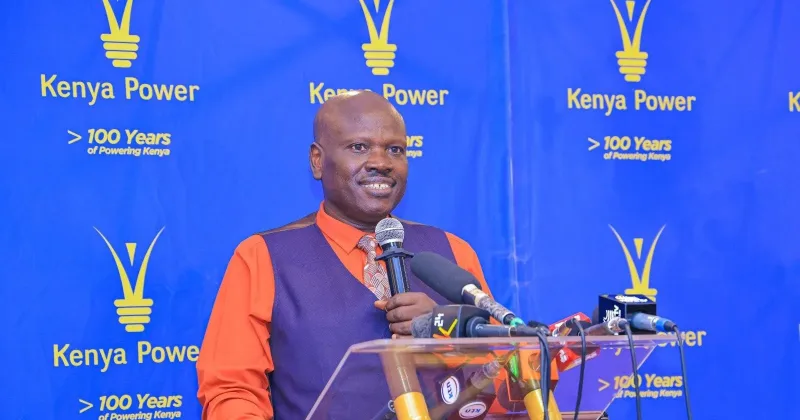
During a media briefing on Tuesday, Kenya Power Managing Director and Chief Executive Officer Dr. Eng. Joseph Siror said Kenya’s electricity relationship with Tanzania would also continue to change as generation capacity grows, with the country potentially switching between importing and exporting power depending on available supply.
“We foresee a situation where our import and export dynamics with Tanzania will continuously change as we develop our generation capacities. The dynamics will always be shifting—at one point we are importing, and at another, we are exporting,” Siror said.
He said the changing electricity flows are part of a wider transformation of Kenya’s power system, which is incorporating more variable renewable energy while requiring sufficient dependable generation and infrastructure to maintain reliable supply.
One of the projects Siror linked to this effort is the proposed 1.5-metre extension of the Masinga Dam wall, which would increase the amount of water that can be stored in the reservoir for hydropower generation.
“Extending the wall of Masinga Dam allows the reservoir to hold a significantly larger volume of water. In hydro-generation, stored water equates to stored energy,” Siror said.
He said the additional storage would be particularly important during dry periods because water held at the top of the Seven Forks cascade can support generation for a longer period as reservoir levels fall.
“By increasing the capacity at the top of the cascade, it takes much longer for the water levels to deplete during dry seasons. This benefits the entire downstream cascade, providing us with a more stable and prolonged energy generation capacity,” he said.
The Masinga project therefore forms part of the broader challenge of ensuring that electricity generated from different sources can be supplied consistently, particularly as Kenya adds more solar and wind power to the national grid.
Siror said the cost of integrating variable renewable energy should also be considered when assessing the overall cost of electricity from sources such as solar.
“There is a common misconception that solar power is universally cheaper. The cost of solar is not just the price of the panel; it includes the hidden cost of grid integration,” he said.
He said solar and wind generation can change depending on weather conditions, requiring other generation capacity to be available to support the grid when their output falls.
This, he said, means the cost of renewable generation cannot be considered separately from the infrastructure and balancing capacity required to incorporate it into the electricity system.
Siror said geothermal generation would continue to play an important role because it provides a more consistent supply of electricity.
“You cannot compare an intermittent 30-minute solar feed with stable, continuous geothermal base load. Geothermal energy provides the grid stability necessary for industrial capacity,” he said.
He said Kenya would continue using solar power but would need to balance it with dependable generation under the Least Cost Power Development Plan.
“While we do utilize solar, it must be balanced within the Least Cost Power Development Plan (LCPDP) to ensure that base load generation is prioritized,” Siror said.
The utility’s position comes as Kenya seeks to expand renewable generation while dealing with the practical requirements of connecting new projects to the national grid.
Siror was also asked about a recent blackout in a neighbouring country and whether it pointed to a wider problem affecting interconnected electricity systems in the region.
He said Kenya Power had examined the technical information surrounding the incident and found that it was not evidence of a wider regional failure.
“From an engineering perspective, we evaluated the data and determined that it was an isolated technical issue, not a systemic regional failure,” Siror said.
At the distribution level, Siror said Kenya Power was also dealing with transformer failures that can affect electricity supply in communities.
He said the failures were frequently linked to environmental conditions and illegal connections rather than faults originating from the transformers themselves.
“When tree branches continuously touch the conductors, it causes arcing and high currents, significantly reducing the lifespan of the transformer,” he said.
Siror said illegal connections could also place transformers under loads beyond their intended capacity.
“The second major factor is illegal connections. A transformer designed to serve 10 legitimate customers is often illegally tapped to serve many more, leading to severe overloading and eventual failure,” he said.
For consumers, the issue has a direct impact because damage to distribution equipment can result in interruptions to electricity supply and increase the pressure on Kenya Power’s maintenance operations.
Siror also addressed another issue affecting prepaid customers – delays in receiving electricity tokens after making purchases through the *977# USSD service.
He attributed some of the delays to communication problems between telecommunications providers and Kenya Power’s servers.
“At times, you may not receive the SMS notification due to communication delays between the telecommunication provider’s gateway and our servers,” he said.
Customers experiencing such delays can use the MyPower application to retrieve their most recent token instead of waiting for the SMS.
“If you experience this delay after using the *977# code, I advise utilizing the MyPower app. By simply selecting the ‘Last Token’ option within the app, you can retrieve your token immediately without waiting for the SMS generation,” Siror said.
He said Kenya Power was engaging service providers to address the gateway interruptions responsible for some of the delays.