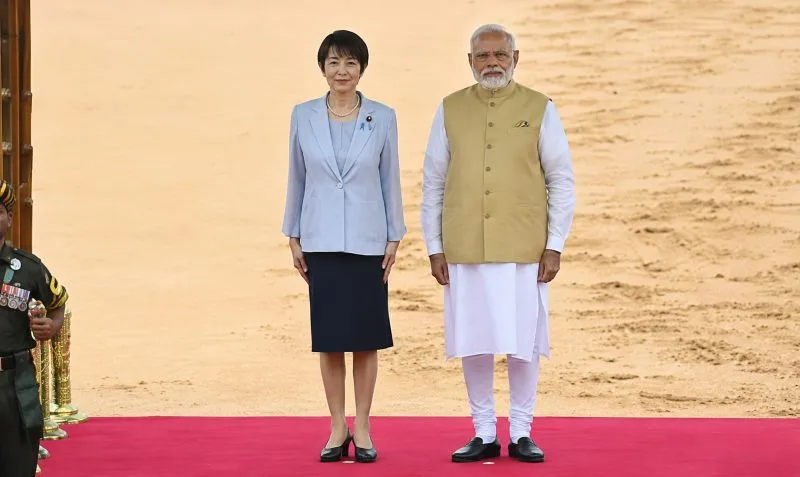
NEW DELHI, Jul 6 — Prime Minister Narendra Modi and his Japanese counterpart Sanae Takaichi on Thursday unveiled an ambitious roadmap to deepen the India-Japan Special Strategic and Global Partnership, featuring more than $10 billion in fresh Japanese investments and expanded cooperation in artificial intelligence, defence, energy, semiconductors and next-generation mobility.
The announcements followed the 16th India-Japan Annual Summit in New Delhi, where the two leaders reaffirmed their commitment to strengthening economic security and building resilient supply chains amid growing global uncertainty.
Addressing a joint press briefing, Modi said the India-Japan investment partnership was gaining momentum, with around 120 new business agreements signed over the past year expected to generate more than $10 billion in Japanese investment.
“Our goal is clear — to attract ¥10 trillion in investment from Japan to India and double the number of Japanese companies operating in India over the next decade,” Modi said.
He noted that a new agreement between the two countries’ financial services regulators would facilitate greater capital flows and investment, while India’s ongoing economic reforms continue to improve the ease of doing business for foreign investors.
The two leaders oversaw the signing of several agreements covering artificial intelligence, energy security, financial cooperation and next-generation mobility. They also released a joint statement on AI, signalling a shared commitment to advancing innovation and digital transformation.
In a significant defence milestone, India and Japan signed their first co-development agreement for the Naval Radio Antenna “Unicorn”, marking a new phase in bilateral defence technology cooperation.
“Taking forward a partnership anchored in trust, shared values and strategic convergence,” India’s External Affairs Ministry spokesperson Randhir Jaiswal said in a social media post following the summit.
Takaichi is on a three-day visit to India, her first official trip to the country since assuming office and the first by a woman serving as Japan’s Prime Minister.
Focus on AI, Advanced Technologies
Modi said the two countries would intensify cooperation in artificial intelligence, semiconductors, quantum technologies and other emerging sectors critical to future economic growth.
“With this vision, we have released a joint statement on AI and signed an agreement to advance bilateral cooperation in this field,” he said.
The leaders also agreed to strengthen collaboration in critical minerals and advanced manufacturing, areas seen as essential to securing global supply chains and reducing vulnerabilities in strategic industries.
Energy and Rural Development
Energy security emerged as another key pillar of the partnership.
Modi announced the launch of the India-Japan Bio-gas Initiative, under which 1,000 bio-gas and organic fertiliser plants will be established across India.
“This will give new strength to sustainability, prosperity and rural livelihoods in India’s villages,” he said.
Economic Security at the Forefront
Economic security remained a central theme of the summit, with New Delhi and Tokyo identifying semiconductors, critical minerals, pharmaceuticals, clean energy, and information and communication technology as priority sectors for deeper cooperation.
Artificial intelligence featured prominently in the discussions, with the newly signed agreement expected to boost collaboration between India’s rapidly expanding digital ecosystem and Japan’s advanced manufacturing capabilities.
The two countries have steadily expanded cooperation in these areas in recent years, including a semiconductor supply chain memorandum signed in 2023 and a critical minerals agreement concluded in 2025.
The summit underscored the growing strategic convergence between India and Japan as both nations seek to strengthen economic resilience, drive technological innovation and enhance regional stability in the Indo-Pacific.