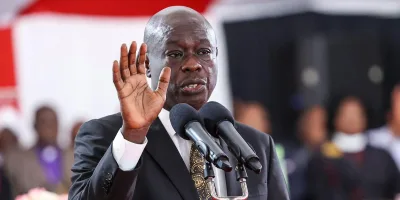
NAIROBI, Kenya, Aug 11 — The State Department for Micro, Small and Medium Enterprises has hit back at former Deputy President Rigathi Gachagua’s description of the Hustler Fund as a “lost cause”, pointing to high uptake and repayment rates in his home county of Nyeri.
The State Department said Tuesday that 420,000 Kenyans in Nyeri County have accessed the Financial Inclusion Fund, popularly known as the Hustler Fund, borrowing a cumulative Sh1.88 billion.
It said the figure represents more than half of Nyeri County’s population.
The department also cited individual borrowing figures to demonstrate the extent to which the fund has been utilised in the county, saying the top borrower in Nyeri has cumulatively accessed Sh2.06 million.
In Mathira Constituency, the top borrower has accessed Sh648,000, while the top borrower in Ruguru Ward has accessed Sh584,000.
Nyeri, according to the State Department, also has the highest Hustler Fund repayment rate in the country at 88 per cent, followed by Murang’a, Kiambu and Nairobi at 87 per cent.
The figures were released shortly after Gachagua delivered a scathing assessment of President William Ruto’s four years in office, in which he criticised the flagship credit programme.
Gachagua calls Ruto presidency ‘imperial’, labels Hustler Fund a ‘lost cause’
Gachagua said the Kenya Kwanza administration had promised to establish a Sh50 billion fund to provide affordable credit to mama mbogas, boda boda operators, mkokoteni operators and other small-scale entrepreneurs.
He questioned the effectiveness of the programme, saying it had reportedly disbursed Sh87 billion to 28 million people.
“What a paradox! What a lie!” Gachagua said in his “Ruto at 4” accountability statement.
He further criticised the size of some loans, saying borrowers had in many instances received as little as Sh500.
Gachagua argued that such amounts were insufficient to establish or grow sustainable businesses and said the high rate of defaults and low loan disbursements demonstrated the programme had failed.
“This is simply a lost cause,” he said.
The State Department’s Nyeri figures offer a direct counterpoint to that assessment, particularly because Gachagua comes from the county and served as its Member of Parliament for Mathira before becoming Deputy President.
The government has also continued to promote the fund as a tool for financial inclusion.
In March, the State Department said the Hustler Fund had provided a platform through which more than seven million Kenyans who had previously been negatively listed with Credit Reference Bureaus had been able to rehabilitate their credit ratings.
The fund’s official platform continues to list personal, group and bridge loans among its products and in July launched the Tukuze Hub to support top-performing borrowers.
However, the government’s defence of the programme comes against a backdrop of concerns over repayment.
In March, the State Department told Parliament that more than Sh84 billion had been advanced to over 27 million Kenyans and sought Sh300 million to strengthen recovery of defaulted loans.
By March, the fund had disbursed about Sh83 billion, of which Sh71 billion had been repaid, according to figures reported in July. That put the default rate at about 15 per cent, equivalent to Sh12.5 billion.
The government has since introduced additional repayment measures, including allowing borrowers to use Safaricom Bonga Points to clear outstanding Hustler Fund loans.
The programme has also faced criticism from outside government.
A 2025 Kenya Human Rights Commission assessment described the Hustler Fund as structurally unsound and economically unsustainable, arguing that its small loan amounts and short repayment periods had failed to generate meaningful enterprise development and could trap low-income borrowers in a cycle of debt.