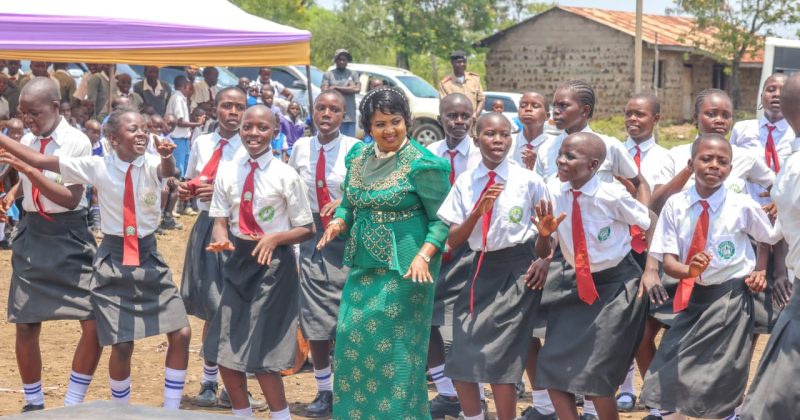
NAIROBI, Kenya, Feb 24 – The Spouse of the Deputy President, Joyce Kithure, has called for renewed investment in education and practical science as a pathway to empowering children and helping communities respond to emerging social and environmental challenges.
Speaking during a fundraiser for the construction of classrooms and a science laboratory at Obalwanda Comprehensive School in Suba North, Homa Bay County, she emphasised that access to quality education remains critical in shaping responsible and productive citizens.
Dr. Kithure said education sets children on a path to better lives, urging teachers, parents and other stakeholders to work together to support learners.
“Let us ensure that no child is left behind due to neglect, discouragement, or lack of support,” she urged.
She highlighted the importance of strong collaboration between families and schools in nurturing discipline and values among young people.
“I urge parents and guardians to continue working closely with teachers to instil discipline, values, and a love for learning in our children,” she noted.
Dr. Kithure, a senior lecturer at the University of Nairobi, described education as a powerful equaliser and encouraged learners to remain committed to their studies while upholding integrity and respect.
“I encourage you to remain focused on your studies. Education is your greatest equaliser. Be disciplined, curious, and determined. Respect your teachers, use your time wisely, and believe in your ability to succeed. Hard work and integrity will always open doors for you,” Dr. Kithure added.
She also called for sustained investment in school infrastructure to create safe and enabling learning environments for children.
“When we invest in classrooms, laboratories, and safe learning spaces, we invest in the future of our children and the future of our nation,” she said.
The Deputy President’s spouse noted that the Science Adding Value to the Environment and the Communities (SaVE) project she is spearheading seeks to apply scientific knowledge to everyday challenges facing communities, particularly those linked to climate change, food security, and sustainability.
“SaVE Communities is already in the process of supporting vulnerable communities through food relief, by providing water tanks to schools to enable rainwater harvesting, and we are also working with farmers to promote climate-smart agriculture by advising on suitable crops and smart farming practices in response to the harsh climate challenges we are facing.
We have also continued to plant trees across various regions as part of our commitment to environmental conservation and sustainability,” Dr. Kithure stated.
She explained that the planned science laboratory aligns with efforts to promote STEM education and practical learning, allowing students to connect classroom theory with real-world problem-solving.
“It will nurture curiosity, innovation, and problem-solving skills among learners, preparing them for a competitive and rapidly changing world,” she added.
Education stakeholders at the event said integrating infrastructure development with initiatives such as climate-smart agriculture, water harvesting, and environmental conservation will help cultivate a generation that views science not as abstract knowledge, but as a practical tool for transforming livelihoods and building resilient communities.