NAIROBI, Kenya Aug 26 – Agriculture and Livestock Development Cabinet Secretary Mutahi Kagwe has challenged Kenya to unlock the full potential of its Sh397 billion meat industry by investing in value addition, processing, technology and premium export markets.
Kagwe said Kenya’s livestock sector had reached a strategic turning point, with a large livestock base, growing domestic demand, entrepreneurial capacity and geographical advantage providing a strong foundation for regional and international competitiveness.
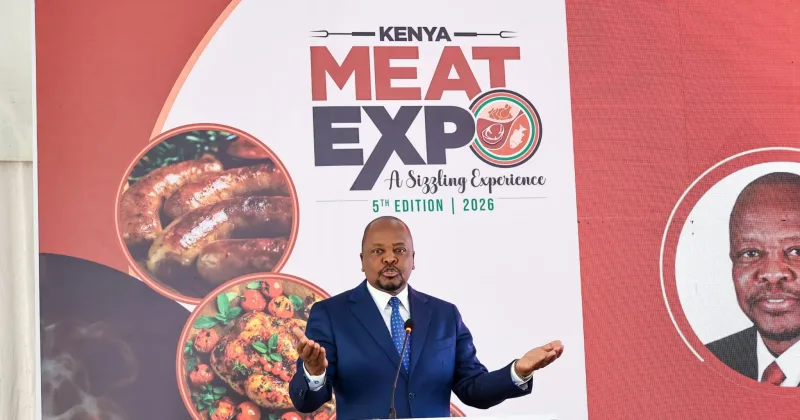
Speaking during the official opening of the Kenya Meat Expo 2026, the CS said the country produced 613,627 tonnes of meat in 2024, valued at approximately Sh397 billion.
He said meat production increased by 10.2 per cent in volume and 30.5 per cent in value compared with 2023.
Beef accounted for about 260,000 tonnes valued at Sh160 billion, while significant opportunities exist in goat meat, mutton, poultry, camel meat, pork and emerging value chains such as rabbit meat.
Kagwe, however, said Kenya must do more to retain value within the country, warning that continued export of live animals deprives Kenyans of employment and business opportunities.
“When we export the animals, then we are sending out jobs. We are exporting jobs to Europe. We are exporting jobs to Dubai. We are exporting jobs to the Middle East,” he said.
The CS called for increased investment in meat processing, branding and product development to enable Kenya to export finished meat products and ensure farmers and pastoralists earn more from their livestock.
Kagwe said Kenya has approximately 2,000 slaughter facilities, comprising 49 large slaughterhouses, 322 medium slaughterhouses and about 1,530 slaughter slabs.
He said the priority should now shift from expanding the number of facilities to improving their quality, efficiency and capacity utilisation.
“It is not just a question of quantity. It is also an issue of quality,” he said.
The CS called for improved hygiene, meat inspection, refrigeration, regulatory compliance, waste management, logistics and market connectivity to enable Kenyan meat products to meet international standards and attract premium prices.
He said the meat value chain starts from animal production and extends to processing and consumption, making animal health and food safety critical to the sector.
Kagwe highlighted the Animal Identification and Traceability System (ANITRAC) as a key component of the government’s strategy to modernise the livestock sector.
The system will enable authorities to trace animals from their origin and ownership to vaccination records, movements and eventual slaughter.
“Going forward, every Kenyan animal should have an identity and a traceable history,” Kagwe said.
He said the technology was being developed locally, including chips and systems by Kenyan universities.
ANITRAC is also expected to strengthen efforts to combat livestock theft and banditry by making attempts to interfere with animal identification detectable.
Kagwe called for increased investment in improved livestock genetics, artificial insemination, breeding, animal nutrition and commercial feedlots.
He also urged investment in climate-smart livestock production, water pans, boreholes and livestock insurance to protect farmers from losses caused by drought, floods and other extreme weather events.
He said feedlots should have adequate feed, water and supporting infrastructure, while insurance schemes should provide protection against climate-related losses.
Kagwe urged the government, county governments and the private sector to work together to strengthen the livestock value chain and create new investment opportunities.
The CS challenged young people to view livestock beyond traditional herding and embrace opportunities in breeding, animal nutrition, processing, manufacturing, technology, branding, logistics and trade.
“Ukulima wa ng’ombe ni pesa. Na nyama siyo tu chakula. Pia ni pesa. Nyama ni chakula, na nyama ni pesa,” he said.
Kagwe also highlighted the potential of hides and skins, saying proper handling of animals can improve the quality and value of by-products and support the growth of Kenya’s leather industry.
He said Kenya should also pursue new international markets, citing Algeria and other markets with demand for livestock and meat products.
Kagwe recalled Algeria’s previous indication of demand for one million goats during Ramadan, saying such opportunities demonstrate the potential available to Kenyan livestock producers.
“We want new markets. We want new enterprises. We want new jobs. We want new opportunities for livestock producers,” he said.
Kagwe said stronger investment across the meat value chain would enable Kenya to move from exporting raw livestock to exporting higher-value meat products while creating jobs and increasing incomes for farmers and pastoralists.