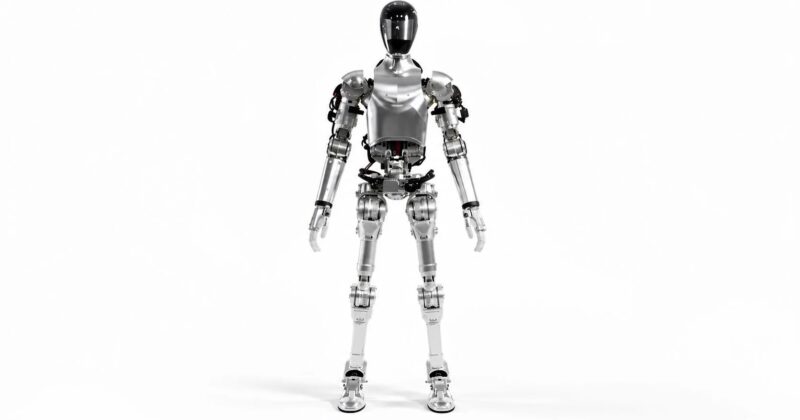
China’s ambition to shape the next generation of technology is increasingly visible in its push into humanoid robots. At international trade fairs, factory demonstrations and public exhibitions, machines capable of walking, manipulating objects and performing increasingly complex tasks have become prominent symbols of China’s technological aspirations.
The message is unmistakable. Beijing wants China to be at the forefront of artificial intelligence, robotics and what is increasingly known as embodied intelligence, where AI systems interact directly with the physical world.
But behind the impressive demonstrations lies a more consequential question. Can China’s rapidly developing humanoid robot industry move from technological spectacle to commercially sustainable mass deployment?
The answer is not yet clear.
China has identified embodied intelligence and humanoid robotics as important emerging industries alongside other strategic technologies. Government initiatives increasingly link robotics with industrial modernisation, productivity and future economic growth. In 2026, China’s Ministry of Industry and Information Technology and the State-owned Assets Supervision and Administration Commission launched a programme designed to accelerate the use of humanoid robots in real-world industrial, service and specialised environments.
The programme aims to establish more than 100 high-value application scenarios and build the capacity for deployment at the scale of tens of thousands of units by the end of 2026. Importantly, the initiative is focused not simply on demonstrations but on training robots in real operating environments and generating the data needed to improve their performance.
That distinction matters.
Humanoid robots have made remarkable progress, but impressive demonstrations do not necessarily translate into commercial viability. A robot performing a choreographed routine at an exhibition is very different from one working reliably for long hours in a factory, warehouse, hospital or care facility.
The real test is whether these machines can operate safely and consistently in unpredictable environments, adapt to changing conditions and perform useful tasks at a cost that makes economic sense.
Recent developments suggest that Chinese policymakers and investors are becoming more conscious of that challenge. Reuters reported in September that Chinese regulators were slowing the rush of humanoid robotics companies towards initial public offerings amid concerns that high valuations and some state-backed revenues might not accurately reflect underlying commercial demand. Unitree Robotics’ volatile market performance added to those concerns.
That does not mean China’s humanoid robotics ambitions are failing. Rather, it suggests that the industry is entering a more demanding phase in which technological claims increasingly have to be matched by customers, orders, productivity gains and sustainable revenues.
This is where China’s industrial model could become an important advantage.
China already possesses extensive manufacturing capacity, dense supply chains and expertise in batteries, motors, sensors, electronics and precision manufacturing. These capabilities provide a strong foundation for producing robots at scale and reducing costs as technologies mature.
The country has also moved towards establishing common standards for humanoid robotics. In March, China unveiled its first national standard system covering areas ranging from components and intelligent computing to applications, safety and ethics. More than 120 research institutions, companies and industry users were involved in developing the framework.
The strategy is therefore not simply about producing impressive machines. It is also about building an ecosystem around them.
There is a broader economic rationale as well. China’s ageing population and shrinking working-age population are likely to increase pressure on employers and policymakers to find ways of maintaining productivity with fewer workers. Robotics could eventually help address labour shortages in manufacturing, logistics and selected service sectors.
But demographic pressures alone will not create a successful robotics industry. The technology still has to work.
One of the biggest challenges is data. Humanoid robots need to learn how to respond to countless variations in physical environments. They must recognise objects, understand spaces, manipulate different materials and recover from unexpected situations. China’s latest government programme explicitly recognises this problem by prioritising real-world training and the accumulation of high-quality data.
There are encouraging signs that Chinese companies are attempting to solve the problem in innovative ways. Reuters reported this month that Shenzhen-based startup DexForce is using synthetic data and virtual simulations to train robots, potentially reducing the cost and time involved in collecting physical-world training data. The company has also attracted significant investment and has begun deploying its technology in industrial and public-service settings.
These developments make it difficult to dismiss China’s robotics push as simply government-driven hype.
At the same time, government support creates a legitimate question about market discipline. When governments provide funding, infrastructure and deployment opportunities, early demand can be encouraged before a technology has demonstrated that consumers and businesses are willing to pay for it independently.
That is not unique to China. Emerging technologies often require public and private investment before they become commercially viable. The more important question is whether state support ultimately produces competitive products or simply sustains companies that cannot survive without it.
International markets present another challenge. Chinese technology companies already face increased scrutiny in several advanced economies, particularly where artificial intelligence, data security and national security are concerned. As humanoid robots become more connected to AI systems and collect information from physical environments, similar questions about data, cybersecurity and technological dependence are likely to emerge.
Yet writing off China’s ambitions would be equally premature.
The country has repeatedly demonstrated an ability to use manufacturing scale, infrastructure, supply-chain integration and sustained investment to transform emerging technologies into globally competitive industries. Electric vehicles, solar equipment and batteries provide important examples, although each industry has its own circumstances and the comparison should not be treated as a guarantee of success.
Humanoid robotics may follow a similar path, or it may prove considerably more difficult.
The crucial issue is therefore not whether China can build humanoid robots. It clearly can. The more important question is whether those robots can become sufficiently capable, reliable and affordable to generate genuine demand on a large scale.
That is the experiment now unfolding.
China’s humanoid robot push represents a combination of technological ambition, industrial policy and economic necessity. It is also an attempt to secure an early position in what could become an important new field of artificial intelligence.
The coming years will reveal whether the country’s strategy produces a transformative industrial ecosystem or an industry that struggled to move beyond spectacular demonstrations and heavy investment.
For now, the evidence supports neither dismissal nor triumphalism.
China has built a formidable foundation for humanoid robotics. The harder task is turning that foundation into machines that can deliver measurable economic value in the real world.
That, rather than the spectacle of a robot walking across a stage, will ultimately determine whether China’s humanoid gamble becomes a technological revolution.