NAIROBI, Kenya Aug 4 – Kenya’s Competency-Based Curriculum (CBC) must equip learners with critical thinking, creativity and the responsible use of artificial intelligence (AI) if the country is to remain competitive in a rapidly evolving global economy, education and innovation experts said during Capital in the Morning on Tuesday.
The discussion, held ahead of the 9th Young Scientists Kenya (YSK) National Science and Technology Exhibition taking place this week in Nairobi, focused on whether Kenya’s education system is preparing learners with the skills needed for an AI-driven future.
Speaking during Capital in the Morning show, Evelyn Maris, Deputy Head of Mission and Head of Cooperation at the Embassy of Ireland in Kenya, said conversations around AI are taking place across the world as governments and education systems seek ways to harness the technology while managing its risks.
She said while AI has created uncertainty about the future of work, it also presents an opportunity for schools to nurture innovation by allowing learners to safely explore and experiment with emerging technologies.
“We can’t run away from what scares us. We have to embrace it, and I think it’s really important in our education system that we’re creating those safe spaces for children to explore, and young people to explore and to be innovative. Because ultimately, they are the ones that will design the future,” Maris said.
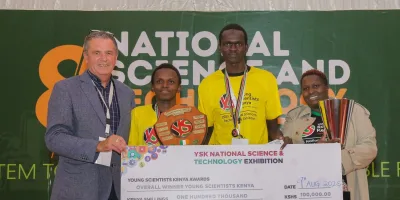
The 9th Young Scientists Kenya National Science and Technology Exhibition, which runs from August 5 to 8 under the theme “Shaping Kenya’s AI Future Using STEM,” will bring together learners from schools across the country to showcase innovations that address real-world challenges.
Organised by Young Scientists Kenya, the annual event promotes science, technology, engineering and mathematics (STEM) education while exposing young innovators to opportunities that can help develop their ideas.
Maris said Kenya already has a strong foundation for digital innovation and is well positioned to become a leader in AI if it continues investing in young people and innovation.
“Kenya is in a really fantastic position in terms of digital innovation… You have a really fertile ground here to embrace AI and to actually be leaders in it,” she said.
Dr. Eng. Victor Mwongera, National Director of Young Scientists Kenya, said the exhibition provides learners with an opportunity to present their ideas, interact with innovators and gain exposure to opportunities beyond the classroom.
He said this year’s event has attracted participants from schools across 45 counties, with many learners coming from regions that have historically had limited access to innovation programmes.
“This exhibition gives a space for young innovators… they come to Nairobi for four days… and it’s an opportunity for them to see that the ideas that they are able to generate are good enough for the global economy,” Dr. Mwongera said.
He noted that several former participants have gone on to compete successfully in international innovation competitions, including Microsoft’s Imagine Cup, demonstrating the potential of locally developed ideas when learners receive the right support.
Dr. Mwongera said Young Scientists Kenya also conducts outreach programmes throughout the year in underserved counties, working with partners to expose learners and teachers to STEM education while supporting AI learning initiatives in marginalized communities.
“Even if they come from what we call marginalized communities, it doesn’t mean that they are not as capable. In fact I find people from that community are even more capable because they come to win,” he said.
The discussion comes as governments, educators and employers around the world continue reviewing how education systems should adapt to artificial intelligence, which is increasingly reshaping learning, workplaces and the skills required in many professions.
Throughout the interview, the speakers emphasized that preparing learners for that future will require more than simply introducing AI tools into classrooms.
Maris said creativity should be nurtured from an early age, arguing that education systems should encourage curiosity, innovation and independent thinking alongside the use of technology.
“Creativity and innovation starts from such a young age… I think it’s up to us as parents, it’s up to us as educators, up to us as a government system to create those safe spaces,” she said.
She added that as AI becomes more integrated into everyday life, critical thinking and emotional intelligence will remain essential human skills.
“We as humans need to have confidence in our abilities as humans to retain that critical thinking. And that emotional intelligence is really, really quite important,” Maris said.
On whether AI should become a standalone subject in schools, Dr. Mwongera said learners would benefit more from understanding the principles behind the technology, including creativity, computational thinking and responsible use, rather than studying AI in isolation.
“We would be better served if we taught some of the fundamentals that go into someone being able to use AI responsibly… creativity, problem solving and computational thinking,” he said.
The interview also explored concerns about misinformation and overreliance on AI-generated content.
Maris said countries would need to work together to establish common principles and safeguards governing AI while encouraging people to question and verify the information they receive.
“We have to reach some level of global consensus… Kenya alone can’t do it, Ireland alone can’t do it… this has to be something that unites us,” she said.
Dr. Mwongera said AI should complement rather than replace human creativity, noting that learners should view it as a tool to help solve problems instead of a substitute for original thinking.
“Young people also understand that their creativity should not disappear as they use AI… AI is more of a tool. It’s not so much the one all and end all, it’s a tool that you use as part of your arsenal,” he said.
Looking at Kenya’s education system, Maris said expanding digital access, particularly for girls and learners in underserved communities, would be critical in ensuring more young people benefit from AI-driven opportunities.
She also stressed that policy reforms should be complemented by grassroots programmes that inspire learners to identify and solve challenges within their communities.
“You need the policy, but you also need those grassroots innovations that are doing the outreach, that are creating safe spaces, that are inspiring young people to ask those questions,” she said.
Dr. Mwongera welcomed the Ministry of Education’s collaboration with Young Scientists Kenya but said greater engagement with stakeholders, including the private sector and education partners, would strengthen future AI-related education policies.
“The Ministry of Education could do better in bringing some of the stakeholders on board… If the government took advantage of that we’d move very, very far,” he said.