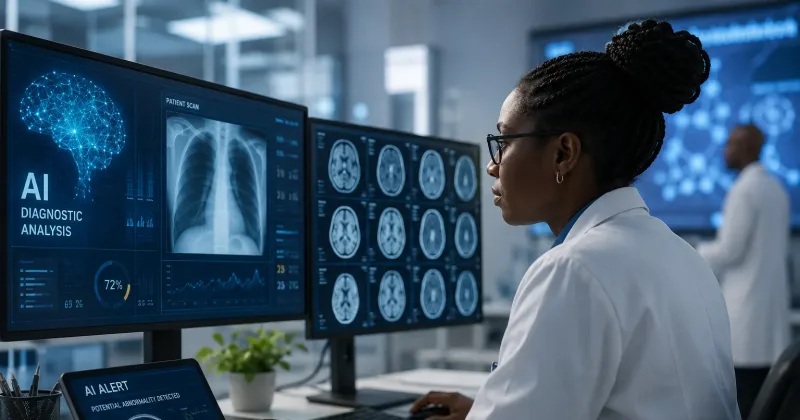
NAIROBI, Kenya, Jul 30 – Artificial intelligence is emerging as a key driver of preventive healthcare, with experts saying its growing use in diagnostics and clinical decision-making could help African health systems detect diseases earlier, improve efficiency and ease pressure caused by a shortage of healthcare workers.
The technology is increasingly being deployed in medical imaging, clinical documentation and patient record management, allowing healthcare professionals to make faster, data-driven decisions while reducing administrative workloads.
Stephan Bandelow, Associate Professor and Associate Director of Research at St. George’s University, said AI is already moving from experimental applications to routine clinical practice, particularly in areas where speed and accuracy are critical.
“AI-powered tools are already becoming part of everyday medical practice, helping clinicians make faster and more data-driven decisions.”
“These systems are designed to support physicians rather than replace them, functioning as a second layer of review.”
The shift comes as investment in AI-powered healthcare accelerates across Africa. Earlier this year, the Gates Foundation and OpenAI announced a $50 million initiative to deploy AI across 1,000 primary healthcare clinics and surrounding communities by 2028, beginning in Rwanda.
The investment is expected to help bridge healthcare access gaps in sub-Saharan Africa, where the region faces an estimated shortage of 5.6 million health workers.
Evidence is also growing that AI can strengthen early disease detection. A South African study involving more than 1,000 women found that AI-supported breast ultrasound systems identified more cases requiring follow-up than clinical examinations alone, suggesting the technology could improve cancer screening in resource-constrained settings.
However, Bandelow cautioned that AI is unlikely to replace physicians in complex clinical decisions, noting that empathy, ethical judgment and contextual reasoning remain uniquely human capabilities.
The World Health Organization says AI-assisted diagnostics, telemedicine and electronic health records are becoming increasingly important as Africa accelerates its digital transformation of healthcare.