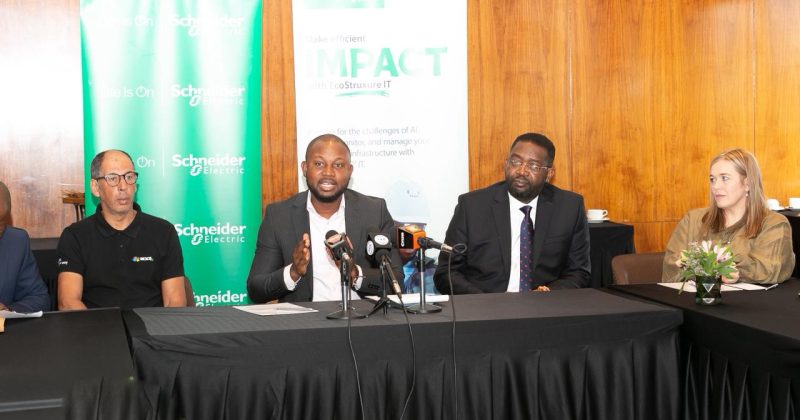
NAIROBI, Kenya, Sept 17 – Africa has unveiled its first Artificial Intelligence (AI) data center in Uganda, represting a turning point expected to shift data from foreign servers back to the continent and give institutions, researchers, and businesses greater control over their digital assets.
Speaking during the launch, Synectics Technologies Executive Vice Chairman and CEO Oladele Oyekunle said the first phase of the project will cost Sh157.2 billion ($1.2 billion).
The facility will run on 100 megawatts of renewable energy and adopt a modular design that allows expansion as technology evolves. Rollout is expected to begin by mid-next year and span three years.
The initiative is anchored on four key goals: managing and processing data, supporting research and development, providing advisory services, and training local talent.
It will also host an AI Center of Excellence under a Build-Operate-Transfer (BOT) model to ensure African engineers, researchers, and universities not only access the infrastructure but also gain the skills to manage and innovate within it.
The project aims to reduce Africa’s dependence on foreign expertise and transform the continent into a net exporter of digital skills within five years.
Spanning more than 80 acres, the “digital city” will serve as an ecosystem where researchers in medicine, agriculture, climate science, and other fields can apply AI innovations locally, rather than exporting raw data abroad for processing.
The facility is being developed in Uganda by Synectics Technologies in partnership with Schneider Electric, Nvidia, and Turner & Townsend. Together, they aim to provide Africa with local infrastructure for data processing, research, and AI innovation.
Despite a population of 1.4 billion people, Africa accounts for less than 1 percent of global data center capacity, according to the Africa Data Centres Association. Most African data is still hosted overseas, raising concerns about security, sovereignty, and compliance with data protection laws.
“At least 30 African countries, including Kenya and Nigeria, have enacted data privacy regulations in recent years, requiring more data to be processed locally,” Oyekunle noted.
Turner & Townsend’s Head of Real Estate in Africa, Wendy Cerutti, said the facility is designed to meet international standards while securing Africa’s long-term digital future.
“This project shows that we can deliver world-class facilities here, with predictability, clarity, and impact,” she said, adding that it aligns with net-zero targets as a long-term infrastructure program.
Analysts estimate that AI could contribute up to KES 195 trillion ($1.5 trillion) to Africa’s GDP by 2030, with the data center positioning the continent as a hub for research, innovation, and skills export.
Schneider Electric East Africa Country President Ifeanyi Odoh said the absence of large-scale infrastructure has discouraged global hyperscalers from investing heavily in Africa.
“It’s not that we don’t have the data. The basic infrastructure—fiber, power, redundancy—has not been available at scale,” he said.
The facility will be supported by multiple fiber routes, redundant transformers, and advanced automation to guarantee reliability.
Africa’s digital infrastructure gap underscores the urgency of the project. Despite its size, the continent remains heavily reliant on Europe and North America for data hosting.
Experts warn that without local capacity, risks of data misuse and weak compliance will escalate as AI adoption grows in healthcare, fintech, and education.
By embedding privacy and compliance frameworks into the facility, Synectics and its partners say they are building not just infrastructure but also trust.
Industry observers view the project as a watershed moment. The creation of an AI factory powered by renewable energy is expected to catalyze digital economies across East Africa and beyond while symbolizing Africa’s entry into the Fourth Industrial Revolution.
As Oyekunle concluded: “Science is precise whether in Kenya, Uganda, or China. For Africa, this is our time not just to consume technology, but to define our own digital future.”
By Faith Masita