NAIROBI, Kenya, Feb 13 – Kenya’s banking sector is increasingly talking the language of climate finance. From polished sustainability reports to partnerships with development banks, the country’s largest commercial banks are keen to showcase billions of shillings in green loans and climate‑aligned portfolios.
But behind the rising figures lies a critical disconnect: the vast majority of these green funds flow to large corporations and formal enterprises, while Micro, Small and Medium Enterprises (MSMEs) and Jua Kali artisans the backbone of Kenya’s economy remain largely on the outside looking in.
Green Finance Gains Traction-But Not Across the Board
Green finance is meant to accelerate climate mitigation and adaptation. In Kenya, this has translated into banks increasingly earmarking capital for environmentally beneficial projects such as renewable energy installations, energy‑efficient technologies, sustainable agriculture, and waste management.
Kenya’s largest lender, KCB Group, reported disbursing Sh53.2 billion in green loans in 2024, bringing its green lending to about 21.32 % of the total loan book, up sharply from the year before.
“The conversation today must be aligned to how we safeguard the Planet and People even as we pursue Profits,” said its CEO Paul Russo during the lender’s sustainability report launch last year.
These funds support energy transition initiatives, climate adaptation, blue economy projects and e‑mobility solutions.
Banks such as Standard Chartered Kenya and Equity Bank have also reported rapid growth in climate finance products, with Standard Chartered noting a tenfold increase in sustainable finance assets and Equity surpassing Sh26 billion in climate‑related lending by the end of 2024.
“We are creating sustainable finance products to support sustainable development. Our frameworks, developed in collaboration with Sustainalytics, the leading provider of ESG and corporate governance research, set out what qualifies as ‘sustainable’ and ‘green’ products.”
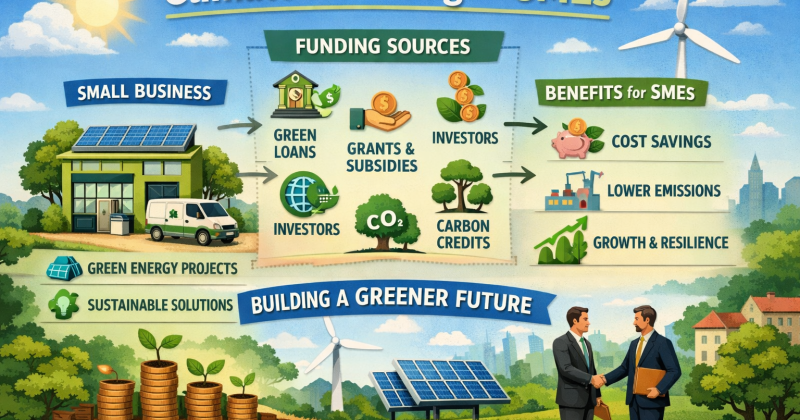
For large firms, these green financing mechanisms open doors to cheaper capital, international partnerships and stronger ESG positioning. But for the vast numbers of smaller enterprises across Kenya, the picture is starkly different.
The 97 % Gap: Small Businesses Struggle to Qualify
Industry insiders point to an unusual and troubling statistic: only about 3 % of SMEs currently qualify for green financing products in Kenya.
This figure has been cited in sector commentary and reflects how restrictive eligibility frameworks remain for smaller firms.
In other words, while billions of shillings are classified as green finance on the books of banks, the lion’s share of that capital goes to big players, not Main Street businesses.
This gap isn’t simply about numbers on a balance sheet; it reflects who actually gets access to climate finance and who does not.
Small enterprises often lack the formal ESG documentation required by lenders, including environmental impact assessments, carbon data, and governance frameworks; all prerequisites for green loan approval.
The costs associated with generating these documents can run into millions of shillings and take more than a year to complete, placing them far beyond the reach of most SMEs.
SMEs and Jua Kali: The Heart of Kenya’s Economy
The exclusion of small businesses from green finance is not just unfair, it undermines Kenya’s broader development goals.
MSMEs and the informal sector are central to the national economy.
According to the World Bank, the sector contributes roughly one‑third of GDP and form the majority of Kenya’s formal business landscape, with microenterprises employing millions of workers.
The Jua Kali sector; informal artisans, micro‑manufacturers, traders and craftspeople; sustains livelihoods for countless households and fuels grassroots innovation.
These enterprises are deeply embedded in local economies, from energy‑efficient cookstoves and solar sales to urban recycling and climate‑smart agriculture.
Their economic footprint and employment impact vastly outweigh their access to formal climate finance.
Yet, while banks enthusiastically report green loans and sustainable portfolios, the systemic hurdles facing small businesses remain unaddressed.
A major part of the solution lies in policy innovation and regulatory reform; an area where Kenya has begun to take steps.
In April 2025, the Central Bank of Kenya (CBK) launched the Kenya Green Finance Taxonomy (KGFT) and a Climate Risk Disclosure Framework designed to bring clarity and consistency to climate finance.
The taxonomy sets out what qualifies as green investment and aims to reduce “greenwashing” by giving lenders and investors a common standard to assess climate alignment.
By standardizing definitions and requiring banks to disclose climate‑related exposures, the CBK hopes to redirect capital to genuinely climate‑aligned activities and encourage innovation in product design.
Alongside this, the Kenya Bankers Association set up the Centre for Sustainable Finance and Enterprise Development (CSFED) to help embed sustainable finance principles within the industry and bolster support for underserved segments, including MSMEs.
But these frameworks are still early in implementation and focus largely on classification and disclosure, rather than directly tackling the structural barriers that keep small enterprises out of green financing.
The Stakes: Economy, Resilience, and Jobs
Leaving small enterprises out of green finance has real consequences for Kenya’s economic resilience and social stability.
When green capital flows predominantly to large players, it risks reinforcing inequality in economic growth and stifling grassroots climate innovation.
MSMEs provide millions of jobs, particularly to youth and women, and are often the first to adopt incremental, low‑cost climate solutions; from solar distributors to agroforestry micro‑businesses.
Excluding them from climate finance deprives Kenya of distributed climate impact and leaves innovation and resilience concentrated in formal sectors.
Government and development actors have taken note.
In early 2026, the World Bank committed approximately Sh5.55 billion to a green investment fund for Kenyan SMEs, channeled through the Kenya Development Corporation’s Green Investment Fund under the Kenya Jobs and Economic Transformation Project.
The funding forms part of Component 3 of the Kenya Jobs and Economic Transformation (KJET) Project, which aims to increase private sector investment, access to markets, and sustainable finance.
“Through KJET and Supporting Access to Finance and Enterprise Recovery (SAFER) Project, KDC is delivering tangible results by crowding in private capital, strengthening financial intermediaries, and expanding access to patient and affordable finance for SMEs. The Green Investment Fund is a critical step towards scaling climate-smart investments that create jobs, enhance resilience, and support sustainable enterprise growth,” said KDC Director General Norah Ratemo.
This initiative aims explicitly to help small businesses adopt climate‑aligned technologies and meet ESG criteria to access private capital.
Experts say blended financing combining public funds, technical assistance and private capital is essential to de‑risking investments for small businesses that would otherwise be excluded by traditional criteria.
Towards an Inclusive Green Finance Future
Kenya’s experience illustrates a broader truth about climate finance: climate goals and financial inclusion must go hand in hand. It is not enough to report rising green loan volumes if those products continue to serve only the most established firms.
For inclusive impact, several shifts are needed: Simplified criteria for SMEs that lower documentation burdens without compromising environmental integrity.
Likewise, capacity building and technical support so small businesses can demonstrate climate impact is key.
Public‑private financing structures that absorb risk and incentivize lenders to include smaller enterprises goes along way.
Doing so would not just broaden the reach of climate finance; it would harness the entrepreneurial energy of millions working in Kenya’s informal economy and turn them into active participants in the nation’s climate strategy.
Kenya’s green finance story is one of progress tempered by exclusion.
While banks now boast growing green portfolios and regulatory frameworks set benchmarks for climate‑aligned lending, the 3 % participation rate for SMEs paints a sobering picture of who is actually served by the green capital flowing through the financial system.
Kenya’s policymakers and banking sector face a clear test; translate good intentions and large headline figures into genuinely inclusive climate impact, ensuring that the informal entrepreneurs and small business owners who power the economy are not left behind.