NAIROBI, Kenya, Oct 15 — Matatu operators have announced immediate fare increases following a sharp rise in fuel prices, setting the stage for higher transport costs for commuters across the country.
Matatu owners’ association boss Albert Karakacha said operators would raise fares in response to the latest adjustments announced by the Energy and Petroleum Regulatory Authority (EPRA), citing the impact of rising fuel costs on public transport operations.
Karakacha said operators would pass the additional costs on to passengers, warning that the latest fuel price increase had added to the financial strain on an industry already grappling with high operating costs.
He appealed to President William Ruto to honour his earlier pledge to keep diesel prices low.
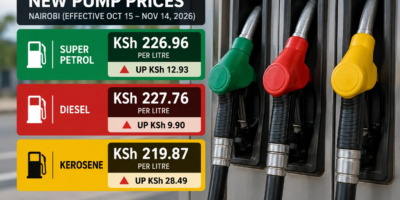
The fare adjustments come after EPRA raised the price of Super Petrol by Sh12.93 per litre, diesel by Sh9.90 and kerosene by Sh28.49 in its latest monthly review, with the new rates taking effect on October 15 and remaining in force until November 14, 2026.
The diesel increase is particularly significant for the public transport sector, where operators rely on the fuel to run many of the vehicles serving commuters.
Higher fuel costs could also feed into the prices of goods and other essential services as businesses pass on increased transportation expenses to consumers.
The latest increases have also drawn criticism from the Motorists Association of Kenya (MAK), which has questioned EPRA’s pricing calculations and called for greater transparency in the determination of pump prices.
In a statement issued on October 15 under its newly appointed Director General, Eng. Edward Mwirigi Kinyua, the association said the increases in retail prices did not correspond proportionately with the reported changes in the landed costs of imported petroleum products.
“The Motorists Association strongly condemns the petroleum price increases announced by the Energy and Petroleum Regulatory Authority (EPRA), under its newly appointed Director General, Eng. Edward Mwirigi Kinyua, for the period beginning 15 October and ending 14 November 2026,” MAK said.
MAK said the landed cost of Super Petrol rose by 11.81 per cent, diesel by 11.32 per cent and kerosene by 9.41 per cent.
However, the corresponding pump price increases were 6.04 per cent for petrol, 4.54 per cent for diesel and 14.89 per cent for kerosene.
The association acknowledged that retail fuel prices are influenced by taxes, levies, transportation expenses and stabilisation adjustments but called on EPRA to publish a detailed breakdown showing how the latest prices were calculated.
It also questioned the regulator’s explanation that the increase in kerosene prices was partly intended to narrow the price gap between kerosene and automotive fuels to discourage fuel adulteration.
MAK further demanded an independent audit of the Government-to-Government fuel import arrangement to establish whether it delivers savings compared with competitive procurement.
It warned that it could mobilise motorists, transport operators, traders, commuters and other stakeholders for peaceful demonstrations if the government failed to address its concerns.
The dispute comes as households and businesses face the prospect of higher transport and operating costs following the latest fuel review.
EPRA cites higher import costs
EPRA attributed the price adjustments to changes in the cost of imported refined petroleum products, which Kenya purchases from international markets using established pricing benchmarks.
According to the regulator, the average landed cost of imported Super Petrol rose from US$874.26 per cubic metre in August to US$977.55 in September 2026.
Diesel costs increased from US$957.05 to US$1,065.38 per cubic metre, while kerosene rose from US$1,003.87 to US$1,098.31 over the same period.
“Currently, Kenya imports all its petroleum product requirements in refined form, and the products are traded in international markets based on a pricing benchmark,” EPRA said.
Under the new schedule, Nairobi’s maximum wholesale prices stand at Sh211.89 per litre for Super Petrol, Sh212.68 for diesel and Sh204.79 for kerosene.
In Mombasa, the corresponding maximum wholesale prices are Sh208.73 for petrol, Sh209.53 for diesel and Sh201.64 for kerosene.
Nakuru’s maximum wholesale prices are Sh210.65 per litre for petrol, Sh211.85 for diesel and Sh203.98 for kerosene.
In Eldoret and Kisumu, petrol is priced at a maximum of Sh211.43 per litre, diesel at Sh212.63 and kerosene at Sh204.76.