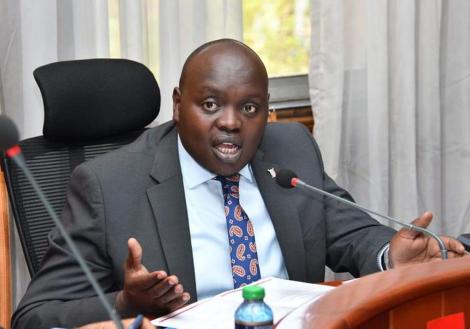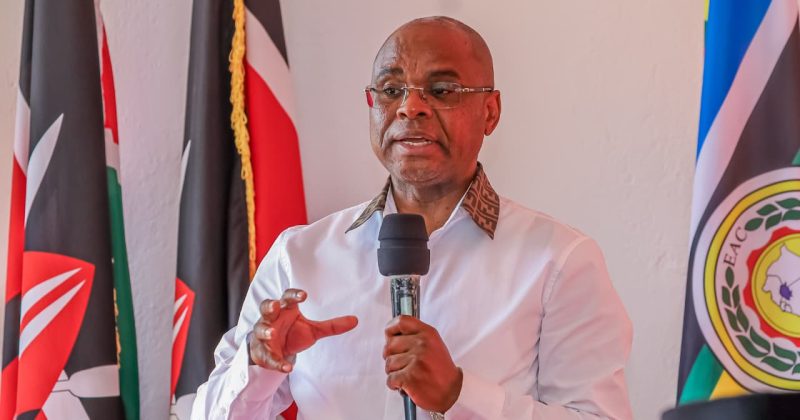
NAIROBI, Kenya Oct 6 – Senate Speaker Amason Kingi has urged county bosses to implement Senate committee recommendations without delay, including taking disciplinary action against underperforming county officials, to restore accountability in devolved units.
During the first day of the week long the Senate Mashinani in Busia county when he made a courtesy call to the office of the governor, the speaker decried the failure by some county administrations to act on Senate reports and audit findings, warning that inaction undermines service delivery and public confidence in devolution.
Senators pitched tent in Busia County in the western based county focusing on the efficiency of cross-border trade, regional integration, and stalled infrastructure projects that have delayed key development goals in the border county.
“We have very many reports where we have made recommendations, but you find that ten, five or three years have gone by and the recommendations haven’t been implemented on the ground,” Kingi said.
“So governor, if you see recommendations to either sack certain officials or take action against them, please implement that.”
The Speaker, who served as Kilifi Governor for ten years, said he understood the challenges governors face in managing county staff, but urged them to act decisively against incompetence and laxity.
“Sometimes when you are preparing to appear before watchdog or departmental committees, you find that certain departments are just incompetent,” he said.
“You give them a week to respond to issues raised before the Senate, but they still give bogus responses. What I used to do before I appeared before the Senate was to sack them. When they asked me what I had done about the bogus response, I told them the said officers were already at home and they clapped for me.”
Kingi admitted that dismissing officials is not always easy due to political issues and regional balance but insisted it is sometimes necessary to safeguard performance and accountability as the conduct of county officials determines the governors score card at the end of his term.
“I know it’s not good to sack an officer because he’s a family man with responsibilities, but as a governor, if you allow laxity, you fail the whole county. I want to urge county officials please don’t fail in your duties,” he said.
The Senate Speaker also defended the Senate’s oversight role, saying its intention is not to antagonize governors but to ensure prudent use of public funds and stronger devolution.
Speaker Kingi highlighted that’s its always a tug of war between National Assembly and the Senate when counties are pushing for equitable revenue share under the Division of Revenue of Bill each financial year.
“There’s no frosty relationship between the county assemblies and the Senate. When we put governors on the spotlight over the usage of funds, it’s to ensure devolved resources are well utilized,” he said.
“As Senate, we really fight with the National Assembly to ensure counties get enough resources. If the Senate wasn’t there, counties would be getting meagre allocations.”
Kingi praised Busia County for maintaining a cordial working relationship between the governor and the county assembly, saying it was a model of success in devolution.
“We can’t be jubilant because counties are having issues. Our success is the success of counties. When we see wars between the executive and the legislature, we are not happy because when the two arms collide, it’s the mwananchi who suffers,” he noted.
On his part,Busia Governor Paul Otuoma urged the Senate to broaden the scope of the Equalisation Fund to include frontier counties that face unique cross-border challenges.
Governor Otuoma said that while all counties receive the equitable share of revenue and a few benefit from the Equalisation Fund, border counties like Busia contend with additional pressures that are not reflected in current allocations.
He noted that Busia, which lies along the Kenya–Uganda border, often bears the burden of providing essential services including healthcare to citizens from neighbouring countries.
“There is need to look into the challenges facing frontier counties like Busia. We plan and budget for our citizens, but we also have our brothers and sisters crossing from Uganda to seek the same services,” said Otuoma.
The governor lauded the Upper House for its continued support of devolution but lamented the persistent financial and administrative challenges confronting county governments.
He cited delayed disbursement of funds, disputes over devolved functions, frequent industrial actions, and outdated pre-devolution laws as major obstacles hampering effective service delivery.
“We still face a lot of challenges in terms of functions and resources following functions. There is still a lot of push and pull between the national and county governments,” Otuoma said.
The sittings in Busia are part of ongoing efforts by the upper House to enhance its working relationship with counties and interaction with the people at the grassroots.
Previous Mashinani sittings were held in Uasin Gishu, Kitui, and Turkana counties in 2018, 2019, and 2023 respectively. No sittings were held in 2020 and 2021 due to the Covid-19 pandemic.