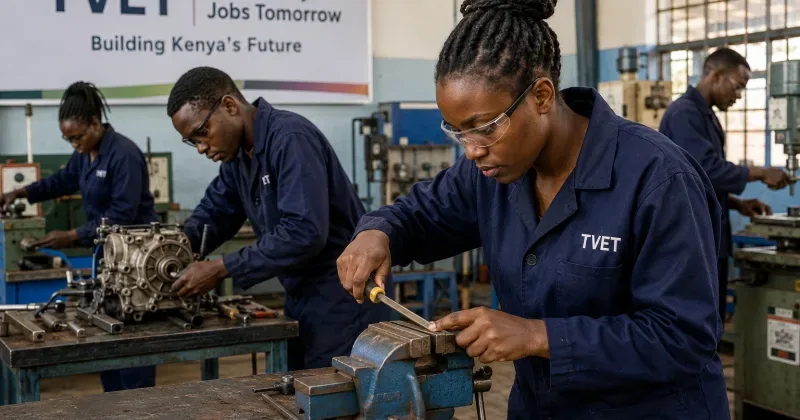
NAIROBI, Kenya, Jul 2 – For generations, success in Kenya followed a familiar script: excel in school, earn a university degree and secure a white-collar job.
That formula is increasingly being rewritten.
As thousands of university graduates struggle to secure formal employment, a quiet revolution is unfolding across the country.
Technical and Vocational Education and Training (TVET) is rapidly emerging as one of Kenya’s most reliable pathways to jobs, entrepreneurship and industrial growth, driven by soaring demand for practical skills across construction, manufacturing, renewable energy, transport and the digital economy.
The shift reflects a changing labour market where employers increasingly value competence over credentials and practical expertise over academic qualifications alone.
Kenya’s TVET sector has expanded rapidly to meet that demand. The country had 3,126 TVET institutions in 2025, including 1,529 private technical and vocational colleges and 139 private vocational training centres, with enrolment reaching 825,484 learners, underscoring the growing appetite for skills-based education.
From electricians wiring affordable housing projects and welders fabricating steel structures to automotive technicians servicing increasingly sophisticated vehicles, solar installers powering the clean energy transition and ICT specialists deploying fibre-optic networks, skilled trades are becoming central to Kenya’s economic transformation.
The demand is being fuelled by major investments in affordable housing, transport infrastructure, manufacturing, industrial parks, renewable energy and digital connectivity—all sectors that require technicians capable of immediately applying specialised skills.
Unlike many office-based occupations that are increasingly vulnerable to automation, technical professions continue to require hands-on expertise, making them among the most resilient careers in the age of artificial intelligence.
From skills training to innovation
TVET institutions are also evolving beyond traditional artisan training into centres of innovation, applied research and product development.
Speaking during the closing ceremony of the 8th Annual International Multi-Disciplinary Conference and 6th National Skills Competition (CARI 2026) at Kisumu National Polytechnic, Principal Secretary for the State Department for TVET Dr Esther Muoria challenged institutions to move beyond displaying innovations at exhibitions and instead commercialise technologies capable of solving real-world problems.
She argued that artificial intelligence, automation and climate change are reshaping industries at unprecedented speed, requiring TVET institutions to prepare graduates who can design, build, maintain and improve emerging technologies.
“The technicians of the future must not only understand how systems operate but also how to make them safer, cleaner and more efficient,” she said.
Muoria urged institutions to embed AI competencies across engineering, agriculture, construction and manufacturing while developing commercially viable products rather than stopping at prototypes.
She also directed Kisumu National Polytechnic to establish an implementation register to track innovations presented during the conference and announced a partnership with the University of Eldoret to scale up robotics innovations emerging from TVET institutions.
Government betting on technical skills
The government’s investment signals growing confidence that technical skills will underpin Kenya’s industrial ambitions.
Parliament approved Sh58.49 billion for the State Department for TVET in the 2026/27 financial year, increasing funding for infrastructure, modern equipment, instructor training and institutional development.
That investment complements several strategic partnerships.
Under Phase III of the Kenya-China Project, 70 institutions will receive modern training equipment, 1,190 instructors will be trained across priority disciplines and Competency-Based Education and Training (CBET) will be fully rolled out.
Kenya has also signed a cooperation agreement with Italy to modernise up to 70 institutions with advanced technologies supporting training in robotics, renewable energy, artificial intelligence and digital manufacturing.
The government is targeting two million TVET enrolments by 2027 while expanding partnerships with Austria and the World Bank-funded EASTRIP programme to strengthen maritime and specialised technical training.
At the same time, reforms are making technical education more accessible.
Annual tuition fees have been reduced from Sh105,000 to Sh67,000, while the government plans to recruit between 8,000 and 10,000 technically trained graduates into internship programmes supporting affordable housing and other national infrastructure projects.
Education Cabinet Secretary Julius Ogamba has also tightened oversight by directing institutions to adhere strictly to approved fee structures while integrating automation, artificial intelligence and digital technologies into training programmes.
Building the skills pipeline
The transition to Competency-Based Education is expected to reinforce the momentum.
Unlike the previous curriculum, which largely rewarded examination performance, the competency-based system emphasises practical skills, creativity, innovation, collaboration and problem-solving, making progression into technical training a more natural pathway for many learners.
The reforms also seek to change long-held perceptions that vocational education is a second-choice option.
Across Kenya, graduates are launching welding workshops, vehicle repair garages, electrical installation firms, refrigeration businesses, furniture workshops, beauty enterprises and digital technology companies.
Many are creating employment for themselves while generating opportunities for others, demonstrating that technical education is becoming as much a pathway to entrepreneurship as formal employment.
Women are also entering fields once dominated by men—including welding, electrical engineering, automotive mechanics and industrial manufacturing—broadening participation in Kenya’s skilled workforce.
A different future of work
The rise of artificial intelligence is reinforcing, rather than diminishing, the value of technical skills.
While AI is expected to automate many routine administrative tasks, occupations requiring physical expertise, engineering judgment, equipment maintenance and complex problem-solving remain difficult to replace.
Instead, AI is transforming how technicians work, creating demand for workers capable of operating smart factories, maintaining automated machinery, installing renewable energy systems and supporting increasingly digital industries.
For Kenya, the TVET revolution is no longer simply about producing artisans. It is about building the skilled workforce needed to industrialise the economy, strengthen manufacturing, power the clean energy transition and equip millions of young people with practical skills that can generate employment in an increasingly technology-driven world.