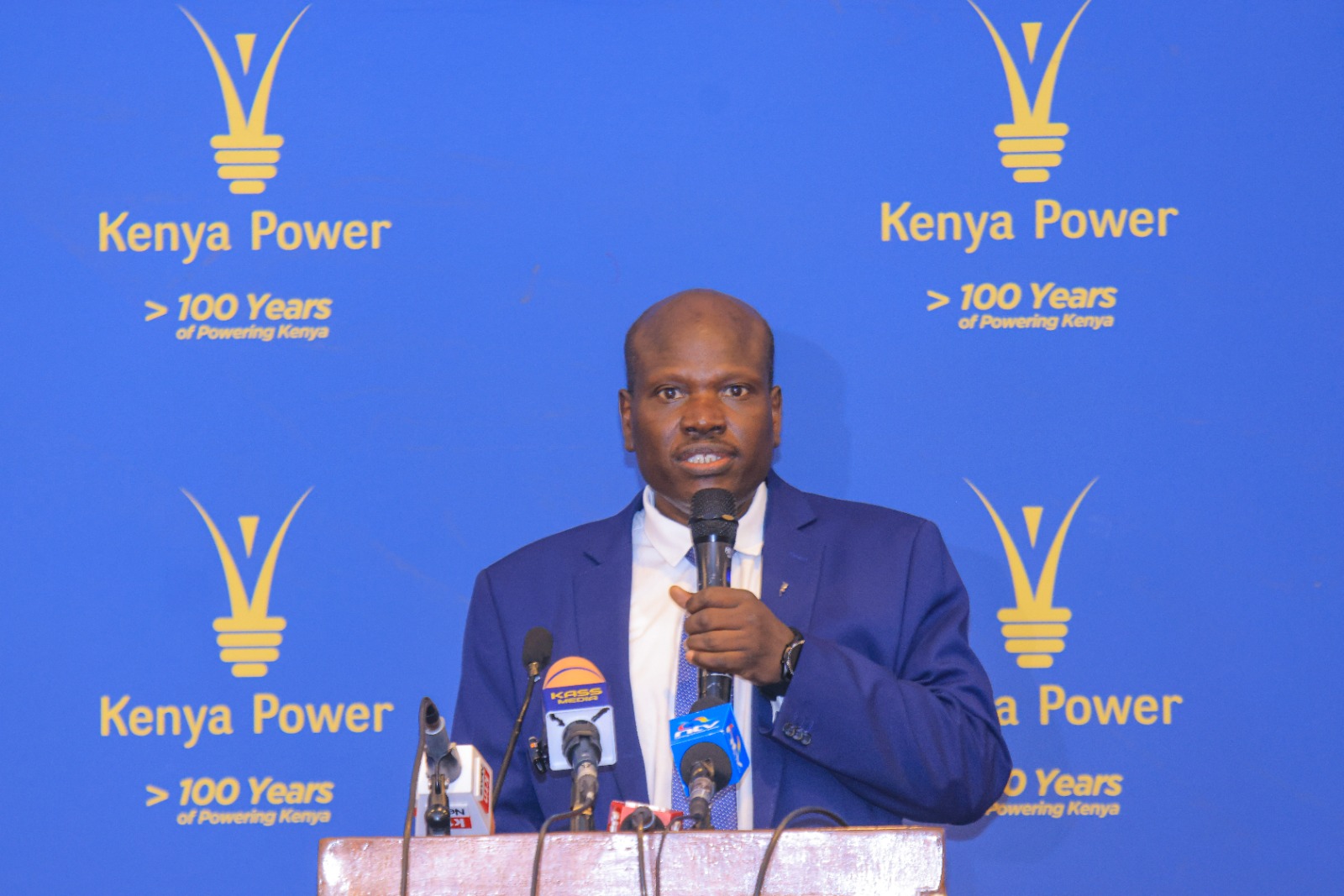
NAIROBI, Kenya, Aug 11 – Kenya Power Managing Director and Chief Executive Officer Eng. Dr. Joseph Siror has explained how changes in electricity generation and demand can destabilise the national grid and trigger power outages.
Siror said grid stability depends on maintaining a balance between electricity generation and demand while continuously monitoring voltage and frequency.
“Grid stability is dependent on two key factors. Generation, demand. Of course, there are parameters that one always has to monitor. That is the voltage and the frequency.”
He explained that when voltage or frequency moves beyond predetermined levels, the grid can automatically trip as a safety measure to protect the electricity system and equipment.
“If they go beyond certain levels, for its own safety and the safety of other equipment, the grid will trip.”
According to Siror, some outages experienced by consumers can therefore result from the grid’s automatic protection mechanisms rather than a complete absence of electricity generation.
“Actually what you would call an outage at times is just the system kicking a mechanism to protect further damage.”
Siror said frequency is particularly affected by the balance between electricity supply and demand.
“Those two things, especially the frequency, is affected by the balance of demand and supply. What you are demanding, the grid has to generate to meet it.”
He illustrated this using a scenario where electricity demand on the grid is 1,600 megawatts (MW) and generation is also 1,600 MW.
If solar power is contributing 200 MW and a cloud or heavy rain suddenly causes that generation to fall to almost zero, total generation could drop to about 1,400 MW while demand remains at 1,600 MW.
“There is an imbalance between what is being demanded and what’s being generated. How it manifests, there will be a frequency dip.”
Siror said that if the frequency dip becomes too severe, the grid may automatically disconnect some loads to restore the balance between generation and demand.
“It knocks off some of the loads just to be able to ensure that now what is being demanded by the grid is say at 1,400, so it has to knock off the extra 200, which means some places go off so that there’s a balance between the two.”
However, the same problem can occur in the opposite direction when generation suddenly increases.
Siror said if cloud cover clears and solar generation suddenly increases by 200 MW, generation could rise to 1,800 MW while demand remains at 1,600 MW.
“You have a situation where the demand is 1,600, but the generation is 1,800. That one manifests by a frequency spike.”
He said a significant increase in frequency can also threaten grid stability and potentially lead to a wider system failure if it exceeds the required threshold.
“If it goes above a particular threshold, you stand seeing, depending on the speed, you can actually also suffer a grid collapse.”