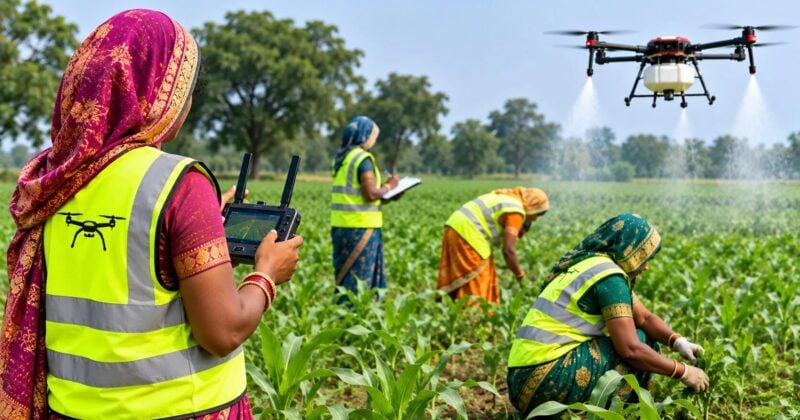
Nov 19 – A machine weighing 28 kilograms once intimidated Rekha Devi. Today, she is among a growing number of rural Indian women using agricultural drones to spray crops, earn livelihoods and challenge the belief that operating sophisticated technology is a man’s job.
Rekha’s journey reflects a wider transformation taking place under India’s Namo Drone Didi initiative, which is equipping women from rural communities with skills to operate drones for agricultural purposes.
The women, popularly known as ‘Drone Didis’, are combining technology with farming expertise to improve crop management while changing perceptions about women’s roles in agriculture and rural enterprise. Didi, the Hindi word for elder sister, is a term of respect and affection commonly used for women in communities.
Their experiences, including those of Sabina Khatoon from Ayodhya, Sita Devi from Karnal, Rekha Devi from Agra and natural farming advocate Kanta Devi from Ambedkar Nagar, show how agricultural innovation is opening new opportunities for women.
For decades, crop spraying has involved farmers walking through fields carrying heavy tanks to apply fertilisers, pesticides and liquid nutrients such as Nano Urea. The work is physically demanding, takes considerable time and often requires large amounts of water.
Drones are changing that process by allowing farmers to apply agricultural inputs more quickly, uniformly and efficiently.
Sita Devi is among the women who have embraced the technology. Before beginning her journey, she had limited knowledge of the wider world, including where Delhi was located. She subsequently completed pilot training in Gurugram and began offering drone-spraying services across five districts.
She has now covered about 5,000 acres and travelled to Delhi to share her experience on a national platform, illustrating how rural women are gaining confidence and expertise in technology-driven agriculture.
The path to becoming a drone operator, however, has involved overcoming unfamiliar technology, personal sacrifices and resistance from communities.
When Sabina Khatoon enrolled for training at Droner Aviation in Motihari, Bihar, she had only encountered drones used to film weddings and movies. She initially imagined that if agricultural work did not materialise, she could use the equipment to film local weddings.
The prospect of operating a large agricultural drone was intimidating. Rekha Devi was similarly taken aback when she encountered the 28-kilogram machine after completing three months of training in Hyderabad, Allahabad and Bihar.
Her training was further complicated by a language barrier in Hyderabad, where lessons were initially delivered in English. She struggled to follow instructions, relying on hand gestures until Hindi-speaking trainers were arranged.
The programme required five to six hours of classes each day. Rekha also had to leave her three-year-old son behind during training, a decision she made with the support of her husband and in-laws.
Despite these difficulties, both women gradually gained confidence as they learnt to operate the drones.
Returning home presented another challenge. In many communities, drone operation was viewed as a male occupation, with women questioned about their ability to handle expensive machinery.
Rekha recalls men mocking her and boasting about their driving licences while doubting her credentials.
She responded that although they were licensed to drive two- and three-wheelers on the ground, she was the only person in her district licensed to fly in the air.
To convince a farmer who was initially reluctant to allow her to spray his crops, Rekha offered a free demonstration. The results helped persuade him to trust her services.
Sabina Khatoon also faced hostility in Chaudhara Gram Panchayat, where a male drone operator reportedly encouraged a crowd and local children to ridicule her as she prepared to work.
She told her colleague, Sheila Didi, to disregard the heckling and concentrate on the flight. Sabina carefully manoeuvred the drone around overhead power lines before spraying a banana plantation.
The demonstration changed the mood, with the women winning applause and securing orders to service 40 acres of farmland.
The initiative is also helping create a network of women with the skills to train others, extending its impact beyond individual operators.
Organised through village Self-Help Groups (SHGs), the programme encourages trained women to become trainers, enabling communities to build their own capacity to operate drone-based agricultural businesses.
Sabina has trained 80 women farmers, while Rekha works with 15 of the 20 women’s groups in her village. She is preparing between five and 10 backup operators in each group to ensure that services remain available when a pilot is unable to work.
Alongside the adoption of technology, women such as Kanta Devi are promoting more sustainable agricultural practices.
Kanta, from Roshan-garh village in Ambedkar Nagar, leads a network of more than 500 women farmers who advocate chemical-free farming using natural inputs derived from cow dung and cow urine.
She promotes beejamrit, an organic microbial preparation used to treat seeds before planting to protect them from soil-borne diseases, and jeevamrit, a fermented liquid bio-fertiliser used to improve soil fertility and encourage beneficial microbial activity without synthetic chemicals.
The growing influence of the Drone Didis is extending beyond the fields. Through their work, women are earning incomes, developing businesses and gaining recognition within their communities, where they are increasingly addressed as Sabina Didi or Drone Didi.
Their success is also helping shift attitudes in households and villages. Men who previously expected women to remain confined to domestic duties are increasingly seeing them as examples of what their daughters and wives can achieve.
By bringing together agricultural knowledge, natural farming practices and modern aviation technology, the women are not only changing how crops are managed but also expanding the possibilities available to rural women in India.