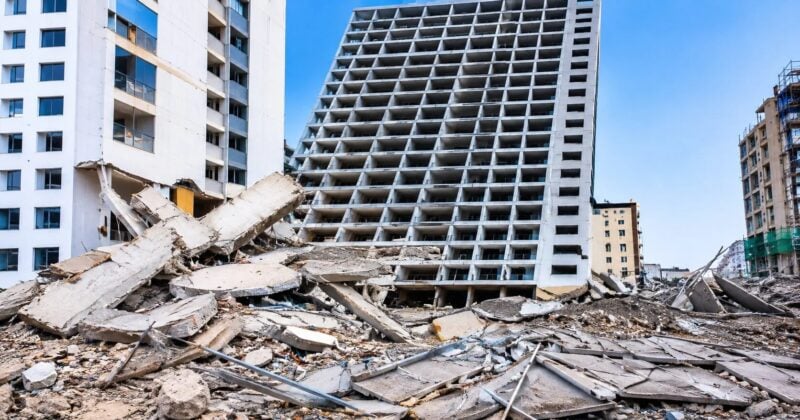
NAIROBI, Kenya Nov 19 – Kenya’s growing trail of deadly building collapses is exposing deep failures in construction regulation, with fresh revelations of forged approval documents in Eastleigh and unanswered safety concerns surrounding Bridge Port Apartments in South C raising questions about the safety of property buyers and occupants.
The crisis has placed the National Construction Authority (NCA), county governments, Engineers Board of Kenya (EBK) and National Environment Management Authority (NEMA) under scrutiny over alleged regulatory negligence, weak inspections and failure to enforce building standards.
In South C, residents are demanding urgent intervention over the 15-storey Bridge Port Apartments, which neighbours the 16-storey building along Muhoho Avenue that collapsed in January 2026, killing two people.
The South C Residents Association has alleged that Bridge Port Apartments, owned by Kenneth Nyachae, brother of former East Africa Court of Justice judge Charles Nyachae, was approved for only 10 floors and that its structural pillars were damaged during the neighbouring building’s collapse.
In a May 11, 2026 letter to Lands Cabinet Secretary Alice Wahome, residents demanded the release of an investigation report and an independent structural assessment to establish whether the apartments remained safe for occupation.
They also sought a public safety certificate or appropriate enforcement action, warning that occupants could be exposed to danger if the alleged structural damage remained unaddressed. The residents say no action has been taken.
The concerns have been compounded by revelations surrounding the October 23 collapse of an 18-storey building along Ninth Street in Eastleigh, which killed eight people, injured several others and exposed apparent loopholes in Nairobi’s development approval system.
In a statement, the South C Residents Association chairman, Abdi Karim Hassan, demanded that the Cabinet Secretary release the multi-agency inquiry report into the collapse of Plot 68/1306 and provide an update on the status of Bridge Port Apartments.
The residents also demanded a public safety certification or demolition order for the adjacent 15-storey building owned by Bridge Port Apartments Limited.
“This building was approved for 10 floors but stands at 15, with documented structural damage to its pillars,” the statement said.
image
Caption: Protesters outside Ardhi House demanding accountability following the South C building collapse that claimed two lives in Nairobi, April 20, 2026.
Appearing before the Nairobi County Assembly’s Urban Planning Committee, Assistant Director for Development Control Fredrick Ochanda disclosed that City Hall had never approved the building’s architectural or structural plans.
He told the committee that developer John Mutie Musyoki had initially obtained approval to change the property’s use from private residential to commercial and residential development but had failed to secure construction approval.
Architect Emmanuel Mwangi Maina submitted an application on November 25, 2024, for a building comprising a basement and 15 floors. The application was unsuccessful after an invoice of Sh2 million remained unpaid.
A second application submitted on November 14, 2025, attracted an invoice of Sh1.1 million, which was paid. However, it was not approved because of inadequate parking, proposed basement shops and failure to obtain Kenya Civil Aviation Authority clearance.
“As of now, there is no application that has been approved,” Ochanda told the committee.
He further disclosed that documents allegedly presented to the NCA to demonstrate county approval were forged.
“An application was made to us, but it did not meet the minimum requirements. Regarding the question of NCA approval, the letters in question did not originate from us. They were forgeries,” he said.
Yet the NCA had registered the project on July 30, 2025, under registration number 53128815710410, listing 9th Street Plaza Limited as developer and Stromax Holdings EA Limited as contractor.
The revelations raise questions about how construction proceeded to 18 floors without county approval and why enforcement agencies failed to stop it.
The County Assembly committee, chaired by Baba Dogo MCA Geoffrey Majiwa, also expressed concern over the failure of the developer, contractor and some county officials to honour summonses. Governor Johnson Sakaja’s Chief of Staff David Njoroge and adviser Osman Khalif Abdi were among those asked to appear.
“In an inquiry, when you are adversely mentioned, you are summoned to come and clear your name,” Majiwa said, insisting that nobody should be condemned unheard.
Acting Director of Planning and Compliance Tom Achar had also alleged political interference by powerful individuals in City Hall’s approval processes.
The disasters are not isolated. On November 13, an eight-storey building near Nairobi’s Mombasa Road and SGR terminus collapsed, killing six people and leaving five rescued.
Other incidents in 2026 in Karen, Shauri Moyo, Kibra and Kericho claimed several lives, while a retaining-wall collapse along Riverside Drive killed four people and injured 11.
In the Eastleigh tragedy, four people were rescued alive, while three others remained unaccounted for when the search was called off.
A compilation by Stats Kenya puts reported building collapses between January 2020 and November 2026 at 84, resulting in 102 deaths and 138 injuries. The Architects Association of Kenya has previously warned about non-compliance, inadequate professional oversight and weak enforcement.
Under the regulatory framework, county governments approve building plans and issue development permits, the NCA registers construction projects and monitors compliance, EBK regulates engineers and engineering firms, while NEMA oversees environmental compliance.