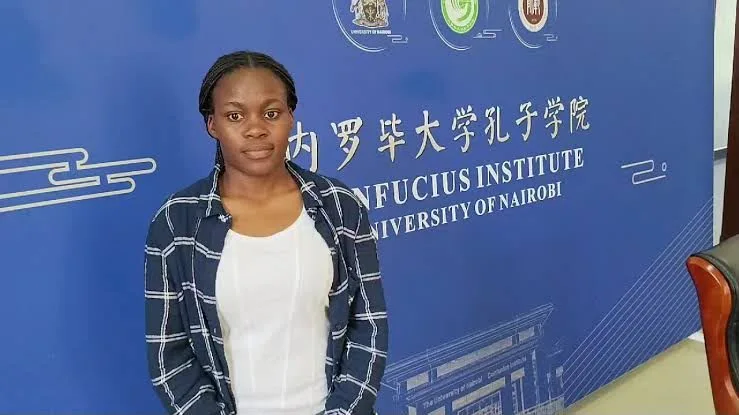
NAIROBI,Kenya Sep 7 – Miriam Achieng was not looking for a new career when she stumbled upon a Chinese television drama as a high school student.
At the time, she was convinced she would become a doctor.
Then a programme featuring traditional Chinese medicine caught her attention. The treatment methods were unfamiliar, the language sounded strange and the culture was unlike anything she knew.
Instead of simply changing the channel, she became curious.
That curiosity would eventually lead the 23-year-old University of Nairobi geospatial engineering student thousands of kilometres from home, where she would compete against some of the world’s finest Chinese-language learners.
She has now returned to Kenya after finishing among the top 15 contestants out of 157 participants from 137 countries at the 25th Chinese Bridge Chinese Proficiency Competition for Foreign College Students.
She was also one of the three highest-ranked contestants from Africa.
For a young woman who once doubted whether she could even speak Chinese well enough to enter the competition, the result has been as much a personal victory as an international achievement.
“I first got interested in learning Chinese when I was in high school, when I had watched a certain TV programme. It was showcasing a Chinese drama, where it was basically about Chinese medicine,” she says.
“At that time I wanted to become a doctor, so I got intrigued by the strange ways of healing that I could see in that movie, and that is how I started.”
What began as curiosity slowly became a habit.
Learning beyond the classroom
When she joined the University of Nairobi, Achieng discovered that she could formally pursue the language through the Confucius Institute.
She enrolled for Chinese lessons and worked her way up to HSK 3.0 level.
But she soon realised that mastering a language required more than attending classes and memorising vocabulary.
So she found an unconventional teacher: her phone.
“I decided to bring China to myself through what I was able to afford, which was my phone,” she says.
She switched to Chinese-language content, watched Chinese films and videos and spent increasing amounts of time on Chinese media and social platforms.
The entertainment she had once consumed in English became part of her language training.
Her reasoning was simple.
“I feel like if you want to learn a language, you have to live the language,” she says.
“You can learn a whole lot of vocabulary in class. You can learn a whole lot of writing and reading, but if you do not get out there and start actually speaking and actually listening, you are halfway there.”
It was this immersion that would later give her the confidence to take a step she had not planned.
The competition she nearly avoided
Achieng did not wake up one morning and decide she would represent Kenya on a global stage.
In fact, she almost missed the opportunity altogether.
A teacher told her about the Chinese Bridge competition and urged her to apply. Achieng had not been following some of the class groups closely and was unaware that applications were open.
Her teacher could not understand her hesitation.
“Why have you not applied? Your Chinese is so good. Why have you not applied?”
But Achieng had a different assessment of her abilities.
“It’s not that I don’t want to apply. I do not dare to apply because I feel like I wouldn’t be able to make it,” she recalls.
She applied anyway.
The decision took her into a competition featuring some of the strongest Chinese-language students from around the world.
The finals, held in China from August 5 to 23, tested contestants in far more than spoken Mandarin. They had to demonstrate listening, speaking and writing skills while also showing their knowledge of Chinese culture through speeches, quizzes, performances and other activities.
For Achieng, competing against students who had spent years learning Mandarin some from childhood was intimidating.
“It was very competitive because you get to compete with the top people from every single country,” she says.
Then came the moment she had been waiting for.
As the names of contestants who had reached the top 30 were announced, Achieng was unsure whether she would hear hers.
“My hope was dwindling more and more. I wanted to get to the top 30, but I also didn’t have that confidence that I had gotten there,” she says.
Then her name was called.
“And then finally, I hear my name, and voila, I’m in the top 30.”
The next stage brought an even bigger surprise.She made the top 15.
“I was kind of exhilarated, but at the same time, I was content with my performance because I had not thought I would make it to even the top 30, and now I had made it to the top 15. I felt very proud of myself,” she says.
For Achieng, the real prize was not the ranking.
It was the discovery that she had underestimated herself.
“At the beginning of the competition, I didn’t have that much self-confidence in my Chinese or my stage presence at all, and being able to make it that far just proves my then self very wrong,” she says.
From a phone screen to the Great Wall
The competition also gave Achieng her first opportunity to see China for herself.
Until then, much of the country she knew had come through the small screen of her phone.
In Beijing, she visited the Forbidden City and the Great Wall, experiences that gave a physical reality to the country she had spent years studying from afar.
Standing on the Great Wall was particularly significant.
“When I was able to walk the Great Wall of China and climb it, I felt like everything is possible because who would have thought I would go to the Great Wall of China?” she says.
“I only expected to experience China just as I was used to, just through my phone.”
She also travelled to Pingtan and Xiamen, two places that left a strong impression on her.
“I don’t think there’s a city more beautiful than Xiamen,” she says.
But perhaps more important than the landmarks was the diversity of people she encountered.
Contestants from different countries lived and competed alongside one another, turning the competition into an unexpected lesson in the wider world.
“I got to interact with lots of people from lots of different places, and at that moment it felt like the world was really such a small place,” she says.
Mandarin and the Kenyan job market
The experience has also changed how Achieng thinks about her future.
Before Chinese became part of her life, she had imagined a fairly predictable path finish university, find a job in Kenya and settle into working life.
Now, she believes the language has given her options she had not previously considered.
“I realised I have opened the door to lots of opportunities, and now I have a very vibrant variety of choices for my future,” she says.
Her academic background could make the combination particularly useful.
As a geospatial engineering student, she sees opportunities to combine her technical skills with Mandarin as Chinese companies continue to participate in major infrastructure and development projects in Kenya.
“I definitely see myself using Chinese professionally in the future. There’s lots of development projects that are happening in Kenya that are being facilitated by the Chinese, and I am in the engineering field, so I’m definitely going to use it,” she says.
She is also looking beyond engineering.
Mandarin, she believes, can open doors to translation, teaching, business, scholarships and further studies in China.
“If you are well-versed in Chinese, you can apply for scholarships to go and study in China. You can also find jobs in Kenya because there are a lot of projects that Chinese people are doing here in Kenya, and most of the time, they lack translators or people that they can communicate with freely in the places of work,” she says.
For Achieng, Kenya’s changing landscape provides a visible reminder of the value of the language.
“Everyone can literally see it, the expressway, the railway, Talanta Stadium,” she says.
“If there is a blank space somewhere between these developments, between these factories, between these projects and the labour in Kenya that is available for them, I don’t see the reason why you should not learn Chinese and fill that gap.”
‘You have to live the language’
Mandarin, she admits, is not an easy language for a Kenyan learner.
Its characters, pronunciation and sentence structures can feel distant from the English and Kiswahili many Kenyans grow up using.
But Achieng believes learners often make the mistake of treating language as an academic subject rather than something to be lived.
“Language is not something that you read in a book and remember or memorise. Language is something that you need to speak now and then,” she says.
Her own journey reflects that philosophy.
The classroom provided the foundation, but her daily exposure to Chinese films, videos, social media and conversations helped make the language part of her everyday life.
The mother who changed her mind
Back home, Achieng’s journey has also changed her mother’s perception of Mandarin.
Hellen Juma, 46, initially feared that Chinese lessons would interfere with her daughter’s university education.
Juma, a mother of four, says she could not understand why her first-born daughter was investing so much time in a language she initially considered unrelated to her studies.
That view has since changed.
“At first I never liked it when she told me she wanted to learn Chinese because I thought it would distract her studies. Now I encourage others to learn Chinese,” she says.
She has even developed an interest in Chinese programmes herself.
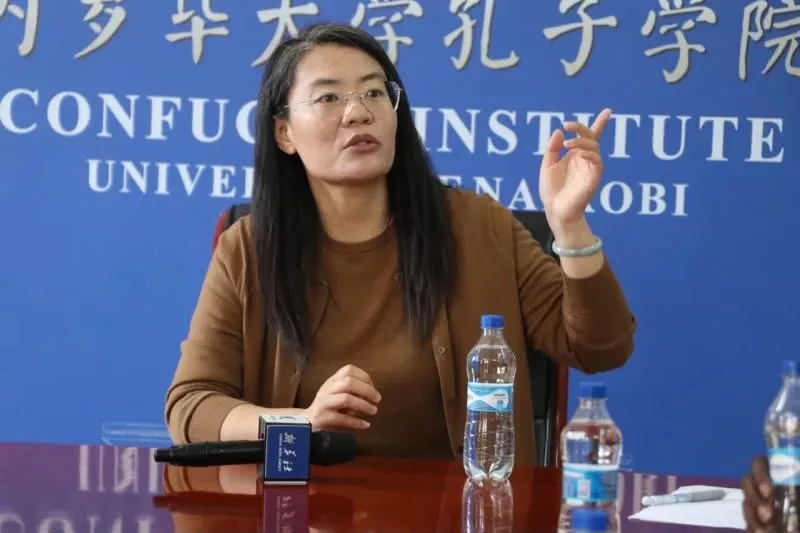
At the University of Nairobi, Achieng’s performance has also been welcomed by the Confucius Institute. Its director, Wang Shangxue, said the student’s performance exceeded expectations and demonstrated the ability of Kenyan students to master Chinese.
For Achieng, however, the global competition is only one chapter.
She wants to keep improving her Mandarin and find ways of combining it with her engineering career.
More importantly, she hopes her story will persuade other young Kenyans to take opportunities even when they do not feel ready.
After all, she nearly talked herself out of entering the competition.
She did not think her Chinese was good enough.
She did not think she could make the top 30.
She certainly did not expect to finish among the world’s top 15.
Sometimes, her story suggests, the first step towards an unexpected future is simply having the courage to apply.