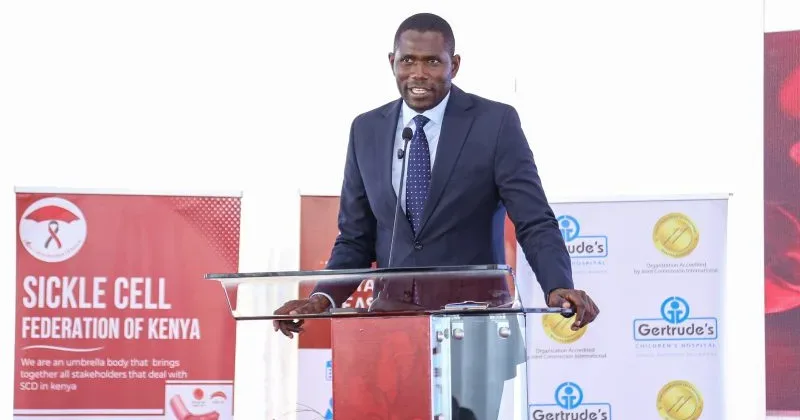
NAIROBI, Kenya, July 17 – Health Principal Secretary Dr. Ouma Oluga has challenged health stakeholders to urgently strengthen sickle cell disease care, warning that Kenya cannot continue relying on donor funding as international support declines.
Speaking at the Kenya Sickle Cell Disease Symposium in Nairobi, Dr. Oluga called for sickle cell treatment to be fully integrated into the Social Health Authority (SHA), saying the country must establish sustainable local financing to guarantee patients access to treatment without suffering financial hardship.
“We are better off building our own house. That house is the Social Health Authority,” Oluga said.
He urged stakeholders to act while there is political goodwill, citing both his medical background and personal experience with the disease.
“If you don’t solve the problems of sickle cell when I am Principal Secretary, I’m not so sure when you will ever solve them again. One is because I am personally affected—I have family members who have sickle cell—and secondly because I’m a physician, so I understand sickle cell very well,” he said.
Oluga said the government’s priority is to protect Kenyans from both illness and poverty by ensuring people do not have to sell assets to pay for treatment.
“One is that we protect Kenyans from financial ruin when they get sick, that people don’t go into poverty because of illness,” he said.
The symposium also heard calls for stronger government support from the American Society of Hematology (ASH) President Dr. Robert Negrin, who said coordinated policies are essential to improve care.
“ASH has been extraordinarily committed to the sickle cell disease community both in the US and across the globe,” Negrin said.
He said expanding access to screening, vaccinations, antibiotics, hydroxyurea and other supportive care would significantly improve patient outcomes, while noting that emerging gene therapies remain unaffordable for most patients.
“Now this has been demonstrated that this works, but it’s just too expensive. It’s just unavailable to most people with sickle cell disease,” he said.
Dr. Benard Awuonda, a sickle cell specialist from Kisumu, called for increased investment in newborn screening and consistent availability of essential medicines.
“We need to strengthen screening, especially newborn and infant screening. The Ministry of Health already has a policy framework in place, so we need ring-fenced funding for that process,” he said.
Awuonda also urged greater public awareness to combat stigma surrounding the disease.
“People need to know that it’s not a contagious condition, that it is a genetic condition… and that for a child to have sickle cell disease, the gene is inherited from both parents, not one parent,” he said.
Health experts say expanding screening, improving access to treatment and securing sustainable domestic financing could significantly improve care for people living with sickle cell disease across Kenya.