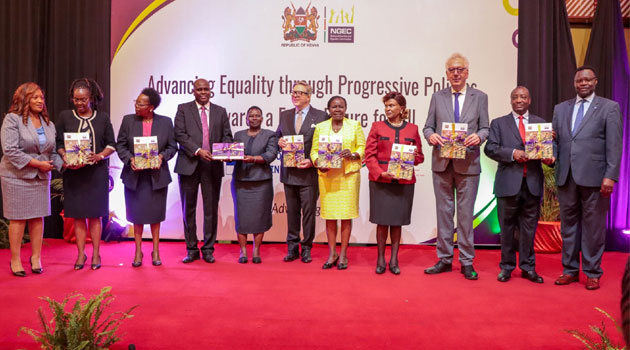
NAIROBI, Kenya, Jan 30 – The National Gender and Equality Commission (NGEC) successfully launched a series of crucial reports on Gender Equality and Social Inclusion in an event was graced by Cabinet Affairs Principal Secretary Dr Idris Salim.
The launch of the four reports are part of NGEC’s ongoing efforts to promote gender equality and freedom from discrimination.
They offer comprehensive policy recommendations, some of which have already been implemented, showcasing the Commission’s commitment to fostering a more inclusive society.
They include; the 2023 Inequality Diagnostics: Mind The Gap-Towards A More Equal Kenya, a National Inclusive Development Framework for Marginalized Communities in Kenya, The Status of Gender Equality and Inclusion in the Public Sector, 2023, and Model Gender Mainstreaming Policy for the Technical and Vocational Education and Training (TVET) Sector (With Elements of Inclusion), 2023.
Speaking at the launch, Dr Dakota, lauded NGEC on the launch of their reports that provide solutions that “address Gender Inequalities in the TVET sector, strategies for Inclusion of minority and marginalized groups in national development; and opportunities for accelerating gender mainstreaming in the public sector.”
Dr Dakota also highlighted specific areas where Kenya had excelled in improving livelihoods of Kenyans and taming major drivers of inequalities and outlined strategies for further improvement. “Notable achievements include the transformational agriculture initiatives, expansion of opportunities for decent work and job creation, comprehensive responses to climate change, and reforms in the Technical and Vocational Education and Training (TVET) sector,” he said.
In his address, Dr Dakota acknowledged challenges such as corruption, climate hazards, global competition, and weakening democracy, urging a collective effort from all stakeholders to mitigate these drivers of inequality.
He called for a stronger partnership between the government, private sector, citizens, and development partners to address these challenges.
NGEC expressed gratitude for the government’s openness to accountability and feedback, noting that the assessments provided valuable insights for shaping policies, resource allocation, and investment priorities.
The Commission also recognized government agencies and individuals who have excelled in promoting gender equality and social inclusion.
As part of the commitment to reducing inequalities, the government will seek to scale up efforts highlighted in the various reports.
He specifically mentioned the expectation that inequalities resulting from the not more than two-thirds gender rule would be addressed by the current Parliament.
The four reports were developed by NGEC in close collaboration with various stakeholders, with support from various development partners including the Republic of Finland, Federal Republic of Germany, United Kingdom and the World Bank.