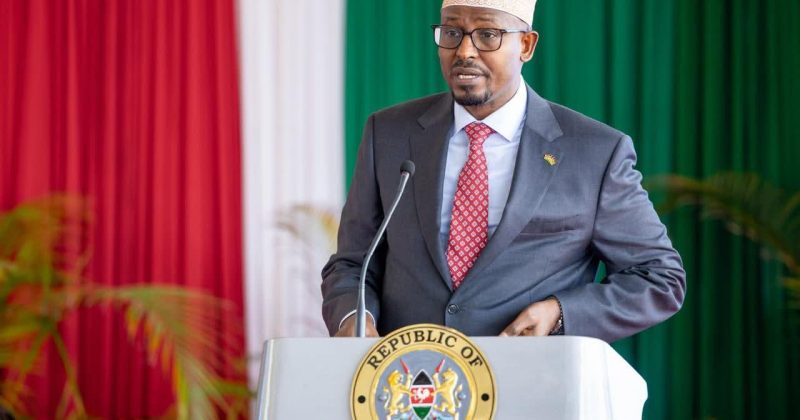
NAIROBI, Kenya, Jul 23 – Council of Governors (CoG) Chairperson Ahmed Abdullahi has accused the Ministry of Health of fuelling recurring health worker strikes by failing to honour funding and administrative agreements, insisting county governments are being unfairly blamed for disruptions in public healthcare.
Speaking during a media briefing on Thursday, the Wajir Governor said the Aden Duale-led ministry, alongside other national government agencies, had failed to implement key intergovernmental agreements, resulting in repeated industrial action by doctors and Universal Health Coverage (UHC) workers.
Abdullahi dismissed reports of a looming doctors’ strike, insisting county governments have no dispute with the Kenya Medical Practitioners, Pharmacists and Dentists Union (KMPDU).
“We have absolutely no issue with the KMPDU. Beginning August, we will start paying doctors the CBA rates as agreed,” he said.
He attributed delays in implementing the doctors’ Collective Bargaining Agreement (CBA) to a year-long wait for a special payroll code from the Ministry of Public Service, saying counties only recently received the clearance required to effect the revised salaries.
“We had no mechanism to pay. We were waiting for a special code from the Ministry of Public Service because this placed doctors above what the HR system could allow. We have just obtained it, and we will pay,” he said.
Abdullahi maintained that the delay was administrative rather than financial, arguing that counties could not process the enhanced salaries until the payroll system was updated.
The CoG chair also defended county governments over the ongoing nationwide strike by UHC workers, blaming the Ministry of Health for failing to honour agreements reached with counties on funding and implementation of the programme.
“If the national government respected all the agreements that we have had with respect to UHC, there would be no UHC worker out there demonstrating or striking,” he said.
“All we’re saying is, let every person keep their part of the bargain. Put this money where we’ve agreed it should be put, and we’ll pay the UHC workers.”
He urged striking UHC workers to pursue the dispute through established intergovernmental mechanisms rather than demonstrations.
“This matter can only be solved through the intergovernmental architecture. It cannot be resolved through demonstrations in the streets,” he said.
Abdullahi also rejected renewed calls to return healthcare services to the national government, arguing that health is a constitutionally devolved function and can only be recentralised through a referendum.
“The solution is not to return health to the national government. In any case, the national government hospitals are not run any better than county hospitals. KNH is not under county governments,” he said.
“To take health back to the national government requires a referendum. It is Kenyans who can do that, not us.”
His remarks come as thousands of UHC workers continue a nationwide strike, with the Health Unions Caucus maintaining that county governments have failed to transition workers to permanent and pensionable terms despite Parliament allocating Sh8.9 billion for the exercise.
Earlier, Health Unions Caucus Chairperson Peterson Wachira accused governors of failing to implement court orders and agreements governing the workers’ employment.
“Despite ourselves having demonstrated for more than six months and gotten a budgetary allocation of Sh8.9 billion to confirm the Universal Health Coverage staff on permanent and pensionable terms, the governors have refused to do so,” Wachira said.
He argued that County Public Service Boards bear responsibility for implementing the transition, insisting the strike was directed at county governments rather than the national administration.
“This is a strike against neglect and inaction by county governments on what they should do,” he said.
CoG’s stance comes amid renewed hostility between county governments and health unions over responsibility for recurring labour unrest, with each side accusing the other of frustrating implementation of agreements intended to stabilise the health sector.
The latest dispute comes after months of turbulent relations between the Council of Governors and KMPDU over labour disputes in county health facilities.
KMPDU slams CoG’s ‘heartless’ denial of infant deaths in Kiambu
KMPDU plots Wamatangi ouster as Kiambu health crisis deepens, asks Ruto to step in
KMPDU calls off Kiambu doctors’ strike in CoG deal unlocking June, October salaries
During last year’s prolonged Kiambu doctors’ strike, the union accused governors of failing to honour agreements, called on President William Ruto to dissolve the Kiambu County Government and threatened nationwide industrial action.
The standoff escalated further after KMPDU accused the Council of Governors of downplaying reports of infant deaths linked to the disruption of healthcare services in Kiambu, describing the governors’ response as insensitive and demanding an independent investigation.
Relations later thawed after the Council of Governors brokered a settlement that ended the 151-day Kiambu doctors’ strike, paving the way for payment of salary arrears, implementation of agreed employment terms and a commitment by both county governments and the union to resolve disputes through dialogue.
Abdullahi cited that experience to argue that counties remain committed to working with KMPDU, maintaining that the remaining obstacles now lie in unresolved intergovernmental issues, particularly implementation of doctors’ CBAs and financing of UHC workers.
He urged the national government to honour agreements reached with counties, saying sustained cooperation—not confrontation—is the only way to avert further disruption to healthcare services.