NINGZIA, China, Jul 11 – China’s Poverty Alleviation Model Offers Lessons for the Global South
YINCHUAN, China, Jul 11 – China’s success in lifting nearly 800 million people out of poverty over the past four decades is increasingly being cited as a model that developing countries can study as they pursue their own paths to modernization and shared prosperity.
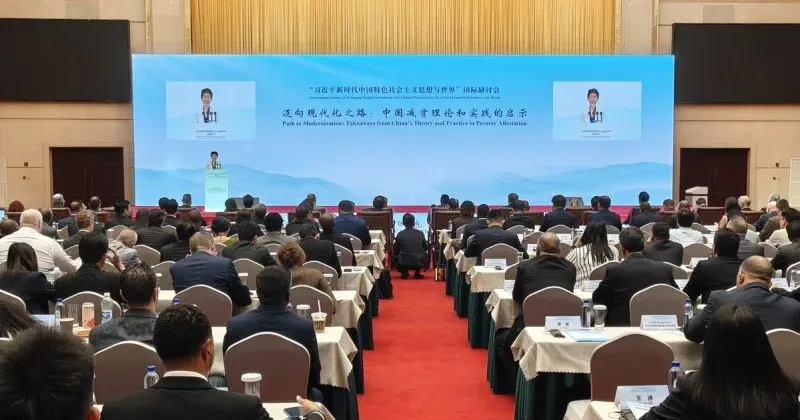
This emerged during the International Seminar on Xi Jinping Thought on Socialism with Chinese Characteristics for a New Era held in Yinchuan City, Ningxia Hui Autonomous Region, under the theme “Path to Modernization: Takeaways from China’s Theory and Practice in Poverty Alleviation.”
The seminar brought together scholars, policymakers and political leaders from Asia, Africa and Latin America, many of whom described China’s poverty reduction campaign as one of the most significant development achievements in modern history.
According to experts at the forum, China has eliminated absolute poverty and lifted approximately 800 million people out of destitution, accounting for about 75 percent of global poverty reduction over the same period.
China’s achievement has been widely recognized as unprecedented in scale and speed. It demonstrates how a large and populous developing country can eliminate extreme poverty through sustained policy implementation, targeted interventions and long-term planning.
Professor Peter Kagwanja, President and Chief Executive of the Africa Policy Institute (API), said China’s victory over absolute poverty demonstrates that other developing countries in the Global South can also overcome seemingly insurmountable development challenges.
“China’s story of victory over absolute poverty shows that other developing countries in the Global South can also eliminate poverty,” Kagwanja said.
He noted that when President Xi Jinping assumed leadership in 2012, China had already lifted more than 700 million people out of poverty through reforms initiated in 1978. However, nearly 100 million people still lived in poverty, while thousands of villages lacked basic infrastructure.
At the time, nearly 100,000 villages were not connected by paved roads, some 4,000 villages had no electricity, and an estimated 8.3 percent of rural households still lived in grass-thatched mud houses with limited access to markets.
“Xi had to lead the country to lift 10 million people out of poverty every year or 20 people every minute. It was a Herculean task by any measure,” Kagwanja said.
According to Kagwanja, China’s final push against poverty targeted 14 impoverished regions, 832 poor counties and 128,000 villages through a highly focused strategy that combined infrastructure development, social support and economic empowerment.
The campaign succeeded in lifting 98.99 million rural residents out of extreme poverty by the end of 2020.
He noted that more than 1,800 officials and workers lost their lives while serving on the frontlines of China’s poverty eradication campaign, underscoring the scale and sacrifice involved in the effort.
Kagwanja said Africa could benefit from China’s poverty alleviation experience through deeper cooperation under initiatives such as the Belt and Road Initiative, the Silk Road Fund and the Global Development Initiative.
He also called for greater Africa-China collaboration through the G20 Global Alliance Against Hunger and Poverty, particularly in areas such as infrastructure development, rural transformation, industrialization and job creation.
Vice Minister Sun Haiyan of the International Department of the Communist Party of China (CPC) Central Committee said poverty alleviation remains central to President Xi’s vision of shared prosperity.
“President Xi is committed to ensuring everyone is lifted out of poverty in China,” she said.
She added that the seminar reflected the CPC’s commitment to improving livelihoods, promoting common development and sharing China’s development experiences with other countries.
Participants from across Asia pointed to China’s targeted approach as one of the key lessons other nations can learn from.
Sophia Apaeva, Dean of the Kyrgyz-Chinese Research Institute at Kyrgyz National University, said China’s experience had shown that even the most complex development challenges could be overcome through effective governance and long-term planning.
“China has proven to the world that even the most complex challenges can be solved,” she said.
Apaeva attributed part of China’s success to what she described as a clear chain of command within the CPC that extends from the national leadership to local communities and villages.
“This has succeeded through the CPC’s clear chain of command down to the villages,” she said, noting that local economic development continues to play a central role in sustaining poverty reduction gains.
From Nepal, Gopal Khanal, a member of the Department of Foreign Affairs of the Communist Party of Nepal (Unified Marxist-Leninist), described China’s achievement as evidence of the importance of strong political leadership and policy consistency.
“The CPC, through Xi Jinping Thought, has won the biggest challenge of alleviating poverty across the country and with that China has achieved the goal,” Khanal said.
“There is a lot countries can learn from China’s experience. It is a testament that strong political leadership will always win.”
Khanal said one of the most important lessons from China was the emphasis placed on infrastructure development as the foundation for poverty reduction.
“What we learn from here is targeted poverty alleviation. The CPC was clear in its strategy that for the war on poverty to be won, it had to start with fixing infrastructure,” he said.
Cambodian scholar Chea Munyrith, President of the Cambodian Chinese Evolution Researchers Association, said China’s development model had gained considerable attention in his country.
“Xi Jinping Thought is famous in Cambodia, where the Chinese example and model has a universal application,” he said.
Munyrith noted that Cambodia has established Chinese model villages inspired by China’s rural development experience.
“I met Xi Jinping when he served as vice president and what he told us then was his commitment to eliminate absolute poverty. Today, it is remarkable to see that happening,” he said.
Lebanese scholar Adham Sayed, Coordinator of Asian Affairs at the Arab Left Forum, said China’s development journey demonstrated the importance of putting people at the center of policymaking.
“CPC has put the people first,” he said, adding that improvements in living standards and the growth of China’s middle-income population reflected the success of that approach.
Professor Li Xiaoyun of China Agricultural University said poverty eradication had been elevated to a major political objective under the CPC, supported by clear policies aimed at improving people’s livelihoods.
He noted that expanding market access and creating economic opportunities in rural areas had played a critical role in helping communities escape poverty.
“Transfer of market opportunities worked well,” Li said.
Zimbabwean Senate President and Political Bureau Member of the Zimbabwe African National Union-Patriotic Front (ZANU-PF), Mabel Memory Chinomona, said one of the most impressive aspects of China’s poverty reduction strategy was its holistic and long-term approach.
She cited Ningxia’s transformation from one of China’s poorest regions into a growing center of economic activity as evidence that poverty alleviation can be achieved through sustained commitment and coordinated development efforts.
“The transformation of once impoverished communities into thriving centers of economic activity stands as a testament to the Communist Party of China’s visionary leadership, sound policy implementation and the unwavering commitment to improving the lives of the people,” Chinomona said.
She particularly praised President Xi Jinping’s role in advancing targeted poverty alleviation and promoting regional cooperation through China’s paired assistance strategy.
“We particularly commend the leadership and commitment of Xi Jinping, general secretary of the CPC Central Committee, whose vision and guidance have been instrumental in advancing China’s targeted poverty alleviation, particularly through the implementation of the paired assistance strategy,” she said.
The programme, launched in 1996, pairs more developed eastern regions of China with less developed western provinces to accelerate development through investment, expertise sharing and institutional support.
Ningxia has become one of the most notable examples of the initiative’s success.
When Xi served as a senior official in Fujian Province, he oversaw cooperation between Fujian and Ningxia, helping establish mechanisms for consultations, investment partnerships and exchanges of government officials.
The programme contributed significantly to Ningxia’s poverty reduction efforts, with all 803,000 people previously classified as impoverished in the region lifted out of poverty by 2020.
Delegates said the Ningxia experience demonstrated how long-term planning, institutional coordination and targeted interventions could produce transformative development outcomes.
Moroccan Deputy Speaker of Parliament Mohammed Ouzzine highlighted the concept of “targeted poverty alleviation” championed by Xi, describing it as one of the defining features of China’s success.
He said the approach emphasized tailoring policies to local conditions, accurately identifying poor households and ensuring resources reached those most in need.
“The Chinese experience has demonstrated that strong political will, correct theoretical guidance, precise operational mechanisms and broad social mobilization are key approaches to eradicating poverty,” Ouzzine said.
Ghulom Halimzoda, chairman of the Socialist Party of Tajikistan, said the most important lesson from China’s experience was not simply the level of resources invested but the consistency of policies and the people-centered philosophy guiding implementation.
“The core lesson from China’s experience in poverty alleviation is the continuity of policies, the governance capacity to coordinate and mobilize various forces and, most importantly, the people-centered development philosophy,” he said.
For many participants, China’s poverty reduction story is not simply about economic growth but about the ability of a country to combine political will, targeted policies, infrastructure development and long-term planning to improve the lives of millions of people.
As China enters a new phase of high-quality development, delegates said its experience in eliminating absolute poverty offers valuable lessons for countries across the Global South seeking inclusive growth and modernization.
While acknowledging that each nation must pursue development according to its own circumstances, participants agreed that China’s experience demonstrates how strong political commitment, effective governance and people-centered policies can be deployed to tackle one of humanity’s oldest challenges — poverty.
For many attending the seminar in Ningxia, the story of China’s poverty alleviation journey is no longer simply a Chinese success story, but an increasingly global reference point in the search for sustainable development and shared prosperity.