NAIROBI, Kenya, Oct 15 — The A3 bloc at the United Nations Security Council comprising African States has lauded Kenya-led Pan-African peace efforts in Colombia and Haiti which continue to suffer conflicts.
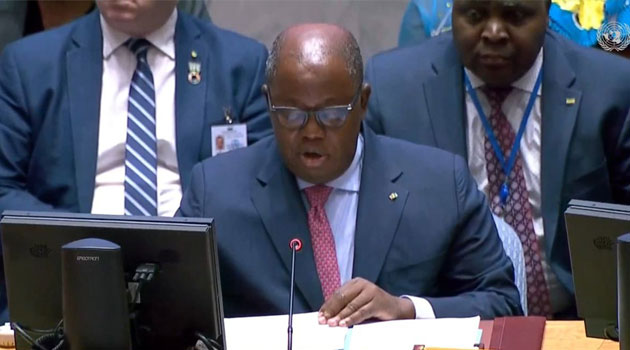
In a key moment for Kenya’s diplomacy and foreign policy, Michael Moussa-Adamo, Gabon’s Minister for Foreign Affairs, noted the critical role Kenya has played in fostering Pan-African solidarity in the operations of the Security Council.
He was speaking on behalf of the A3 (Gabon, Ghana, and Kenya) in the council during a Quarterly Open Briefing on Colombia and its peace process.
Ambassador Macharia Kamau, Principal Secretary, Ministry of Foreign Affairs noted in a statement that since joining the Security Council in January 2021 for a two-year term, Kenya has been advocating for security, dignity and prosperity of all African peoples, including the worldwide diaspora.
Colombia and Haiti are the countries whose conflict situations are under the purview of the Security Council.
Colombia in particular, is in the process of consolidating a peace process following a decades-long civil war, Amb Kamau noted.
Colombia’s interaction with the Security Council, according to PS Kamau, is a vital component in the legitimization and entrenchment of the peace agreement.
From its first participation in a Colombia briefing, the Kenyan delegation in New York sought to promote inclusivity as a fundamental pillar upon which to forge peace.
Kenya’s consistent advocacy for Colombia’s need to prioritize the implementation of the Ethnic Chapter of its Final Peace Agreement encouraged several delegations in the Council to adopt the same stance.
Kenya’s argument was further bolstered by its signature event during its October 2021 Presidency of the Council.
The open debate, held at Head of State level according to PS Kamau was ‘Diversity, State-building and the Search for Peace’.
It called on the Council to explore the relationship between real or perceived marginalization and exclusion of identity groups as one of the primary drivers of violent conflict.
Kenya argued that reconciling identity differences in a way that is inclusive, fair and equitable way is crucial for effective state building and the pursuit for peace.
This was the argument advanced by the A3 during the Wednesday, October 12th briefing on Colombia.
This time, following the recent electoral victory of President Gustavo PETRO and Vice President Francia Marquez, the Colombian government has a new impetus to embrace the Ethnic Chapter and the deeper inclusion of Afro-Colombian and indigenous communities.
The Security Council was addressed by Álvaro Leyva Duran, Colombia’s Minister of Foreign Affairs.
He argued that the peace accord specifically addresses the suffering of ethnic people who he said have been “dispossessed of their territory and resources as a result of “colonialism, slavery, and exclusion.”
Duran further acknowledged the government’s responsibility to ensure the “full exercise of their collective rights, based on the principle of non-regression and self-determination.”
PS Kamau said that Kenya demonstrated why it “has built a reputation as a principled actor on the global stage giving voice to those who are most vulnerable” through its engagement with the situation in Colombia.
The background of the peace is a protracted conflict that pitted the Colombian Government against the Revolutionary Armed Forces of Colombia (FARC), and other guerrilla groups such as the National Liberation Army (ELN) and the Popular Liberation Army (EPL).
In 2016, the Colombian government signed a historic peace deal called the Final Peace Agreement, which places emphasis on the fundamental rights of different groups such as indigenous peoples as well as communities of African descent.
Kenya has been pushing for the International Community and the UN to do more for Haiti.
To lead by example, last October, Kenya pledged 2,000 places in its governmental training institutions to Haitians.
“This was based on an awareness that strengthening the competence of the state is key to the country recovering from its security, economic and environmental challenges. Kenya is now at the forefront of seeking greater Security Council support for Haiti’s beleaguered police force,” he added