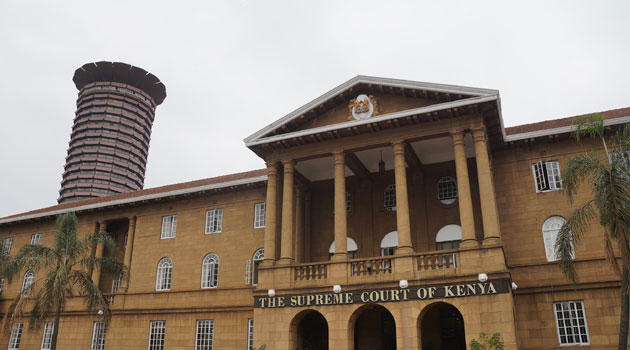
NAIROBI, Kenya Jun 19 – The Supreme Court has dealt a major blow to anti-corruption and asset recovery agencies after dismissing an appeal seeking the forfeiture of nearly Sh20 million held in bank accounts belonging to a woman accused of laundering bribe proceeds allegedly received by her husband.
The seven-judge bench upheld an earlier Court of Appeal decision and ruled that the Ethics and Anti-Corruption Commission (EACC) and the Assets Recovery Agency (ARA) failed to establish a sufficient connection between the funds and any criminal activity, a requirement for forfeiture under the Proceeds of Crime and Anti-Money Laundering Act (POCAMLA).
The case revolved around Sh19.7 million held in bank accounts belonging to Pamela Aboo, whose husband, a former Kenya Revenue Authority (KRA) declaration officer, had been suspected of receiving bribes from importers and clearing agents.
Investigators argued that the money deposited into Ms Aboo’s accounts constituted proceeds of corruption and that she had acted as a conduit through which illicit funds were concealed and laundered.
The agencies pointed to what they described as suspicious banking patterns, including frequent cash deposits made in Mombasa and Embakasi, key centres for import and cargo clearance operations. They further argued that the deposits involved unusually large sums and that Ms Aboo had failed to provide adequate documentary evidence to support her claim that the money originated from legitimate business activities.
The Assets Recovery Agency had successfully obtained forfeiture orders in the High Court, which found that Ms Aboo had failed to satisfactorily explain the source of the funds.
However, the Court of Appeal overturned the decision, holding that investigators had not demonstrated a direct nexus between the money and any criminal conduct.
Dissatisfied with the appellate court’s findings, EACC and ARA moved to the Supreme Court, arguing that civil forfeiture proceedings target property rather than individuals and therefore do not require proof of a specific crime or conviction.
The agencies maintained that once they demonstrated that the funds were suspicious and likely to have originated from unlawful conduct, the burden shifted to Ms Aboo to prove their legitimate source.
They warned that requiring investigators to establish a direct connection between property and a specific offence would undermine efforts to recover proceeds of corruption, money laundering and organised crime.
But the Supreme Court rejected that argument.
In a detailed analysis of the Proceeds of Crime and Anti-Money Laundering Act, the court held that the existence of criminal conduct remains central to forfeiture proceedings and that investigators must place before the court credible evidence linking targeted property to crime.
The judges stated that forfeiture orders can only be issued where property has been used in the commission of an offence, is intended for such use, or constitutes proceeds of crime.
“A reading of the provisions leaves no doubt that an order for forfeiture under POCAMLA can only be made against property which, in one way or another, is associated with the commission of a crime, or is a proceed of crime,” the court said.
The judges emphasized that although forfeiture proceedings are civil in nature and do not require a criminal conviction, anti-corruption agencies cannot merely rely on suspicion or unexplained wealth to recover assets.
“The incidence of crime remains central to such forfeiture proceedings,” the court added.
The Supreme Court also clarified a key distinction between forfeiture proceedings under POCAMLA and recovery of unexplained assets under the Anti-Corruption and Economic Crimes Act (ACECA).
Under ACECA, EACC can seek recovery of assets that are disproportionate to a person’s known lawful income without necessarily proving a specific act of corruption.
However, under POCAMLA, the court said, authorities must establish a connection between the property and criminal conduct before seeking forfeiture.
The judges observed that while the burden of proof may shift to a respondent once investigators establish a credible case, that shift can only occur after the State has first discharged its initial evidentiary burden.
“The Agency must place before the court credible evidence that satisfies the crucial ingredients of the law,” the court held.
The ruling also addressed a broader question that has frequently arisen in asset recovery cases,whether a person can be compelled to explain the source of their wealth merely because investigators suspect wrongdoing.
The court held that while an individual may be required to account for the source of assets once a prima facie case has been established, investigators cannot avoid their duty to prove a link between the property and criminal activity.
Applying those principles to the case before it, the Supreme Court found that EACC and ARA had not presented sufficient evidence connecting the Sh19.7 million to bribery, corruption or any other criminal offence.
The judges therefore upheld the Court of Appeal’s decision and dismissed the appeal.
The judgment is expected to significantly shape future asset recovery litigation in Kenya by clarifying the evidentiary threshold required in civil forfeiture proceedings.
The ruling strengthens constitutional protections against arbitrary deprivation of property while simultaneously setting clearer guidelines for anti-corruption agencies seeking to recover suspected proceeds of crime.
For EACC and ARA, the decision represents a major setback in a case they had argued was crucial to combating increasingly sophisticated money laundering schemes where illicit funds are often concealed through relatives, associates and third-party accounts.