NAIROBI, Kenya, August 27 – The Public Service Superannuation Fund has sharply reduced its reliance on government securities as it seeks higher returns from equities and other investments, with its assets rising to Sh340.4 billion.
Government securities, which accounted for 99 per cent of the Fund’s portfolio in 2023, now make up 74 per cent, according to figures released by the pension administrator.
The shift has seen quoted equities emerge as the second-largest asset class at 14 per cent, while corporate bonds account for five per cent. Offshore investments make up three per cent, private equity two per cent and property one per cent.
The change marks a significant departure for a fund that was previously almost entirely invested in government debt, exposing it to a narrower range of investment opportunities.
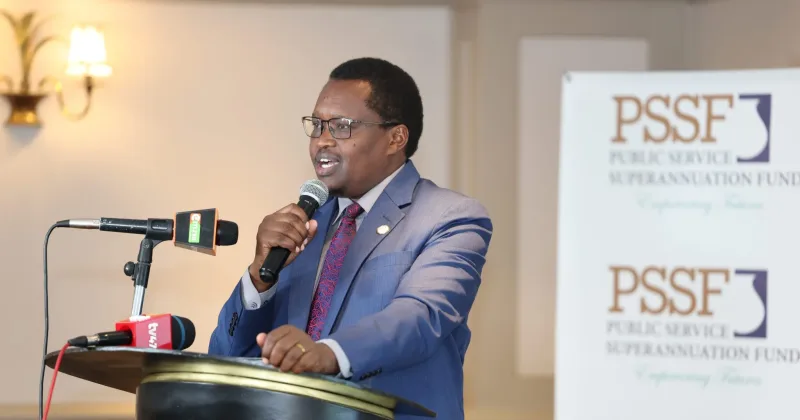
PSSF chief executive officer Jonah Aiyabei said the diversification was intended to balance risk, liquidity and returns.
“The diversification of the Fund’s portfolio is part of our strategy to balance safety, liquidity and returns while safeguarding members’ retirement savings over the long term,” Dr Aiyabei said at a media roundtable in Nairobi on Thursday.
The move into equities comes as pension funds increasingly look beyond government securities amid the need to generate returns that preserve the value of members’ savings over long investment periods.
PSSF said its assets under management had grown to Sh340.4 billion by June 30, 2026, from a membership base of 529,635.
The Fund began operations in January 2021 following reforms to the public service pension system, which introduced mandatory contributions by employees and the Government.
Employees contribute 7.5 per cent of their basic pay to the scheme, while the Government contributes 15 per cent.
Returns rise
The Fund reported a 17.68 per cent investment return for the 12 months to June 30, 2025, while its annualised return over three years was 19.7 per cent.
But the investment return should not be confused with the amount credited to individual members.
The Board of Trustees approved a 17.89 per cent income distribution to members for the year ended June 2025, compared with 11.9 per cent the previous year.
The difference between the two figures reflects the fact that a pension fund’s overall investment return and the rate ultimately credited to members are separate measures.
Aiyabei attributed the improvement partly to the recovery in financial markets, including gains recorded by listed banking and telecommunications companies.
PSSF said it had met its investment objective of generating returns equivalent to inflation plus four percentage points over both the one-year and three-year periods.
The performance, however, comes against a backdrop of significant changes in the domestic investment environment, including fluctuations in government bond yields and movements in the Nairobi Securities Exchange.
Teachers dominate membership
The Fund’s membership has increased from 330,318 when it started operations to 529,635 as at June 30, 2026.
Teachers make up the largest group, with 332,950 members, followed by disciplined services at 120,084.
Civil servants account for 60,322 members, while county governments have 16,279.
The large teacher membership reflects the scale of the Teachers Service Commission workforce within the public sector, while the disciplined services category covers the National Police Service, Kenya Prisons Service and National Youth Service.
New entrants to the public service are automatically enrolled in the scheme.
Concentration risk
Despite the diversification, government securities remain by far the largest component of the portfolio, accounting for nearly three-quarters of PSSF investments.
This means the Fund remains substantially exposed to the Government’s borrowing programme and the performance of the domestic fixed-income market.
The increased equity allocation introduces the potential for higher long-term returns but also exposes members’ retirement savings to market volatility.
PSSF said its asset allocation is monitored against limits set by the Retirement Benefits Authority and the ranges contained in its investment policy.
Its investment performance is also independently reviewed, according to the Fund.
The growth of PSSF comes five years after the Government replaced the previous non-contributory pension arrangement for new public servants with a contributory scheme.
The Fund now describes itself as Kenya’s second-largest pension scheme by assets.
Its expansion also places greater importance on how it manages the growing pool of public servants’ retirement savings, particularly as it moves into investments carrying different levels of risk.
The Fund is expected to discuss pension investment, policy and retirement security at its second Pan-African Pensions Conference scheduled for November 18-20 in Mombasa.