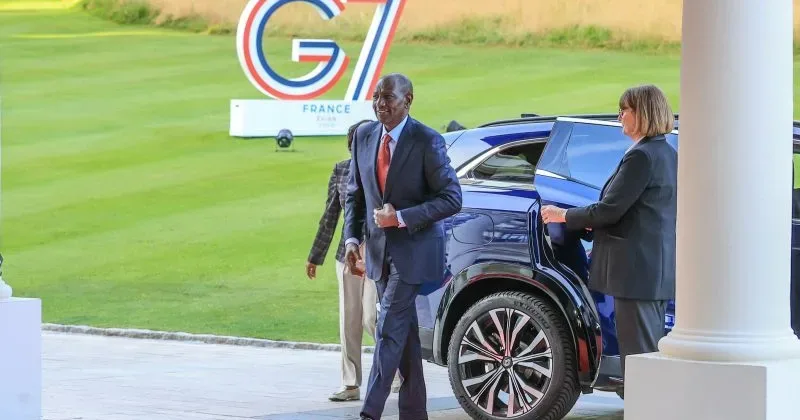
EVIAN, France, June 16 — President William Ruto has called for greater inclusion of Africa in the reform of international financial and governance institutions, saying the current global system no longer reflects modern realities and must evolve to serve all nations fairly.
Speaking during a media interview on the sidelines of the G7 Summit in Evian, France, President Ruto said institutions such as the United Nations Security Council, the International Monetary Fund (IMF) and the World Bank require democratic reforms to ensure equal representation and fairness.
“We are not asking for special treatment as Africa, but there must be equal treatment,” President Ruto said.
The President noted that Africa was excluded from the table when many global financial and governance institutions were established following the Second World War in 1945, arguing that the continent must now play a central role in shaping future systems of global cooperation and development.
“As the African continent, we need a new paradigm shift with our partners. We need a new relationship and a new engagement,” he said.
Ruto stressed that Africa is no longer a passive observer in global affairs but an active participant whose voice should be included in key international decisions.
He warned that fragmented responses to global challenges would only deepen instability, insisting that the international system must become more inclusive, representative and accountable.
The President expressed confidence that discussions at the G7 Summit would help advance reforms at the United Nations Security Council to make it more democratic and reflective of contemporary global realities.
“This meeting will be an opportunity for Africa to have a forthright and candid conversation with our partners,” he said, adding that the “UN must not be run by an administrator but by a reformer”.
At the same time, President Ruto described Africa as a major driver of future global prosperity, citing the continent’s vast natural resources, mineral wealth, arable land and untapped renewable energy potential.
He projected that by 2050, Africa would account for 40 per cent of the world’s workforce and 25 per cent of the global population, positioning the continent as both a major labour force and an expanding consumer market.
President Ruto outlined three priority areas that he said must be addressed to unlock Africa’s economic potential.
First, he said African countries need greater access to concessional development financing to support economic growth and infrastructure development.
Second, the President criticised the high borrowing costs imposed on African economies by international financial institutions, saying the continent continues to face unfair lending terms compared to other regions.
“We must also sort out the problem of global rating agencies exaggerating Africa’s risk yet the continent is not as risky as they want the world to believe,” he said.
Third, President Ruto called for Africa’s inclusion in global conversations on emerging technologies, particularly artificial intelligence, saying the continent must actively participate in shaping how technology is used to drive economies and development.
The President’s remarks come amid growing calls by African leaders for reforms to global governance structures to better reflect the changing geopolitical and economic landscape.