For more than four decades, China’s economic ascent has been defined by its remarkable capacity for reinvention. Today, that story is entering an exciting new chapter, powered not by cheap labour and vast infrastructure alone, but by artificial intelligence, advanced semiconductors, new energy systems, industrial robotics, commercial aerospace and a constellation of emerging industries reshaping the country’s productive landscape.
These “new quality productive forces” are increasingly becoming a powerful engine of China’s economic transformation, with their impact now visible across manufacturing, investment, employment and technological innovation.
Consider manufacturing, the bedrock of China’s industrial strength. In the first seven months of 2026, the new economy, including high-tech manufacturing and digital product manufacturing, contributed 50.9 per cent of total growth in industrial value added. The figure points to an important structural shift: new industries are assuming an increasingly prominent role in driving growth.
As Peking University economist Professor Su Jian has observed, the upward trajectory reflects the accelerating rise of new growth drivers. The scale of high-tech manufacturing is itself expanding rapidly. In the first half of 2026, high-tech manufacturing value added rose by 13.3 per cent year on year, significantly faster than the growth of overall industrial output. By July, growth had climbed to 16.9 per cent.
The transformation is both broad-based and profound.
Aerospace equipment manufacturing grew by 16.3 per cent, while electronic communications equipment rose by 17 per cent. AI-related industries maintained growth rates exceeding 30 per cent.
These figures tell a larger story about the direction of China’s economy. Manufacturing is moving steadily towards the middle and higher end of the global industrial and value chains. The change is not merely about producing more. It is increasingly about producing smarter, more sophisticated and higher-value products.
Artificial intelligence has emerged as one of the most dynamic forces behind this transformation.
China’s AI core industry surpassed 1.2 trillion yuan, or approximately US$177 billion, in 2025, with growth expected to remain strong in 2026. The technology is increasingly being integrated into major industries, while more than 6,200 AI enterprises are now operating across the country.
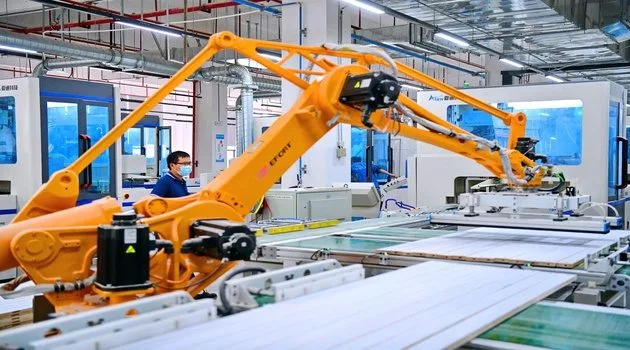
The impact on manufacturing is particularly significant. China has developed more than 56,000 foundational-level smart factories and 15 leading smart factories operating at the frontier of industrial intelligence. These facilities are helping demonstrate how AI can improve productivity, reduce costs and transform traditional production systems.
Beyond AI, China’s technological advance spans a wide range of emerging industries.
Output growth in integrated circuits, industrial robotics and 3D printing equipment has consistently exceeded 20 per cent, while lithium-ion battery production has surged by more than 40 per cent.
The new energy vehicle industry has also reached a significant milestone. Production and sales both exceeded seven million units in the first half of the year, while the retail penetration rate remained above 60 per cent for three consecutive months.
Commercial aerospace is equally beginning to capture attention. The C919 large passenger aircraft has accumulated 41 deliveries and more than 130,000 hours of safe flight. Meanwhile, China’s commercial aerospace core industry is projected to grow substantially over the coming years.
The financial indicators reinforce the strength of this technological transformation.
High-tech industry investment grew by five per cent between January and July. Investment in electronic circuit manufacturing jumped by nearly 51 per cent, while lithium-ion battery investment rose by almost 25 per cent and integrated circuit manufacturing investment increased by 11 per cent.
Foreign investors are also taking notice.
High-tech industries attracted 182.3 billion yuan, or approximately US$26.9 billion, in actual foreign investment during the first seven months of the year. That represented year-on-year growth of 32.7 per cent and accounted for 41.6 per cent of total foreign investment.
Corporate profits provide further evidence that the transition towards new quality productive forces is generating tangible economic returns.
High-tech manufacturing profits surged by 50.1 per cent year on year, contributing 9.6 percentage points to overall industrial profit growth. Optical fibre manufacturing recorded particularly strong gains, while computer manufacturing and the wider electronics sector also posted impressive profit growth.
This matters because innovation must ultimately translate into real economic value.
China’s technological transformation is not simply producing impressive laboratory breakthroughs or ambitious policy targets. It is creating profitable companies, expanding industrial capacity and generating new opportunities across the economy.
Perhaps even more importantly, the benefits are beginning to reach workers and communities.
In the fast-growing electronics and power equipment sectors, employee wage increases have exceeded nine per cent, significantly outpacing the three per cent average across all listed companies.
In cities such as Suzhou, a major centre of China’s information industry, the economic spillover is increasingly visible. As incomes rise, consumer spending is also expanding, supporting businesses in retail, catering, accommodation and other services.
This demonstrates an important principle: technological advancement can generate benefits far beyond the industries directly involved in innovation.
The transformation is also creating millions of high-quality jobs, while public computing platforms and training programmes are helping workers acquire the skills needed for a rapidly changing economy.
The challenge, of course, is to ensure that technological progress remains inclusive and that workers are equipped to thrive alongside new technologies. China’s continued investment in skills, digital infrastructure and industrial upgrading will therefore be as important as the technologies themselves.
What is increasingly clear, however, is that China is building new foundations for long-term growth.
The country’s economic story is evolving from one driven primarily by low-cost manufacturing and infrastructure investment to one increasingly powered by innovation, advanced technology and higher-value production.
The rise of artificial intelligence, robotics, semiconductors, new energy and commercial aerospace is no longer a distant ambition. It is becoming the living reality of today’s China.
In the global race for technological leadership, the competition is intensifying. But China’s rapid development of new quality productive forces demonstrates that its next phase of growth will not simply be measured by how fast the economy expands.
It will increasingly be defined by how intelligently, efficiently and innovatively it grows.
That may well prove to be the most important chapter yet in China’s extraordinary economic story.