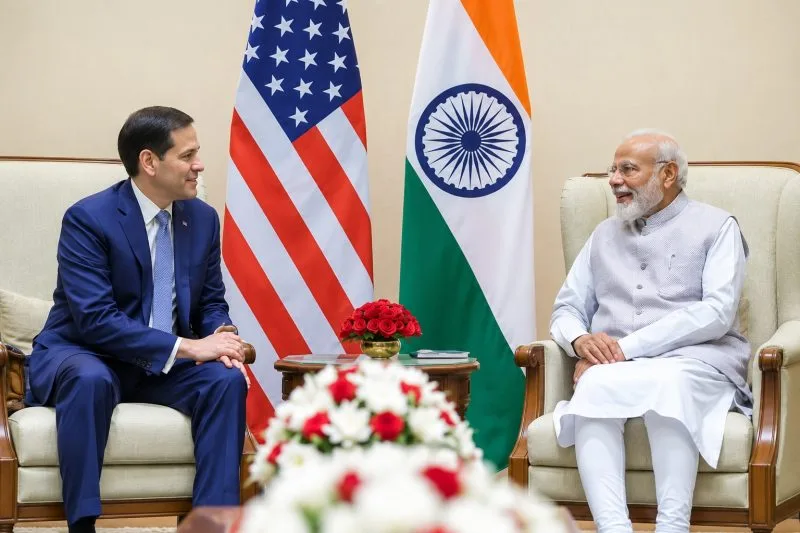
NEW DELHI, June 17 – Relations between India and the United States are entering a new phase of strategic cooperation, with both countries deepening engagement across trade, defence, technology, energy security and critical minerals, following the recent visit by US Secretary of State Marco Rubio.
Rubio’s visit to India from May 23 to 26, his first since assuming office, underscored Washington’s growing recognition of India’s role in shaping the balance of power in the Indo-Pacific amid rising geopolitical competition and shifting global supply chains.
The visit also coincided with the Quad Foreign Ministers’ Meeting in New Delhi, where officials from India, the United States, Japan and Australia reaffirmed their commitment to a stable and prosperous Indo-Pacific region.
Analysts say the renewed diplomatic engagement reflects the steady evolution of India-US relations over the past two decades from cautious cooperation to one of the world’s most significant strategic partnerships, anchored on shared democratic values, economic interests and security priorities.
A major outcome of the visit was renewed commitment to the “Mission 500” initiative, which aims to increase bilateral trade in goods and services to $500 billion by 2030.
Trade between the two countries has expanded steadily in recent years. India’s exports to the United States rose from $76.17 billion in the 2021-22 financial year to $87.32 billion in 2025-26, while imports from the US increased from $43.31 billion to $53.49 billion over the same period. Total merchandise trade reached $140.8 billion in 2025-26, with overall bilateral trade, including services, estimated at between $225 billion and $235 billion.
Both governments are also pursuing a broader trade agreement aimed at improving market access, boosting investment and strengthening supply chains.
Another key development was the signing of the India-US Framework for Securing the Supply of Critical Minerals and Rare Earths, designed to enhance cooperation in mining, processing, recycling and investment in minerals essential for electric vehicles, renewable energy technologies, semiconductors and defence systems.
The initiative complements the newly launched Quad Critical Minerals Initiative, which seeks to diversify global supply chains and reduce reliance on concentrated sources of critical materials.
Defence cooperation also featured prominently during the visit. India and the United States renewed their 10-year Major Defence Partnership Framework Agreement and signed an Underwater Domain Awareness Roadmap aimed at strengthening maritime security cooperation, intelligence sharing and surveillance capabilities.
The agreements are expected to support India’s ambitions to expand domestic defence manufacturing through technology transfers, co-development and co-production initiatives.
Energy security was another focus area, particularly amid concerns about potential disruptions in the Strait of Hormuz, a key route for global energy supplies. The Quad countries launched the Quad Initiative on Indo-Pacific Energy Security to strengthen cooperation on energy technologies, policy coordination and emergency response mechanisms.
The United States also reaffirmed its role as a major supplier of crude oil and liquefied natural gas to India as New Delhi seeks to diversify its energy sources and enhance long-term energy security.
Technology and artificial intelligence emerged as important pillars of the growing partnership. The two countries are expanding collaboration in semiconductors, AI, quantum computing, telecommunications and digital infrastructure.