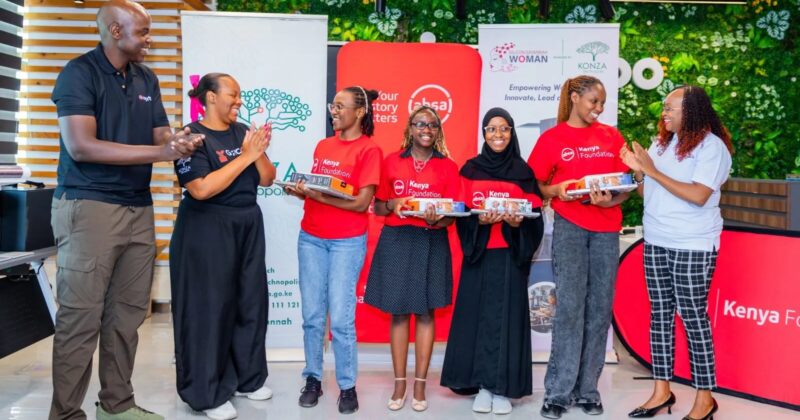
NAIROBI, Kenya Oct 8 – Four young Kenyan women have emerged as the overall winners of the third GirlCode Kenya Hackathon after developing an artificial intelligence-powered digital fare collection platform aimed at addressing payment, safety and financial tracking challenges in the public transport sector.
Speaking during the hackathon, GirlCode CEO Zandile Mkwanazi said the Kenyan winners will proceed to the Pan-African stage, where they will compete against winners from five other countries and receive incubation support to develop their startup solution.
“All six winners from the different countries will then compete on a Pan-African level, where they will win a cash prize of over $5,000, and more than that, they will be incubated for a period of six months where we are going to help them develop their startup solutions. And we look forward to seeing what great innovation is going to come out of this year’s participants,” said Mkwanazi.
The two-day competition, held last weekend at Konza Technopolis, brought together 44 young women, including students, graduates, developers and aspiring entrepreneurs. The winning team comprised Mary Wangui, Linet Mugwanja, Aisha Barasa and Cynthia Chepkorir, who developed Naulisako, a digital fare collection platform targeting challenges faced by passengers, conductors, matatu owners and SACCO managers.
Naulisako is designed to make it easier for passengers to verify fare payments while reducing the need to repeatedly show transaction messages to conductors. It also seeks to give conductors confidence that payment messages presented by passengers are genuine, while helping matatu owners and SACCO managers track reported daily income.
Mugwanja said the team identified trust, privacy and accountability as some of the challenges affecting fare collection in the public transport sector.
“We set out to solve a problem in the transport sector. So we are solving for passengers, for conductors, and for matatu owners and SACCO managers.“
So for passengers, we’re solving the problem they have of safety and security and privacy. They have to trust that when they show their transaction details to conductors, that they won’t be followed home and they won’t be robbed. The conductors have to trust that whatever message a passenger shows them is correct, it’s not fake, and it’s not fraudulent, and they’re not trying to cheat them of their money, or they won’t reverse it. And a SACCO manager and a matatu owner has to trust that whatever the crew reports as their income for the day is actually true and they’re not making up facts or pocketing money.
“So that’s what we identified as a core problem in the transport sector, especially on the passenger side. People don’t like having always to be badgered by conductors to show their message, pass their phones around, so we decided to make a solution for that.”
The hackathon was organised by GirlCode and Absa Bank Kenya, with the Technopolis Development Authority providing mentorship, technical support and hosting the event at Konza Technopolis.
Absa Bank Kenya Chief Information Officer Moses Okundi said the bank’s involvement was focused on equipping young people with skills that can be applied in employment and entrepreneurship.
“Absa is very proud to be a partner and a supporter of this initiative, and it sits squarely within our values where we’re looking to not only empower girls, but we’re also looking for age inclusion and gender inclusion. And we’re looking to support the society by empowering girls with the requisite skill set for them to be absorbed in the in the job market, but also for them to be entrepreneurs and deliver solutions that are solving real problems.”
The Kenya competition was the sixth and final stop in the 2026 GirlCode Pan-African Hackathon Series, following events in South Africa, Tanzania, Ghana, Botswana and Uganda.
The Pan-African winners are scheduled to be announced on October 12, 2026. The winning team will receive R100,000, equivalent to approximately Sh790,655, while the winning SME will receive incubation support to help scale its solution.
Josephine Ndambuki, Chief Manager, Business Development and Innovation at the Technopolis Development Authority, said the 30-hour competition gave participants an opportunity to develop their ideas while receiving mentorship and testing their skills.
“Having participated in this 30-hour GirlCode Hackathon is really special for me as a woman in tech. Just seeing the next generation of women coming up, rising to the challenge, ideating across the night into the day, and coming up with practical solutions really gives me hope. I know that these women in a few years are going to be the next movers and shakers in technology space, and we are quite happy that we are part of that journey.“
And so initiatives like this—and that is the reason why the Silicon Savannah Woman Initiative exists—are really aimed to make sure that women who aspire to become innovators, who aspire to become tech entrepreneurs, are finding the support that they need.”
Ndambuki said some participants had initially been apprehensive about presenting their ideas but that the process also served as an opportunity for mentorship and skills development.
“And so for the ladies that have been here with us today, a lot of them were so scared, and you could see we were trying to encourage them, even in their public speaking. We really recognize that this is part of learning, it is mentorship in application, it is also validating their skills that they can actually do something amazing.“
And so, I think the future of Kenya is in the right hands. We just need to keep supporting and doing more and investing in them, which is what we intend to do beyond this hackathon.”
The competition also produced other technology-based solutions. The Bots team finished as first runners-up with Biashara Bot, a solution that digitises and automates financial record-keeping for underserved and unbanked small businesses, while Korva took third place with Korva Creatives Economy, a platform that consolidates creator revenues, engagement data and intellectual property monetisation across multiple channels.
The top three teams received laptops, tablets, Bluetooth speakers, headsets and inspirational books.
The GirlCode Pan-African Hackathon Series forms part of the organisation’s wider programmes in coding, mentorship, hackathons and digital skills development, with an ambition to reach 10 million girls and women across Africa by 2030.
For the Naulisako team, the next stage will be the Pan-African competition, where the four Kenyan winners will present their solution alongside teams from the other participating countries as they seek to advance the platform beyond the Kenyan hackathon.