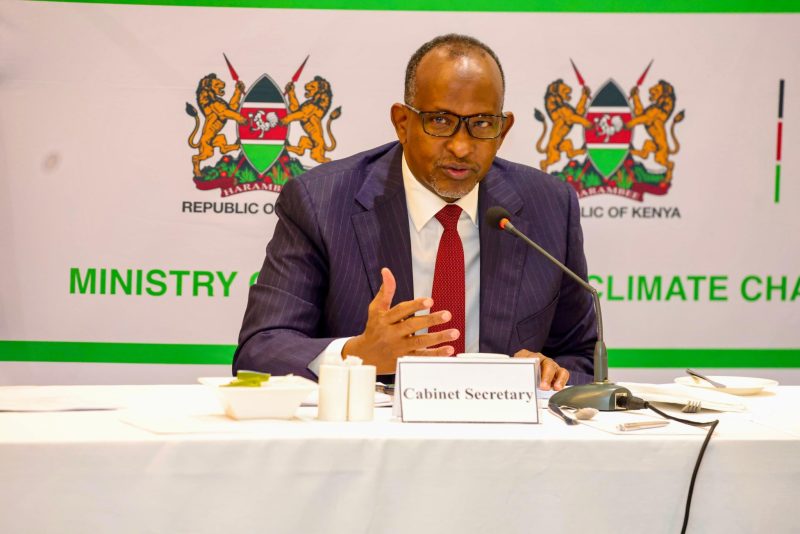
NAIROBI, KENYA Jun 17 — Kenya has urged African leaders and global health partners to urgently escalate political commitment and financing to contain the Ebola Bundibugyo strain outbreak in East and Central Africa which has recorded over 800 cases and nearly 200 deaths across the region.
Health Cabinet Secretary Aden Duale noted that “preparedness at national level is critical in containing outbreaks before they escalate into wider regional crises.”
He made the remarks during a high-level virtual summit organized by the African Union (AU) and the Africa Centres for Disease Control and Prevention (Africa CDC) to establish a unified, cross-border strategy against the deadly viral resurgence.
Duale was representing President William Ruto at the virtual summit. Ruto is out of the country attending the G7 Leaders Summit in France.
The CS emphasized that this crisis highlights why Africa must aggressively scale up its sovereign capacity to manufacture domestic vaccines, diagnostics, and critical medical supplies.
“Kenya has taken deliberate steps to strengthen surveillance at all points of entry, enhance laboratory capacity, and ensure we are ready to support response efforts where needed,” stated Duale.
The Bundibugyo virus disease (BVD) is a rarer variant of Ebola that currently lacks widely approved, strain-specific vaccines. It was first flagged in the DRC’s Ituri Province before spilling across the border into Uganda’s Kampala Metropolitan Area, active conflict zones, intensive artisanal mining migrations, and porous regional boundaries continue to complicate active contact tracing and case isolation.
The Ministry of Health says Kenya has not recorded a single confirmed case of Ebola. It however insists that Kenya remains at high risk of cross-border transmission due to its position as a major regional transport, aviation, and economic hub.
Thousands of traders, long-distance truck drivers, and passengers traverse the active transit corridors linking Kenya directly to Uganda and the DRC every day.
Recognizing this vulnerability, the Ministry of Health has operationalized comprehensive screening mechanisms across 26 official points of entry with over 71,000 travelers screened so far alongside the around-the-clock activation of four specialized national reference laboratories.