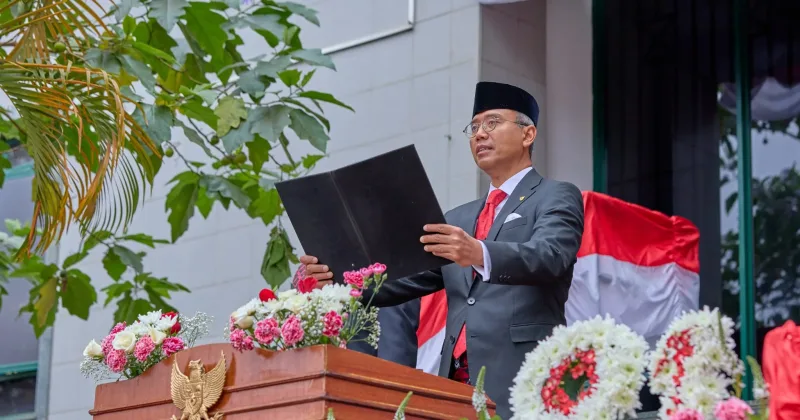
NAIROBI, Kenya, Aug 18 — Indonesia’s experience of forging national unity from hundreds of ethnic groups, languages and religious communities offers lessons for Kenya and other African countries grappling with the challenge of building cohesive nations, Indonesian Ambassador to Kenya Witjaksono Adji has said.
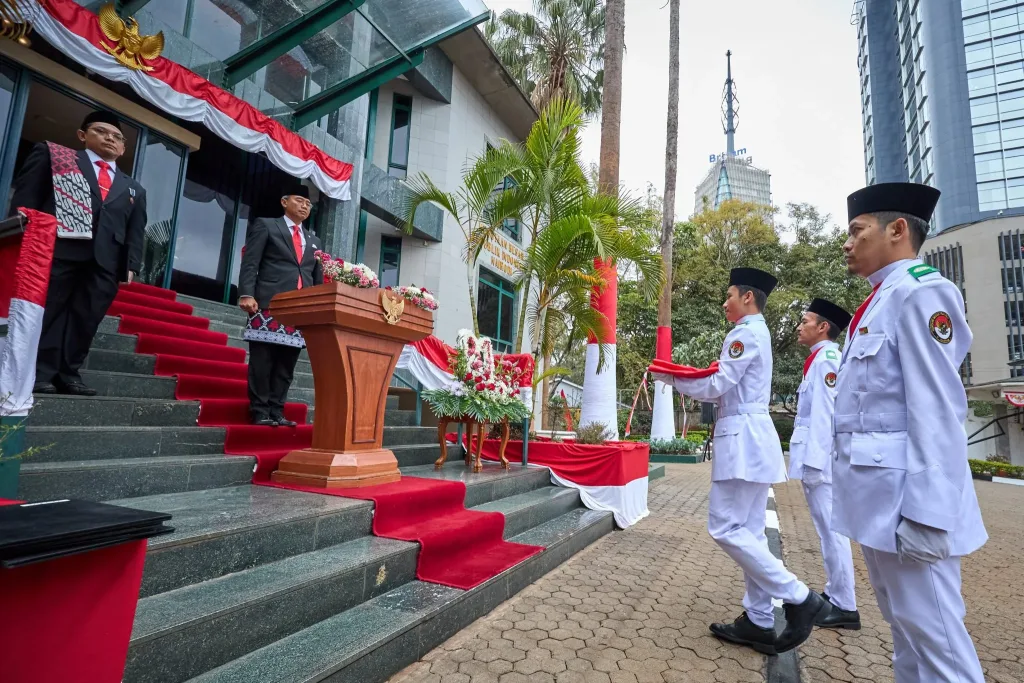
Speaking after the Indonesian Embassy’s flag-raising ceremony in Nairobi to mark Indonesia’s 81st Independence Day, Adji said Indonesia’s greatest achievement since gaining independence was not simply its economic development but its ability to keep a highly diverse population together.
Indonesia has a population of more than 280 million people and is one of the world’s largest archipelagic countries, stretching across thousands of islands and three time zones.
“I think the biggest achievement is not the development that we have been able to achieve. I think the bigger picture is the ability to keep us together so that we can develop together,” Adji said.
Indonesia declared independence from Dutch colonial rule in 1945, but Adji said the foundation for its national identity had been laid much earlier, when young people from different parts of the archipelago began imagining themselves as one nation.
He pointed to 1928, when Indonesian youths from different ethnic and linguistic communities came together and pledged allegiance to one nation, one territory and one language.
At the time, Indonesia was home to hundreds of languages and numerous ethnic communities spread across a vast archipelago.
Unity over ethnic dominance
Adji said one of the important decisions made during Indonesia’s nation-building process was the adoption of Bahasa Indonesia as the national language.
Rather than selecting the language of the largest ethnic group, the founders opted for a relatively smaller language that was widely understood among traders across the archipelago.
The decision helped avoid competition between dominant ethnic communities and gave Indonesians a common means of communication.
“They chose a minority language which is easy, which then became what we call the national language and we call it Bahasa Indonesia,” Adji said.
He said the lesson was that nation-building sometimes requires communities to move beyond the question of which ethnic group or community should dominate.
“If you ask me, what are you? I’m Indonesian first, and then I’m Javanese. But I’m Indonesian first,” he said.
Adji said local identities were not eliminated. Indonesians could retain their ethnic identities and local languages while placing their national identity above them.
‘We are one despite our differences’
The ambassador said Indonesia’s experience was particularly relevant to countries where ethnicity and religion can become sources of political mobilisation.
He said Indonesia deliberately embraced the principle of national unity despite its diversity.
“We are a country of various ethnic groups, various religious backgrounds and various racial makeup, but we declare that we would be one as a nation regardless of all these backgrounds,” he said.
He warned that exploiting ethnic and religious differences for political gain could undermine national cohesion.
“It’s not necessarily easy to keep the country together when you distrust one another because of your ethnicity or because of your religious background,” he said.
According to Adji, Indonesia’s experience demonstrates that diversity does not automatically lead to conflict.
The challenge is creating institutions, values and a national identity strong enough to prevent differences from becoming permanent political fault lines.
Pancasila as a unifying framework
Adji also highlighted Pancasila, Indonesia’s five foundational principles, as a critical pillar of national unity.
The principles include belief in God, just and civilized humanity, the unity of Indonesia, democracy through deliberation and representation, and social justice.
He said Pancasila was designed to provide a common national framework for citizens with different religious and cultural backgrounds.
“Indonesia without the Catholics or the Christians would not be Indonesians; without the Hindu, we would not be Indonesians,” he said.
Although Indonesia has a large Muslim majority, Adji said the country’s national identity was deliberately designed to accommodate other faiths.
The approach, he said, had helped prevent religion from becoming the sole basis of national identity.
A lesson for Kenya and Africa
Adji said Kenya and other African countries could study Indonesia’s experience without necessarily copying its model wholesale.
“I’m not saying that every country should use this path,” he said. “It’s lessons. It’s something you can read about and then try perhaps, or maybe it suits you; you find another solution that suits yourself.”
He said the important lesson was the willingness of different communities to identify what they shared rather than concentrating exclusively on their differences.
For Kenya, where ethnic identity has historically featured prominently in politics, the Indonesian experience raises questions about how national identity can be strengthened while preserving local cultures and languages.
Adji said Indonesia had not attempted to erase its internal diversity.
Instead, it developed a shared identity under which citizens could maintain their local affiliations while identifying first as Indonesians.
Unity before development
The ambassador said Indonesia’s ability to preserve unity had provided the foundation for economic and social development.
He described the country’s diverse composition as potentially a “recipe for eternal conflict” if differences were allowed to dominate national life.
The challenge, he said, was to turn that potential source of conflict into a source of collective strength.
“You must have something that you can use to marshal the energy of that potential for calamity to be something useful,” he said.
For Indonesia, that binding force was the pledge to remain one nation despite differences.
Adji said the experience was particularly relevant to African countries because many of them, like Indonesia, inherited borders and political systems shaped by colonial rule while bringing together communities with distinct histories and identities.
Shared unity
The ambassador also linked Indonesia’s experience of unity to its growing cooperation with Kenya and other African countries.
He said Indonesia and African states shared a history of anti-colonial struggle, pointing to the 1955 Bandung Conference as an important milestone in relations between Asia and Africa.
He said Indonesia was willing to share not only its successes but also its mistakes with African countries.
“We wouldn’t want you to fall into the pitfalls that we’ve come to,” he said.
Adji cited Indonesia’s shift from exporting raw natural resources to processing them domestically as one example of an experience that could benefit Kenya.
He also pointed to potential cooperation in aviation and vaccine manufacturing.
He said Indonesia had developed aircraft capable of operating from short and unpaved runways and could share expertise in vaccine production as Kenya seeks to strengthen its own manufacturing capacity.
“We are here to be partners in carrying forward that ambition,” Adji said.