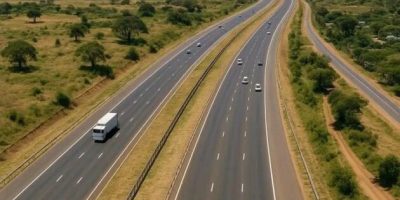
NAIROBI, Kenya, Nov 16 – Parliament’s Departmental Committee on Social Protection has backed the National Social Security Fund’s (NSSF) investment in the Rironi-Mau Summit highway project, saying it is a viable venture expected to generate returns while supporting economic development.
Committee chair Alice Ng’ang’a said the Fund had made the right decision to invest in the project after members inspected the 81-kilometre Rironi-Gilgil section, where construction is about 40 percent complete.
The committee was accompanied by NSSF Board Chairman David Kariuki Njeru and Managing Trustee and Chief Executive David Koross, alongside other officials from the Fund.
“From where I sit at the National Assembly, you made the right decision,” Ng’ang’a told the NSSF leadership, adding that the progress of the works was good.
The contractor has indicated that the Rironi-Naivasha-Gilgil stretch could be fully usable by March 2027.
The 233-kilometre Rironi-Mau Summit highway is being upgraded into a dual carriageway under a public-private partnership launched in November 2025.
The project is divided into three sections: Rironi-Naivasha-Gilgil, covering 81 kilometres; Rironi-Mai Mahiu-Naivasha, covering 58 kilometres; and Gilgil-Nakuru-Mau Summit, covering 94 kilometres.
NSSF and China Road and Bridge Corporation (CRBC) are jointly undertaking the first two sections, while Shandong Hi-Speed Road and Bridge International Engineering is handling the Gilgil-Nakuru-Mau Summit stretch.
The Rironi-Naivasha section is expected to be completed by December 2026, while the entire highway corridor is targeted for completion by June 2027.
The project is financed through a combination of equity and debt, with equity accounting for 25 percent of the funding and debt covering the remaining 75 percent. NSSF has committed 40 percent of the equity.
Under the 30-year concession agreement, NSSF is entitled to 40 percent of toll collections, while CRBC will receive the remaining 60 percent. The Fund’s financial exposure is limited to its equity contribution, with the debt held at the project level.
NSSF said the investment forms part of its strategy to diversify members’ savings beyond traditional assets such as government securities and invest in long-term infrastructure projects that generate income.
The Fund expects toll collections over the concession period to provide returns and help protect members’ savings against inflation.