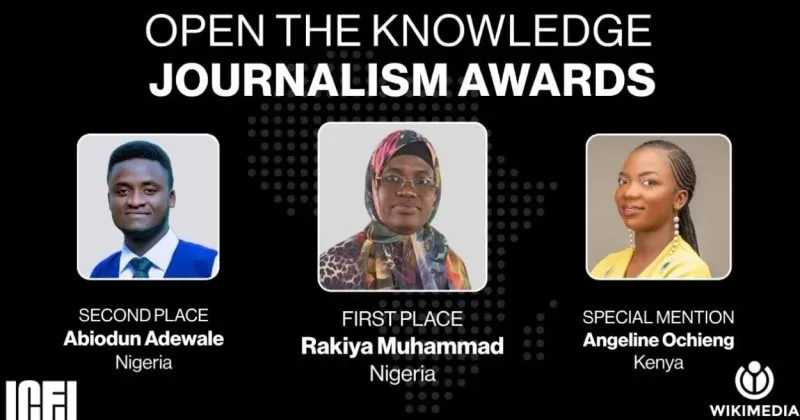
NAIROBI, Kenya Jun 25, — Three African journalists have been recognised for producing reporting that contributes to expanding publicly accessible knowledge, after winning the 2026 Open the Knowledge Journalism Awards.
The awards, announced by the International Center for Journalists (ICFJ) in partnership with the Wikimedia Foundation, honour journalists whose reporting provides reliable source material that can be used by volunteer editors to improve Wikipedia’s coverage of Africa.
The winning stories focus on cross-border migration, women’s cricket and maternal health, reflecting the awards’ emphasis on reporting about women, youth, arts, culture, heritage and sports.
This year’s competition attracted 320 entries from journalists across 40 African countries.
Nigerian freelance journalist Rakiya Muhammad received first prize for her article, West Africa’s Borderless Women: Inside the Yoruba Sisterhood Linking Nigeria and Côte d’Ivoire, published by RM Times. The story explores the migration of women traders from Ejigbo in southwest Nigeria to Côte d’Ivoire and examines their economic and cultural influence across borders.
“Receiving this honour renews my passion for telling stories that place African women at the heart of the narrative as active agents of development, leadership and social change,” Muhammad said.
Second place went to Nigerian sports journalist Abiodun Adewale of The Punch for Breaking Boundaries: How Nigeria’s U-19 Women Are Rewriting Cricket History, documenting the country’s rising profile in women’s cricket during the 2025 International Youth Cricket World Cup.
Kenyan journalist Angeline Ochieng of Nation Media Group received a special mention for The Converts: How Reformed Midwives Are Ending Maternal Deaths, which highlights former traditional birth attendants encouraging hospital deliveries in rural Kenya.
ICFJ President Sharon Moshavi said the awards recognise the growing relationship between journalism and Wikipedia.
“Journalism and Wikipedia need each other,” she said. “Wikipedia’s volunteer editors rely on independent reporting to build a more complete knowledge resource, and journalists benefit from the global and multilingual reach that Wikipedia provides.”
The Wikimedia Foundation’s Chief Communications Officer, Anusha Alikhan, said reporting produced by African journalists plays an important role in making the world’s largest online encyclopedia more representative of African experiences.
Olaniyan Ishola Oulushola, President of Wikimedia Nigeria and a member of the awards selection committee, said the winning stories would help reduce information gaps about Africa by providing high-quality, verifiable reporting for future Wikipedia content.
Wikipedia has 65 million articles in over 300 languages, created by nearly 250,000 volunteer editors from around the world, are viewed nearly 15 billion times every month. Yet, many topics about Africa remain missing or incomplete on the site. Currently, only 3.7% of the articles on the English Wikipedia are about Africa.
“This issue reflects knowledge gaps in the wider media ecosystem; new information can only be added to Wikipedia by volunteer editors if it is supported by a citation from a published, reliable source,” she said.
This year’s award recipients were decided upon by a committee composed of African civil society leaders, academics, ICFJ and Wikimedia Foundation staff, and members of the Wikipedia volunteer community.