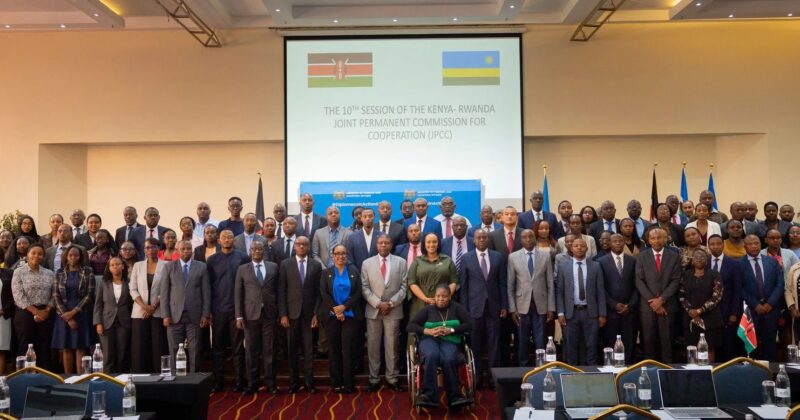
NAIROBI, Kenya, Oct 6— Kenya and Rwanda have expanded cooperation in security, justice, immigration and governance, signing 11 new bilateral instruments as the two countries seek to deepen ties beyond their traditional focus on trade and regional integration.
The agreements were concluded Tuesday following the 10th Session of the Kenya-Rwanda Joint Permanent Commission for Cooperation (JPCC) in Nairobi, covering areas ranging from mutual legal assistance and the transfer of sentenced persons to police cooperation, immigration, local governance and political consultations.
Among the agreements is a new Memorandum of Understanding between the Rwanda Investigation Bureau and the Kenya National Police Service, providing a framework for closer cooperation between the two countries’ law-enforcement agencies.
Kenya and Rwanda also signed an Agreement on Mutual Legal Assistance on Criminal Matters and an Agreement on the Transfer of Sentenced Persons, strengthening the legal framework for cooperation in criminal justice.
The two countries further agreed to deepen cooperation on immigration matters, political consultations, diaspora management, water resources and irrigation, housing and urban development, culture and heritage, and conservation.
The package marks one of the broadest recent expansions of the institutional framework governing Kenya-Rwanda relations.
Prime Cabinet Secretary and Cabinet Secretary for Foreign and Diaspora Affairs Musalia Mudavadi said the JPCC provides a mechanism for translating political commitments between Nairobi and Kigali into practical cooperation.
“The 10th Session of the JPCC provides an important platform for our two Governments to review progress, strengthen follow-up on agreed commitments, address outstanding matters and identify new opportunities for cooperation,” Mudavadi said.
Rwanda’s Minister of State for Foreign Affairs, Usta Kaitesi, said the commission was important in turning the two countries’ political relationship into concrete action.
“The Joint Permanent Commission on Cooperation is an important mechanism for translating our political commitments into concrete actions,” Kaitesi said.
She said the mechanism allows the two governments to assess the status of their relations, identify areas where implementation can be accelerated and explore new areas of cooperation.
Security cooperation takes centre stage
The new police cooperation agreement comes as Nairobi and Kigali reaffirmed their shared interest in regional peace and security.
The two countries exchanged views on developments in the Great Lakes region and committed to working through regional and continental mechanisms to promote peace, stability and development.
They also reaffirmed cooperation through the East African Community, African Union, COMESA and the International Conference on the Great Lakes Region.
The security and justice agreements broaden the relationship beyond economic cooperation, creating additional formal channels for Kenyan and Rwandan institutions to work together on criminal matters and law enforcement.
Despite the expanded cooperation, economic relations remain a major pillar of the partnership.
Kaitesi said Rwanda imported goods worth more than $398 million from Kenya in 2025, while its exports to Kenya were valued at $5.3 million.
She said Kenyan companies, including Kenya Commercial Bank and Equity Bank, have established a strong presence in Rwanda, while Rwandan companies continue to explore opportunities in the Kenyan market.
The two countries agreed to promote greater two-way investment, private-sector partnerships and business-to-business linkages.
They also reaffirmed cooperation in transport, infrastructure and energy, including geothermal energy, housing, urban development and logistics.
New areas of cooperation
Kenya proposed expanding the partnership into emerging areas including digital transformation and artificial intelligence, renewable energy, climate action, food security, innovation and skills development.
Mudavadi said stronger institutional follow-up would be critical to ensuring that agreements reached by the two governments translate into tangible outcomes.
“Our respective institutions should maintain close engagement, with clear responsibilities, timelines and appropriate follow-up mechanisms to ensure that the decisions and commitments reached are effectively implemented,” he said.
The 10th JPCC reviewed implementation of commitments made during the previous session held in Kigali in April 2023.
The two countries agreed to continue using an updated implementation matrix to monitor outstanding commitments.
The next JPCC session will be held in Rwanda in 2028.