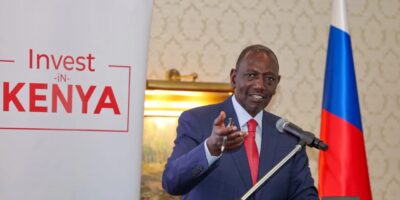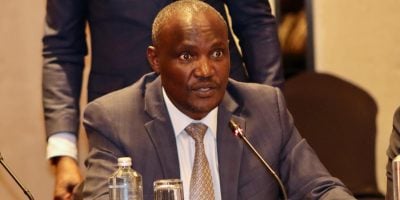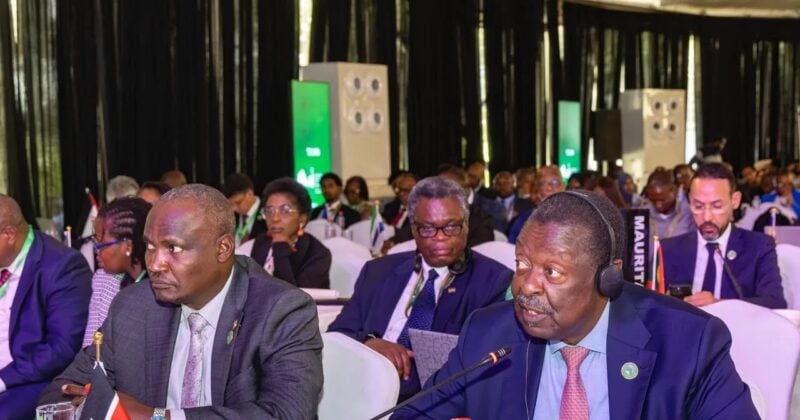
NAIROBI, Kenya, Nov 13 – Prime Cabinet Secretary Musalia Mudavadi and Treasury Cabinet Secretary John Mbadi have backed a new financing framework to reduce the African Union’s dependence on external donors and strengthen its financial independence.
The two Cabinet Secretaries said African countries must take greater responsibility for funding the continental body’s operations and development programmes amid declining predictability of foreign aid, rising public debt and growing global economic uncertainty.
Speaking during an Extraordinary Session of the African Union Executive Council and Ministers of Finance in Accra, Ghana, on Friday, Mudavadi endorsed Option C, a proposed financing framework intended to make the AU financially sustainable and improve accountability in the use of its resources.
Mudavadi, who was representing President William Ruto in his capacity as the AU Champion for Institutional Reform, said the continent’s ability to finance its institutions was central to its political and economic independence.
He argued that the AU’s reliance on external development partners undermined its ability to independently implement decisions and pursue the ambitions outlined in Agenda 2063.
“Africa must have the means to finance the Africa it envisions,” Mudavadi said.
Kenya’s position comes amid renewed efforts to implement previous continental commitments, including the Johannesburg Decision 578 and Kigali Decision 605, which sought to increase member states’ contributions towards financing the African Union.
Mudavadi acknowledged that despite progress by member states, the agreed financing targets remained largely unmet, leaving the organisation significantly dependent on external partners.
Under Option C, Kenya is backing a financing model built around four key areas, including prioritising high-impact programmes, consolidating budget planning, strengthening domestic resource mobilisation and improving institutional efficiency.
On programme financing, Mudavadi said the AU should concentrate its resources on initiatives that deliver measurable benefits to African citizens rather than spreading its budget across competing priorities.
“Kenya maintains that the African Union must concentrate its resources on programmes that deliver measurable benefits to African citizens,” he said.
He added that the continental body’s priorities must be compelling enough to attract investment while demonstrating tangible returns on contributions made by member states.
Kenya is also supporting a consolidated budget framework anchored in a medium-term expenditure plan to improve financial planning, resource allocation and expenditure discipline.
A key component of the proposed reforms is the implementation of a 0.2 per cent levy on eligible imports to provide the AU with a predictable source of funding.
The framework also proposes establishing a US$1 billion African Union Peace Fund endowment, alongside mechanisms for its regular replenishment, to strengthen the organisation’s capacity to finance peace and security operations.
Mudavadi said the proposed measures would give the continental body more reliable resources to implement its mandate without depending excessively on external funding.
The Kenyan delegation also backed reforms to make the AU leaner and more efficient by eliminating duplication of responsibilities, strengthening coordination among its institutions and maximising the use of existing resources.
Mudavadi, however, cautioned that increased contributions must be accompanied by transparency, accountability, prudent financial management and demonstrable value for money.
He said declining predictability of external financing, sovereign debt vulnerabilities and geopolitical uncertainty made it increasingly urgent for African countries to strengthen their own financial institutions.
Kenya consequently supports a structured partnership between the African Union and African Association of Multilateral Financial Institutions (AAMFI) to mobilise capital within the continent and strengthen home-grown financing institutions.
Mudavadi said the partnership would help mobilise African resources and accelerate the implementation of Agenda 2063, the AU’s long-term development blueprint.
He urged member states to approach the financing discussions with a shared sense of responsibility, arguing that differences in national economic circumstances should not derail efforts to secure the Union’s financial future.
Treasury Cabinet Secretary John Mbadi’s participation in the meeting underscored Kenya’s intention to align its diplomatic position with the financial and budgetary considerations underpinning the proposed reforms.
The deliberations in Accra are expected to produce recommendations on the future financing of the African Union for consideration by Heads of State and Government during the 40th Ordinary Session of the AU Assembly in January 2027.
The proposed reforms come as African governments seek to strengthen continental institutions and reduce their exposure to fluctuations in external development assistance.