Kenya, FAO launches strategy to boost action on weed, invasive pests

Kenya, FAO launches strategy to boost action on weed, invasive pests
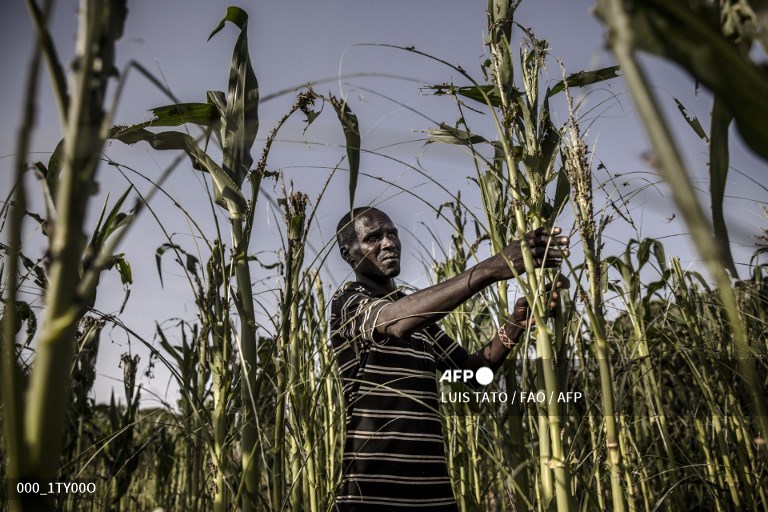
This picture released by FAO (The Food and Agriculture Organization of the United Nations)shows Turkana farmer Joseph Tirkwel asses the severe damage of his maize crops while hopper bands of Desert Locust ravage them in Napeikar, Turkana County, Kenya on June 2, 2020.Joseph Tirkwel is Turkana farmer and father of 6 children with several acres of maize that have been severely damaged by hopper bands.An increasing number of second-generation immature swarms of desert locust continue to form in northwest Kenya. The desert locust upsurge could have devastating consequences in already vulnerable regions, potentially causing large-scale crop damage and threatening food security in countries affected by recurrent drought, conflict, high food prices, as well as the impacts of the COVID-19 pandemic.The Horn of Africa is facing the worst desert locust crisis in over 25 years, and the most serious in 70 years for Kenya. - "The Food and Agriculture Organization of the United Nations (FAO) and the Government of Kenya’s (GoK) have joined efforts as part of its action plan aimed at boosting ground and aerial surveillance on Desert Locusts. FAO has supported governments in scaling up control activities on the fight against Desert Locusts while launching an urgent appeal to support and contain the upsurge and anticipate devastating impacts on livelihoods and food security." (Photo by LUIS TATO / FAO / AFP) / RESTRICTED TO EDITORIAL USE - MANDATORY CREDIT "LUIS TATO/FAO/AFP " - NO MARKETING - NO ADVERTISING CAMPAIGNS - DISTRIBUTED AS A SERVICE TO CLIENTS

NAIROBI, Kenya, Feb 8 -Kenya in partnership with the Food and Agriculture Organization (FAO) of the United Nations on Monday launched an invasive pests and weeds management strategy to boost food and nutrition security in the country.

Peter Munya, the cabinet secretary in the Ministry of Agriculture, Livestock, Fisheries and Cooperatives, said that the migratory and invasive pests in Kenya (2022-2027) strategy will improve human and physical capacities, surveillance, and early warning mechanisms.

“This strategy will establish a modern information and knowledge management system to strengthen surveillance, forecasting and ensure timely and effective control operations,” Munya said during the strategy’s launch in Nairobi, the Kenyan capital, noting that climate change has exacerbated the emergence of pests and diseases that have not been experienced over a long period of time.

He observed that migratory and invasive pests are posing a new challenge in the Eastern Africa region with devastating effects on the environment, national food security and livelihoods of farmers. Desert locust invasion experienced in Kenya over the last two years posed a severe food security threat to more than 4 million people spread across 32 counties.

According to Munya, a multi-stakeholder migratory pest management platform will be established to provide a well-coordinated strategy to help protect human and environmental health and minimize the negative impacts of control operations.

Beth Bechdol, FAO’s deputy director-general, said that migratory and invasive pests like quelea birds, African armyworm and desert locust and invasive weeds like the water hyacinth are a threat to livelihoods. The frequency of invasions and spread of these pests have increased in the recent past, worsened by climate change.

The management of these pests requires a well-thought-out roadmap through a transboundary approach with the neighboring countries. Bechdol lauded Kenya for the successful control of desert locusts and also for launching the first-ever migratory and invasive pests and weeds management strategy in the region.

The strategy provides a robust coordination structure at both the national and county levels in line with the Agricultural Sector Transformation and Growth Strategy and Vision 2030. It has seven pillars that include capacity building, early warning, surveillance, control operation and livelihood restoration.


XINHUA

Xinhua News Agency, founded on November 7, 1931, is China’s national news agency as well as a global news and information network. Xinhua has set up a global news and information gathering network, with headquarters in Beijing, 33 domestic bureaus in provinces, autonomous regions and municipalities plus the special administrative regions of Hong Kong and Macao, as well as 140 bureaus in the rest of the world. Xinhua is yet to set up a bureau in Taiwan, where it has posted resident correspondents. Xinhua provides its worldwide subscribers with news and financial information products in the forms of text, photo, graphics, audio, video, and mobile phone text messages 24 hours a day in eight languages: Chinese, English, French, Russian, Spanish, Arabic, Portuguese and Japanese.