NAIROBI, Kenya, Nov 23 – The National Treasury plans to borrow Sh1.23 trillion to finance the proposed Sh5.24 trillion national budget for the 2027/28 financial year, highlighting the government’s continued reliance on debt to meet its spending commitments.
Treasury Principal Secretary Chris Kiptoo says the government expects to collect Sh3.92 trillion in revenue during the financial year starting July 2027, leaving a financing gap equivalent to 5.4 percent of Gross Domestic Product (GDP).
The deficit will be financed through net domestic borrowing of Sh658.9 billion and external borrowing of Sh570 billion.
The borrowing plan comes amid revenue collection challenges, with the government missing its revenue targets in the first quarter of the current 2026/27 financial year.
By the end of September 2026, total government revenue, including Appropriations in Aid (A-i-A), stood at Sh801.5 billion against a target of Sh859.9 billion, representing a shortfall of Sh58.4 billion.
Income tax collections recorded the largest shortfall at Sh25.4 billion, followed by excise duty at Sh16.3 billion and Value Added Tax (VAT) at Sh10.1 billion.
Government expenditure and net lending, meanwhile, reached Sh1.19 trillion against a target of Sh1.04 trillion, pushing the fiscal deficit to Sh381.3 billion, more than double the planned Sh174.9 billion.
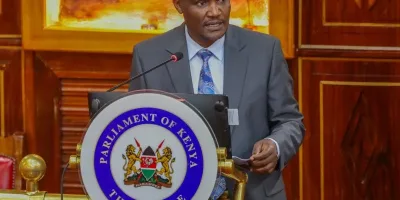
In a statement to Parliament’s Finance and National Planning Committee, Kiptoo attributed the widening deficit to revenue shortfalls and higher spending during the first three months of the financial year.
“Budget implementation in the first quarter of FY 2026/27 has progressed smoothly, albeit with revenue shortfalls and front-loaded expenditure,” he said.
For 2027/28, the Treasury projects ordinary revenue of Sh3.25 trillion, representing an 8.8 percent increase, while total revenue, including ministerial collections, is expected to grow by 8.1 percent.
The projections factor in additional collections from the Finance Act 2026 and Kenya Revenue Authority’s administrative measures, including the use of data and technology to widen the tax base and address revenue leakages.
The government also plans to review tax incentives and strengthen compliance to increase domestic revenue collection.
However, the Treasury has identified rising public debt and debt-servicing costs as major risks to the country’s fiscal position, citing refinancing requirements and exposure to interest-rate and foreign-exchange fluctuations.
“Rising Public Debt and debt-service costs: The evolving financing environment, refinancing requirements and exposure to interest-rate and exchange-rate risks further highlight the need for prudent borrowing,” the Treasury said.
To reduce reliance on conventional government borrowing, the State plans to accelerate the privatisation and partial sale of State-owned enterprises while expanding the use of Public-Private Partnerships (PPPs) to finance commercially viable infrastructure projects.
It also intends to mobilise private capital through the proposed National Infrastructure Fund, which is expected to bring together investments from pension funds, banks, private equity firms and development finance institutions.
The Treasury has based its 2027/28 budget projections on an expected economic growth rate of 5.1 percent in 2027.
The proposed budget allocates Sh3.81 trillion to recurrent expenditure and Sh917.1 billion to development spending, while Sh506.5 billion is set aside for transfers to county governments.
The proposed fiscal plan will now be subjected to parliamentary scrutiny as the government seeks to balance development spending, revenue mobilisation and rising debt obligations.